Zebediah Lomack
StrangersZebediah Lomack is a Reno professional gambler whose transformation from casual stargazer to obsessive collector of lunar images ends in suicide on Christmas Day. The four names he writes across posters of the Moon—Dominick Corvaisis, Ginger Weiss, Faye, and Ernie Block—make his death more than an isolated tragedy: they link his private collapse to a shared, deliberately erased experience at the Tranquility Motel. When Corvaisis discovers the posters, the disturbance they provoke exposes both the reach of the missing memories and the emergence of Corvaisis’s telekinetic power.
Identity and Former Life
For most of his fifty years, Lomack’s life had revolved around cards. A professional gambler, he played poker in Reno, Lake Tahoe, Las Vegas, and smaller gambling towns including Elko and Bullhead City. He loved the game more than women, alcohol, food, or money; winnings mattered chiefly because they allowed him to keep playing. His expertise had brought him substantial wealth, though dice games and taxes reduced what he might otherwise have accumulated. His estate would later be valued at more than half a million dollars, while his modest house was appraised at $35,000.
That identity makes the sudden turn toward astronomy striking. In late August of the summer before last, Lomack began watching the stars and Moon from the back porch of his house while drinking beer. In September he bought a Tasco 10VR refracting telescope and books on amateur astronomy. At first, the interest seemed like an ordinary hobby; it soon displaced the activity that had defined his life.
The Lunar Obsession
The change gathered force over months. By the previous Christmas, Lomack was concentrating less on the stars than on the Moon. He began cancelling casino trips to study it, and by February he was at the telescope every clear night. In April his lunar library exceeded one hundred books. By the end of June it had reached five hundred, and he had begun covering the bedroom walls and ceiling with Moon pictures. He stopped gambling and lived on his savings.
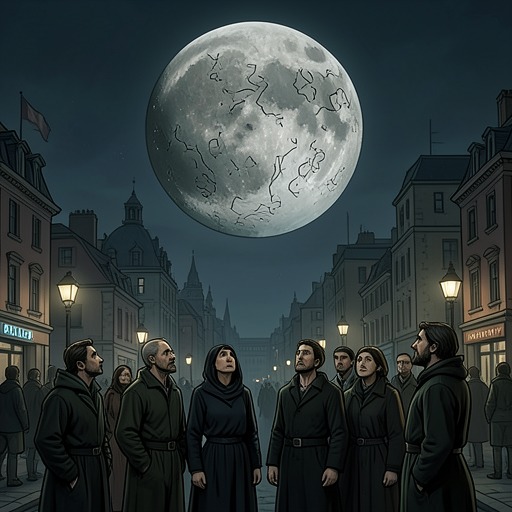
By September, more than fifteen hundred books filled the small house. Lomack spent his days reading about the Moon or staring at photographs, and his nights at the telescope until exhaustion left his eyes sore and bloodshot. In October, he was thinking and dreaming about the Moon constantly. He bought fifty copies of a large color poster made from an astronaut’s photograph, covered the living-room walls, ceiling, and windows with them, and moved out the furniture. The room became a fixed, all-enclosing planetarium: the same lunar face repeated everywhere, with no view beyond it.
The images held him between exhilaration and terror. He could not explain either response, and the narrative does not reduce the obsession to a single cause. It shows instead how a once-chosen pastime becomes compulsory: Lomack cannot resist the Moon’s attraction, while the growing collection turns his own home into an environment from which that attraction is almost impossible to escape.
Christmas and the Names on the Posters
On Christmas night, lying beneath the crowded lunar images, Lomack noticed writing on a poster where no writing had been before. The first name was Dominick; then he found Ginger, Faye, and Ernie on three other Moons. He recognized his handwriting but could not remember writing the names. Nor could he identify most of the people they referred to. Even Ernie’s name, though he knew a couple of people with that name, carried no familiar explanation.
What he did feel was an urgent conviction that these people mattered—that they had played a terrible part in his life and that remembering them was necessary to his sanity and survival. A buried memory seemed to swell toward recovery, promising to restore both their identities and the origin of his fear of the Moon. As the memory pressed nearer, his anxiety became physical: he sweated and shook uncontrollably.
Lomack had already loaded a shotgun and left it on the filthy kitchen table. He had resolved to use it if he could not rid himself of the lunar images before midnight. As the terror intensified, he tried to kill himself, but found that he could not reach the trigger while holding the gun in his mouth. He then braced it with both hands and used a bare toe to press the trigger. At that instant, the names and the forgotten experience returned together: the summer before last, Dominick, Ginger, Faye, Ernie, a young priest, other people, Interstate 80, the Tranquility Motel, and the Moon.
The recovered memory did not save him. The account leaves uncertain whether Lomack could no longer stop his foot or whether the horror of remembering helped drive him to continue. The shotgun fired, killing him. His death ends his terror but leaves the recovered connection behind for others to find.
The House as Evidence
On January 7, Corvaisis, travelling east from Sacramento on Interstate 80, reached Reno and read a newspaper report about Lomack’s Christmas Day suicide and the discovery of his Moon-covered house. The report described the photographs decorating the walls, ceilings, and furniture. Though Corvaisis suspected that the gambler’s obsession might have nothing to do with his own problems, it stirred the same mixture of fear, horror, and awe associated with his nightmares and sleepwalking.
That night, Corvaisis went to Lomack’s address and entered through an unlatched kitchen window. The kitchen had been cleaned after the police found Lomack’s body, and there were no Moon pictures there. But the living room remained covered in posters. Corvaisis’s flashlight revealed the name Dominick on one lunar face, and then three more names: Ginger, Faye, and Ernie. He understood that the other names might belong to fellow sufferers, but he could remember none of them. The Moon images had preserved a connection that the newspaper did not report and that Corvaisis’s own memory could not supply.
The sight provoked his anger at whoever had interfered with his mind. As Corvaisis demanded his memories back, the poster bearing his name tore free of the wall and hovered in the air without his touching it. The episode makes Lomack’s house a turning point in Corvaisis’s story: what first appears to be a haunting becomes evidence of an ability within Corvaisis himself. Ginger Weiss later proposes that his frustration had unconsciously activated telekinesis, drawing on the poster’s movement and on the paper Moons at Lomack’s house as part of her explanation.
Aftermath and Narrative Significance
Lomack never becomes an active participant in the survivors’ later investigation, but the evidence he leaves shapes it. At the Tranquility Motel, Jorja Monatella includes his death alongside Alan Rykoff’s death and Pablo Jackson’s murder as material that could help bring the group’s account to the public. The Moon posters also connect the otherwise separate disturbances: Ginger Weiss argues that the phenomena at Lomack’s house, Corvaisis’s apparent power, and the shaking and window implosion at the Tranquility Grille may share an explanation. Corvaisis and Brendan Cronin’s abilities, she suggests, could have an internal source tied to what happened during the night of the red Moon rather than an external force acting upon them.
The government’s surveillance of the Tranquility Motel group confirms that Lomack’s house had already become part of the larger mystery. Leland Falkirk’s team initially treated Corvaisis’s account of animated Moon photographs as an apparently fevered tale; later events at the Grille and Cronin’s healing powers made the story harder to dismiss. Lomack’s experience therefore functions in two ways: it is a personal catastrophe caused by a memory returning alongside overwhelming fear, and a surviving clue through which the others begin to recognize the connections among their erased pasts, their unusual experiences, and their emerging powers. His final act destroys him, but the names on the posters continue to speak for a past he had been made to forget.