Miles Bennell
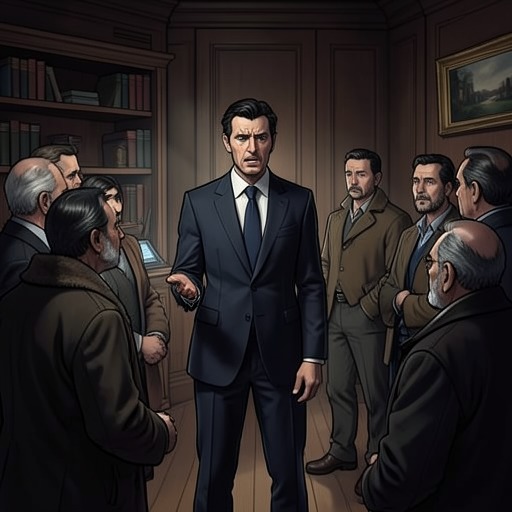
StrangersMiles Bennell is the civilian scientist directing the investigation at Thunder Hill, the underground installation where the secret of July 6 is held behind immense wooden doors. His position places him between the witnesses seeking the truth and the military officials determined to contain it. Though he works within the conspiracy, he quietly helps its victims recover their memories—and ultimately argues that the discovery belongs to the world, not to a few government insiders.
Identity and Work at Thunder Hill
During the summer before last, Bennell moved into Thunder Hill to lead scientific inquiry into the events of that July night. He had left the Depository only three times since arriving, never for more than two weeks, and his absorption in the assignment impressed even the suspicious Colonel Leland Falkirk. The research complex was buried beneath the winter snow, its staff moving among structures and offices in a central cavern far from sunlight. Bennell, like many of its residents, had become pale from the prolonged absence of daylight.
Bennell’s scientific background is broad: he holds doctorates in biology and chemistry and has also studied physics and anthropology. His work at Thunder Hill takes place amid a group of thirty-eight civilian scientists, including Bennell, recruited over eighteen months for specialized knowledge and high-security clearances. Their research occupies a cavern sealed by immense wooden doors, where the project’s central secret is kept. The number and variety of researchers make the operation difficult to control, while the civilians’ lack of military discipline frustrates Falkirk’s effort to treat secrecy as a purely security problem.
Bennell’s competence extends beyond the laboratory. He is a formidable computer hacker, skilled enough to obtain Falkirk’s psychological profile from the Domestic Emergency Response Organization’s computer-stored personnel records. He has kept the six-page printout for fifteen months, rereading it repeatedly. The document informs his assessment that Falkirk’s capacity for violence is not merely a matter of military obedience: it is a personal danger to the people and the research at Thunder Hill.
Reading the Clues and Aiding the Witnesses
The evidence reaching Dominick Corvaisis arrives in stages: an anonymous note, a message consisting of the words The moon, and, later, two Polaroid photographs mailed from New York. The photographs show a young priest and a restrained, helpless-looking young woman, both with vacant expressions. Corvaisis cannot initially explain his intense response to the images, but the correspondence reinforces his suspicion that a frightening episode on the road has been erased from his memory. The notes and photographs are not random intrusions; they are part of an effort to put pressure on the witnesses’ memory blocks.
Bennell is the person who sent the photographs to Corvaisis and the Blocks. He later admits this to General Bob Alvarado, explaining that he chose Corvaisis because he was a writer with a vivid imagination and because the publicity surrounding his forthcoming first novel might make reporters more likely to listen if he uncovered the truth. Bennell’s intervention is therefore both psychological and practical: he uses unsettling images to provoke recollection, while selecting a recipient who might carry the story beyond the circle of witnesses. The full extent of the anonymous correspondence is not attributed to him; Alvarado separately describes his own plan to use postcards to draw Jack Twist back to Thunder Hill.
Bennell and Ginger Weiss also uncover a geographical clue by looking beyond newspaper stories directly about the supposed toxic spill. While examining issues of the Elko Sentinel from the weeks after the highway crisis, they search for seemingly unrelated reports that might reveal what happened on the closed stretch of I-80. Their reading points toward Thunder Hill. Bennell tells the others that Shenkfield was a diversion intended to draw attention away from the real source of the crisis. The discovery redirects the witnesses’ investigation from the official explanation toward the Army installation itself.
As their memories begin to return, the witnesses experience vivid, similar nightmares of being strapped to motel beds and attended by men in decontamination suits. Bennell interprets this recurrence as evidence that gathering the group and working together are putting pressure on the implanted memory blocks. He sees the nightmares not as isolated experiences but as fragments of a shared, suppressed event. Their effect is particularly severe on Ned Sarver, who has had little experience coping with them; shaken by a dream and fearful that Falkirk may target him and Sandy, Ned moves into the motel for safety.
Conflict with Falkirk and the Cover-Up
Falkirk confronts Bennell over the security breach, accusing him either of criminal incompetence or of being the traitor responsible for the photographs. Bennell refuses to be intimidated. His calm, ironic manner frustrates Falkirk, who distrusts the scientists and the security staff alike. While searching personnel files for anyone who could have mailed the notes and photographs from New York, Falkirk encounters further obstacles: two polygraphs have been rendered unreliable, and the growing number of civilians involved in the project makes the search unwieldy. He suspects the leak comes from someone inside Thunder Hill, but Bennell’s composure gives him no easy target.
The dispute becomes more consequential when Falkirk asks what Bennell makes of the extraordinary cures and other phenomena associated with Brendan Cronin and Corvaisis. At this point Bennell’s composure gives way to conviction. He tells Falkirk that fear has narrowed the colonel’s thinking and that the powers may represent a moment of immense importance for humanity. Bennell insists that the government must speak with Cronin and Corvaisis, explain what it knows, and seek their cooperation in understanding their abilities. It must not simply eliminate them or subject them to another memory wipe.
Bennell does not claim certainty about the cause of the powers. He acknowledges that the research team initially considered infection or possession, but says its work has led it away from that explanation. The scientists have devised medical and psychological tests that, taken together, they believe can assess whether the men are infected or remain human. Falkirk remains convinced that apparent humanity could conceal an alien presence and that any transformed witnesses might deceive investigators. Bennell’s position is not that the danger can be dismissed without inquiry; rather, it is that the possibility of danger cannot justify destroying or erasing the people whose experiences might explain it.
That argument places the cover-up itself in question. Bennell recognizes that bringing the Tranquility witnesses into the investigation and telling them the secret could make continued concealment impossible. He accepts that consequence: if the truth cannot be kept secret, the public must be told. Studying Cronin and Corvaisis, and allowing them the chance to develop their abilities, takes precedence over preserving the cover-up.
Alliance with Alvarado and the Choice to Resist
Bennell’s private warning about Falkirk is sharpened by the colonel’s psychological profile. The report describes Falkirk as a controlled masochist who subjects himself to physical tests and, beneath his own justifications, enjoys suffering. Bennell fears that a man who takes pleasure in pain may not be deterred by the possibility of suffering alongside others. In the darkness of his Thunder Hill office, with only a faint glow from the windows facing the central cavern, Bennell worries that Falkirk could destroy the project as well as its staff. To Bennell, that would suppress what he believes may be humanity’s best—and perhaps only—chance at peace, immortality, abundance, and transcendence.
General Alvarado tests Bennell’s loyalties by asking whether he sent the photographs. Bennell hesitates, then admits that he did. Their exchange reveals a friendship built not only on shared work but on games of chess and poker and a mutual appreciation of literature. Alvarado discloses that he, too, has been trying to bring witnesses back to Thunder Hill, although by a separate route. The two men recognize that their independent efforts have converged against Falkirk’s secrecy.
They prepare for the possibility that Falkirk will order the project destroyed. Alvarado plans to conceal a pistol beneath his uniform and to kill Falkirk if necessary; Bennell agrees that he can shoot Lieutenant Horner to prevent him from stopping Alvarado. The plan is not a declaration of eagerness for violence but a recognition of the immediate stakes: Bennell believes the project could be annihilated before its discoveries are shared. Their willingness to act marks his passage from covertly helping witnesses to openly aligning himself with resistance to the Army’s suppression of the truth.
First Contact and Bennell’s Account
When the witnesses encounter the spacecraft at Thunder Hill, Bennell introduces himself as the director of the team studying the event. He regrets what has been done to them and says the discovery should not be a secret held by a few; if he had his way, the world would hear about it the following day. His greeting gives the witnesses a scientist’s explanation and an acknowledgment of their injury, rather than treating them as material to be controlled.
Bennell explains that distant defense satellites first detected the craft as it approached past the Moon, more than 22,000 miles from Earth. At first observers feared it might be an asteroid or meteorite on a collision course. The spacecraft contains a visual record of its makers’ culture, biology, and psychology, though the research team needed weeks to identify the playback system and longer to operate it. Bennell describes the travelers as an ancient spacefaring species that had found five other intelligent species. Their ship could not exceed the speed of light; traveling at roughly ninety-eight percent of it, the vessel had crossed distances so immense that its eight occupants died thousands of years before reaching Earth.
For Bennell, those facts transform the spacecraft from a military secret into a human inheritance. The travelers had undertaken an extraordinarily long journey in the hope of helping another struggling species. His commitment to disclosure is therefore joined to a larger ethical conviction: the witnesses’ new abilities and the aliens’ history must be understood through cooperation, not fear-driven erasure. The same scientist who once used anonymous photographs to stir memory now stands before the witnesses openly, explains the discovery, and insists that its meaning belongs to the world.