DERO
StrangersDERO is the armed force used to support the government’s response to the Tranquility Motel incident, where its military role becomes inseparable from the attempt to control the witnesses. The force is not shown acting as a unified institution with a single settled view of the crisis: it appears as a deployable company within a larger, fractious operation, commanded on the military side by Leland Falkirk. Its orders place soldiers, intelligence agencies, investigators, and researchers in the same effort to contain the consequences of July 6, even as they disagree about what those consequences mean.
Command and deployment
Leland Falkirk is responsible for the military side of the operation. The DERO company is among the many organizations involved in the Tranquility cover-up, alongside the FBI and CIA; the effort also draws on the CIA’s specialists in brainwashing, whose expertise had ordinarily been used in covert foreign operations. The distinctions matter: those specialists are tasked with repressing witnesses’ memories, while DERO supplies an armed military presence to the broader operation. The evidence does not present DERO as the designers of the memory program, but it places the company within the machinery used to keep the event secret.
The force’s deployment is tied to the emergency surrounding the incoming alien craft. After defense computers calculated that its impact point would be in Elko County, they gave only thirty-eight minutes’ warning. That interval was enough to close I-80 and summon Falkirk and his DERO men from training maneuvers in southern Idaho. Their proximity makes the response possible in time; the same fact can be read as fortunate or ominous, as Miles Bennell observes. DERO thus enters the story first as a force available for rapid mobilization, before its role in the cover-up turns that readiness into a means of controlling people as well as a crisis.
The Tranquility operation
The government’s effort to silence the motel witnesses involves more than one agency, and its scale becomes a source of weakness. At one point, an entire DERO company is involved alongside the FBI, CIA, and other participants. Leland Falkirk recognizes that the number of agencies means too many competing chiefs and not enough coordination. The operation is therefore not simply a single command carrying out a stable policy: it is a network of agencies whose involvement makes secrecy harder to maintain even as they attempt to enforce it.
The Salcoe family’s treatment in Monterey shows the human consequence of that effort. After the family had stayed at the Tranquility Motel on the night of the incident, the members’ memory blocks began to deteriorate. The FBI and CIA then held them incommunicado and subjected them to another program of memory repression and alteration. DERO is identified as part of the wider operation, but the account assigns this particular work to the FBI and CIA rather than to DERO soldiers. Their experts’ earlier promise that the witnesses’ memories could be suppressed without fail has already been undermined by the number of people whose conditioning is breaking down. Falkirk judges the attempted renewed suppression of the Salcoes a lost cause, despite continuing to carry out his assignment.
Divided purposes and resistance
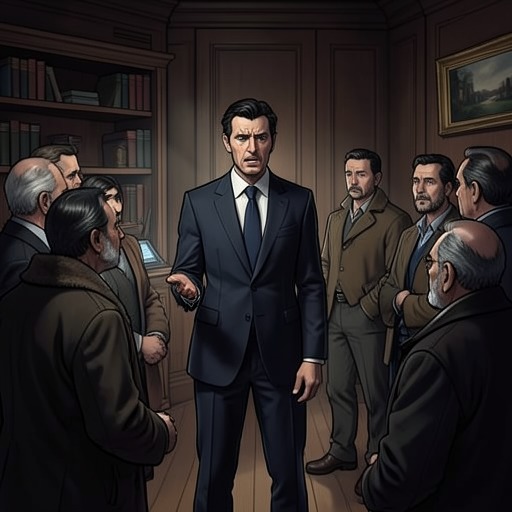
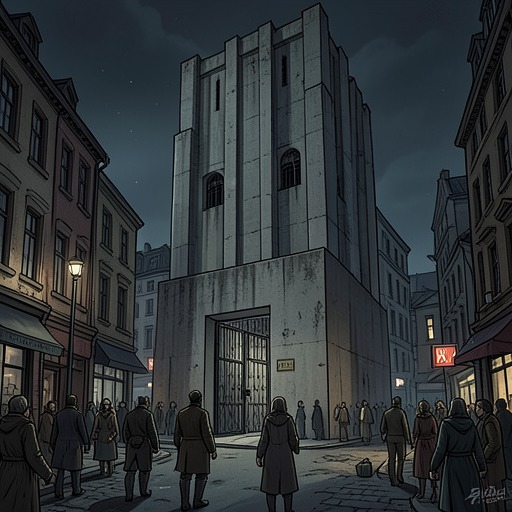
The later dispute over what to do with the witnesses reveals how far the government’s response has fractured. Falkirk wants them brought to the Thunder Hill Depository and expects to persuade officials that a spreading infection is real. He is prepared to destroy the Tranquility group and the Depository staff if he obtains what he considers proof that they are no longer human. Other officials and participants do not accept his assumptions. Foster Polnichev argues that the healings performed by Brendan Cronin and Winton Tolk, together with the telekinetic abilities of Dominick Corvaisis and Emmy Halbourg, point toward beneficial effects rather than a threat. The disagreement makes DERO’s military capacity consequential: the question is not only what the force can do, but whose interpretation of the crisis its orders will serve.
General Bob Alvarado quietly works against the secrecy policy by sending clues to witnesses. He handles postcards with gloves, intending to avoid fingerprints, and plans to direct witnesses toward Jack Twist, whose unlisted number might help set events in motion. He later explains that he came to Miles Bennell because he needs an ally against Falkirk: he believes the colonel has not become reasonable and intends to kill the witnesses and the people at Thunder Hill. This opposition does not amount to an institutional reversal by DERO, but it shows that people operating within the military command structure do not all share Falkirk’s purpose.
The Depository and the force’s limits
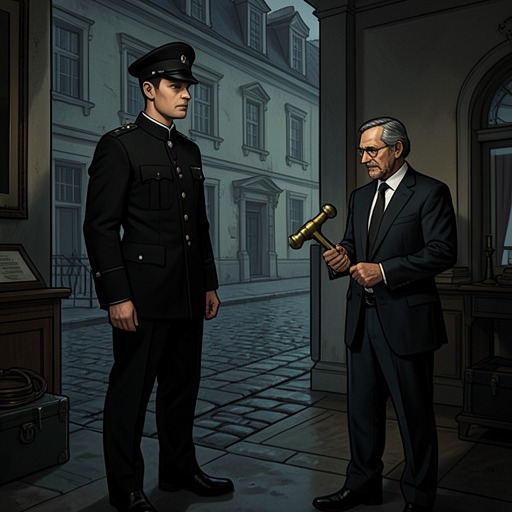
When the witnesses are brought to the Thunder Hill Depository, Lieutenant Tom Horner’s machine gun discourages them from fleeing or resisting. Falkirk orders the other DERO men back to Shenkfield, where they are to bury Stefan Wycazik in an unmarked grave and await further orders. He believes that he and one other man can control the prisoners and destroy the Depository, so he does not consider the whole company necessary. By placing the remaining prisoners under the immediate control of himself and Horner, Falkirk concentrates force rather than relying on the full contingent.
That decision also exposes how personal and unstable the command has become. Falkirk distrusts Horner after the lieutenant has been alone with people Falkirk fears may be contaminated. On the Depository’s lower level, he carries a submachine gun and plans to shoot anyone who moves toward him; if they overwhelm him, he intends to kill himself rather than allow himself to be changed. His paranoia is connected to childhood memories of being forced toward religious behavior by his parents, and he interprets the possibility of alien influence through that long-standing fear of losing his identity. DERO’s armed presence therefore does not secure a coherent response: under Falkirk’s command, military control narrows into an individual’s desperate attempt to control prisoners, staff, and even himself.
The force’s wider significance lies in this contrast between rapid deployment and failing command. DERO can help close a highway, arrive from nearby maneuvers, and place armed men at a secured facility; it cannot make the witnesses’ memories disappear, settle the argument over whether the alien contact is dangerous, or guarantee that its own personnel will follow one reliable purpose. The company is part of the state’s attempt to turn uncertainty into containment, while its divided loyalties and Falkirk’s escalating suspicion show that coercion cannot resolve the truth the cover-up is trying to suppress.