Calvin Sharkle
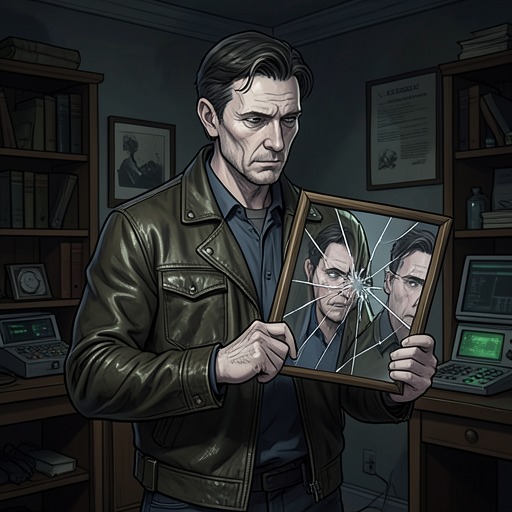
StrangersCalvin Sharkle’s story turns a government effort to bury first contact into a domestic catastrophe. A sociable trucker who once lived peaceably among his neighbors, he becomes convinced that an inhuman force is coming for them and prepares his home for a siege. His fear is not simply delusion: as Father Stefan Wycazik later understands, Calvin has confused a real starship landing with the human agents who detained and brainwashed him afterward. Unable to remember clearly, he mistakes his captors for aliens and his neighbors for people already transformed. The mistake does not make the violence less real; it makes the cover-up’s consequences impossible to ignore.
Life Before the Siege
For months, Calvin’s neighbors in Evanston watched a marked change in a man they had known as cheerful, pleasant, and sociable. A bachelor who lived alone and had been well liked on O’Bannon Lane, he grew brooding, dour, and grim. He told people he had a bad feeling about things and expected something important and terrible to happen. Survivalist books and magazines, talk of Armageddon, and vivid nightmares became part of this change.
On December 1, Calvin quit trucking and sold his rig. He told neighbors and relatives that the end was near and wanted to sell his house, buy remote mountain property, and build a retreat. But, he said, there was no time for that: he would have to prepare the house for a siege instead. He could not identify the source of his fear. He specifically distinguished it from the familiar survivalist anxieties of nuclear war, Russian invasion, and economic collapse, insisting only that something strange and horrible was coming.
His sister, Nan Gilchrist, took him to a doctor, who found him physically fit and attributed his condition to work-related stress. After Christmas, however, Calvin became more guarded and suspicious. During the first week of January, he had his telephone disconnected, fearing that whoever was coming might reach them through it. He could not, or would not, say who they were.
The Attempt to Protect His Neighbors
On the morning of the siege, Calvin crossed the street to visit the Wilkerson family, neighbors from whom he had recently kept his distance. He offered to shelter them in his fortified house when the danger arrived. He could not describe what the attackers would look like or what they would call themselves, but feared they might turn people into zombies. His offer carried the logic of protection: he believed he was prepared and that the Wilkersons were defenseless.
The Wilkersons treated the threat seriously enough to seek help. After Calvin left, Edward Wilkerson called Nan, who arrived with her husband intending to persuade her brother to enter a hospital for observation. Worried that the family might need assistance, Wilkerson and another neighbor, Frank Krelky, went to the house as well. Instead of a relative answering the door, Calvin appeared with a 20-gauge semiautomatic shotgun. Nearly hysterical, he accused Wilkerson and Krelky of already being zombies, said they had been changed, and feared they had come to take everyone at once.
Calvin opened fire. The first blast struck Krelky in the throat at close range and killed him. Wilkerson was hit in the legs as he reached the end of the front walk. He fell and pretended to be dead, a ruse that saved his life. Calvin’s preparations to defend his neighbors had become an attack on them: the protective fortress he had imagined instead trapped his own fear and made it lethal.
The Explosion and Its Public Consequences
As the police and a crowd gathered outside, Father Stefan Wycazik tried to reach the house and buy time to speak with Calvin. He identified himself as a priest, but the crowd surged against the barricade and the police would not listen. Then two small explosions announced that the SWAT team had blown open the steel cellar doors. A much larger blast followed, hurling pieces of the house into the winter sky and sending the crowd scrambling away from the barricade. A police officer realized that Calvin had had a bomb inside.
Calvin died in the explosion, as did his sister, her husband, and members of the SWAT team. The siege became national news, keeping attention on O’Bannon Lane. For Leland Falkirk, the news had an additional danger: among Calvin’s shouted accusations were enough accurate fragments to lead a determined reporter from Evanston to the Tranquility Motel and potentially to Thunder Hill. The violence intended to contain Calvin’s fear thus threatened to expose the larger operation that had helped produce it.
The Encounter Behind the Fear
Father Wycazik initially heard Calvin’s claims as the ravings of a madman, but he had knowledge that the police, reporters, and crowd did not. He could place the accusations beside the events at the Tranquility Motel, the miraculous healings, and the telekinetic phenomena. In that context, Calvin’s words did not sound wholly invented. Wycazik came to believe that Calvin had been brainwashed and that his memory blocks were collapsing, leaving him confused and frightened rather than simply insane.
Wycazik later reconstructed the source of Calvin’s confusion. Calvin had seen a starship descend. Afterward, government personnel in sealed decontamination suits detained and brainwashed him. Because he could not recall the events clearly, he interpreted the suited captors, needles, and confinement as an alien seizure and medical assault. He then fused that misremembered captivity with the hostile beings he had actually seen arrive. His belief that aliens were taking control of people was wrong in its identification of the perpetrators, but it grew from real events and from the state’s effort to erase them.
The mechanism of that erasure is reflected elsewhere in the witnesses’ accounts. Ginger Weiss is told that missing days could be covered with implanted recollections, while her apparent memories of books, television programs, and meals at the motel prove hollow under questioning: repeated, programmed details lack the texture of lived experience. Dom Corvaisis likewise argues that visitors who seemed to remember evacuating with the Blocks may have been brainwashed with them. Later, Parker Faine finds a Salcoe girl wearing earphones while a soothing tape supplies a fictional hotel routine to cover the period of a new memory-conditioning session. These episodes clarify the kind of intervention that could leave Calvin with a confident but distorted story and no reliable access to its source.
Narrative Significance
Calvin’s arc makes the cover-up’s violence visible at the scale of a neighborhood. The official explanation of his behavior as madness cannot account for the specific truth inside his accusations; Wycazik’s belated reconstruction can. Yet that explanation arrives only after Krelky, the Gilchrists, members of the SWAT team, and Calvin himself have died. The gap between what Calvin experienced and what he could remember becomes a deadly trap: the state’s false account does not merely conceal contact but leaves a witness unable to recognize the people who have come to help him.
His story also complicates the distinction between a false belief and a fabricated memory. Calvin is mistaken that aliens held him and that his neighbors have become zombies, but the underlying landing, detention, and brainwashing are real within Wycazik’s account. The tragedy is therefore not that an inexplicable fear appears from nowhere; it is that coercion has severed experience from its explanation. By the time Wycazik can interpret Calvin’s warnings, the house has exploded, and the man who might have testified to the encounter has been silenced by the very machinery meant to hide it.