Marcie
StrangersMarcie is Jorja Monatella’s seven-year-old daughter, a bright, affectionate child whose humor and ordinary enthusiasms coexist with fear and withdrawal that the adults around her struggle to explain. Her recurring images of doctors and the moon are not simply passing childhood preoccupations: they are fragments of a memory that returns unevenly, first as terror and obsession, and finally in the presence of the spacecraft connected to the July 6 event.
Identity and Family
Marcie lives with Jorja, a single mother, and is also close to her maternal grandparents, Mary Monatella and Pete. Her after-school sitter, Kara, is not actually her aunt, though Marcie has called her “Aunt Kara” since their second week together. The affectionate title, like Marcie’s delight in cookies and jokes, belongs to the recognizable texture of her everyday life, not just to the mystery surrounding her.
The family’s circumstances include Alan Rykoff’s abandonment. By the time Jorja tells Marcie that Alan has died, he has been absent for more than a year. Marcie cries, but not for long: Jorja understands that, in an important sense, the child had already mourned him when he left. The loss helps explain some of Marcie’s hurt, but it does not explain the particular, intense fear of doctors that has begun to surface.
Fear of Doctors and the Missing Memory
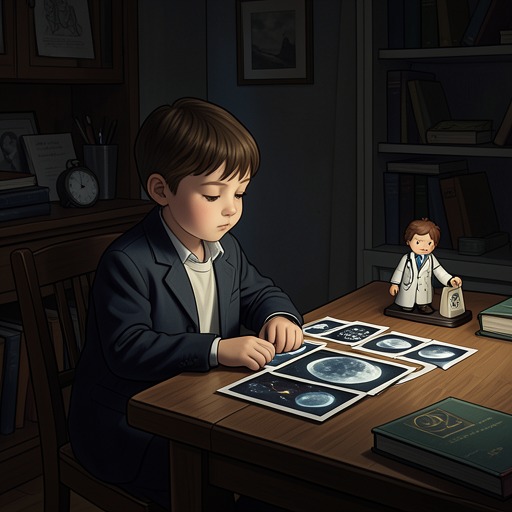
Marcie’s fixation on a Little Ms. Doctor play kit first alarms the adults because it seems far stronger than an ordinary wish for a Christmas present. She tells Kara that she wants to become a doctor so she can treat herself and prevent doctors from touching her again. Her account is precise in its fear, even though the event behind it is inaccessible: doctors strapped her to a hospital bed, stuck her with needles, and flashed lights in her face. She says they hurt her badly and that she will become her own doctor.
Kara’s attempt to ask about the story turns fear into physical distress. Marcie falls silent, then bursts into tears and shakes; when Kara tries to soothe her, she cries harder and runs to hide behind a large green Lay-Z-Boy. It takes Kara at least five minutes to calm her and another ten to coax her out. Marcie makes her promise that if the doctors come for her again, Kara will let her hide and will not tell them where she is. The intensity of that response makes clear that the episode is not, for Marcie, a playful invention.
When Jorja challenges her on the drive home, Marcie insists that the story is true, although she cannot reliably locate the hospital or summon the memory whenever she is asked. Sometimes she remembers it well and becomes frightened; at other times she can hardly remember it at all. On this occasion, she says, she had remembered particularly clearly and scared herself. Her certainty about the experience and her inability to recount it consistently establish the central tension of her early arc: she knows that something happened, but does not yet possess a stable narrative of it.
At Christmas, the doctor kit becomes the focus of a widening disturbance. Marcie arrives in her pajamas as the family prepares the holiday meal and asks whether Santa has brought it. When she opens presents, she rushes through them, abandons a doll she had wanted, and claws at the wrappings in the hope that the kit is inside. Jorja has hidden the set as a final surprise, but Marcie grows pale and trembles as the remaining packages dwindle. Her grandparents’ efforts to slow her down do not work. Later, she refuses the prospect of going to a hospital and says the people there will hurt her as they did before. That night she plays with the kit with unnerving concentration, keeps its pieces beside her bed, and whimpers about doctors, nurses, and needles in her sleep.
The Moon and the Return of July 6
The moon enters Marcie’s story first through a different kind of sleep-talk. After two o’clock, Jorja hears her daughter kick violently, go rigid, and repeat the word moon with amazement and fear. This is not an isolated symbol from Marcie’s private life: by the later investigation, people around her connect lunar images with the moon’s appearance on July 6. For Marcie, however, the connection first takes the form of a sustained activity she cannot explain.
After learning that Alan has died, she turns to a collection of moon pictures and colors them with a scarlet crayon. She has begun the project over the weekend; by breakfast, every photograph and all but fifty of the hundreds of moons she has drawn have become fiery globes. The concentration is so complete that even Pete’s attempts to interest her in something else fail. Jorja fears that the obsession might carry Marcie into a frightening, increasingly isolated state. At the same time, the coloring follows the same pattern as her earlier medical fear: an image associated with something she cannot yet consciously tell begins to take over her attention.
During the group’s discussion of what happened, the adults consider the shared moon imagery alongside the memories of restraints, needles, and other apparent threats. Ginger Weiss argues that Marcie’s changing fascination with a scarlet moon, together with Jack Twist’s nightmare of moonlight turning bloody, may reflect a real memory rather than a dream. The conversation takes place around a dinner table where Marcie draws temporary moon shapes in the residue of turkey gravy with her spoon. Her small, repetitive gesture quietly echoes the larger, more deliberate work of coloring the pictures: the moon is present even when the adults are talking about how to uncover the truth.
Journey to Elko and the Threat of Capture
When Jorja and Marcie travel to Elko to join Dominick Corvaisis, Ginger, and the others, Marcie arrives bundled in a coat and scarf, her eyes puffy from sleeping on the plane and her album of moons clutched to her chest. She has been moody and withdrawn for days, but the sight of Corvaisis and Ginger stirs her. She smiles, answers questions with more enthusiasm, offers to show them her album, and giggles when Corvaisis carries her toward the parking lot. For Jorja, the response makes the journey feel right; the group offers a sense of family that Marcie appears able, for a moment, to share.
That fragile welcome does not make her safe. When Leland Falkirk’s forces take the witnesses into custody, Falkirk uses Marcie as leverage, threatening to hurt her if the others refuse to say where Ginger, Corvaisis, and Jack have gone. As the transport truck moves through the night, Marcie clings fiercely to Jorja. Her earlier, almost unresponsive limpness has given way to a strong need for physical closeness, though she remains disconnected from her surroundings. Jorja takes this change as a hopeful sign, not a cure: her daughter may be finding a way back from her retreat, but the family is still in the hands of a dangerous authority.
Recognition at Thunder Hill
At Thunder Hill, Marcie is carried to the spacecraft displayed inside the facility. Jorja touches the scorched, abraded hull, and Marcie reaches out too. When her tentative hand presses against the metal, she says, “The moon. The moon.” Jorja explains that the moon did not fall: what Marcie saw had glowed white like the moon, then red, then amber. Marcie moves her small hand across the vessel’s flank and says, “Moon fell down.” The repeated phrase now meets an object that can answer it.
Jorja calls it a spaceship, offering Captain Kirk and Mr. Spock as familiar points of comparison. For the first time in this sequence, Marcie turns and looks directly at her mother with eyes no longer unfocused or turned inward. She asks whether the ship is like those characters. The exchange is brief, but it marks a change from the child’s earlier fear and inward absorption: she is responding to Jorja and testing the explanation against something she knows. Jack reassures Jorja that Marcie’s obsession has been a struggle to remember and that beginning to remember may ease that struggle. This is his hopeful interpretation, not proof that her recovery is complete. Afterward Marcie’s eyes blur again, and she returns to her private inwardness.
Change and Significance
Marcie’s story gives the group’s investigation a child’s intimate, bodily register. Before the adults can identify the event, her fear appears in the hiding place behind a chair, the shaking that follows Kara’s questions, her refusal to go to a hospital, and her repeated words in sleep. Later, the same pressure gathers around the Little Ms. Doctor kit and the scarlet moons. These are not interchangeable symptoms: each gives a different shape to what Marcie can remember, fear, or approach at that point in the story.
The spacecraft scene does not erase the danger surrounding her or settle everything she has forgotten. It does, however, bring her recurring image into contact with its source and produces a moment of recognition between daughter and mother. Marcie’s hand on the hull, her insistence that the moon fell, and her question about the spaceship show memory returning through an object she can touch and an explanation she can relate to. Her movement in and out of awareness remains unresolved, but the red moons are no longer only a private obsession: they point toward the shared history the witnesses are trying to recover.