Ginger Marie Weiss
StrangersDr. Ginger Marie Weiss is a capable physician whose outward composure conceals episodes of disorientation she cannot explain or control. In Boston, Massachusetts, an incident at Bernstein's Delicatessen begins a sequence of troubles that turns ordinary objects into sources of terror: first a hand-held ophthalmoscope, then the drain of a surgical sink. Her story sets professional command against involuntary fear, leaving the cause of that rupture unresolved even as it draws her into the larger crisis at Thunder Hill.
Identity and Public Presence
Ginger is introduced as someone accustomed to meeting difficulty head-on. Challenges have generally invigorated rather than discouraged her; she has not imagined that she might encounter a problem beyond her ability to handle. The incident at Bernstein's Delicatessen unsettles that assumption. Its importance lies not only in the danger of the moment but in the new possibility it opens: that determination and expertise may not be enough to explain or master what is happening to her.
Other people can mistake her slight build and quiet manner for weakness. She is five feet two inches tall and weighs 102 pounds, with silvery blond hair, blue eyes, delicate features, slender shoulders, and long-fingered hands. Her soft, musical voice and watchful reserve can also be read as timidity. Yet that impression is misleading: beneath it are self-assurance and authority. The contrast between how others might underestimate her and how she meets a physical threat makes her competence visible in action, not simply a matter of professional standing.
When she brings a subdued mugger into the street because no pedestrians are nearby to call the police, passing traffic stops at the spectacle. The police eventually arrive, to the relief of both Ginger and her attacker. The episode gives concrete form to the resilience suggested by her introduction: she can act decisively under pressure. It also sharpens the difference between a danger she can confront directly and the inward episodes that follow, which resist the same practical command.
Fugue and the Limits of Explanation
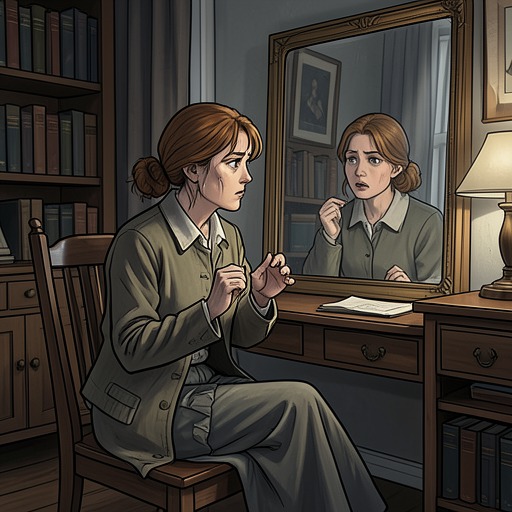
After an early episode, Ginger consults a well-thumbed copy of Taber's Cyclopedic Medical Dictionary. She turns to the entry for fugue, already knowing the term but uncertain why she has gone to look it up. The definition describes serious dissociation, impulsive flight from one's home or surroundings, and a possible loss of memory for actions during the episode. She treats the book almost as a talisman, hoping that seeing the word in print might strip it of power; the gesture exposes both her medical knowledge and her desire to make a frightening experience manageable through explanation.
That effort stops short of investigation. Although she owns other reference books that might provide more information about fugues and their causes, she decides not to consult them. She cannot believe that her transient attack signals a serious medical problem. Her decision is not evidence that the episodes are harmless; rather, it marks the distance between recognizing a possible diagnosis and accepting that it may apply to her. The dictionary supplies a name for the phenomenon, but no answer about what has happened to Ginger.
At George Hannaby's office, the sight of a hand-held ophthalmoscope produces a markedly physical reaction. The ordinary instrument lies on the green desk blotter in the pool of light from a lamp. Ginger knows that doctors use such instruments during routine examinations, and nothing about this one is objectively ominous. Nevertheless, her breath catches, she breaks into a cold sweat, and her heart pounds so forcefully that its sound seems external. The object is familiar within her profession, but familiarity cannot protect her from the danger she suddenly feels.
The scene makes the episode especially disruptive to her identity as a doctor. Ginger is in George's office to retrieve Viola Fletcher's records, using keys George has given her; she moves through the dark professional rooms with a clear purpose before the ophthalmoscope arrests her attention. The shift is abrupt: from controlled work to a bodily alarm she cannot account for. The evidence establishes the trigger and her response, but does not identify why that instrument has acquired such force for her.
At the Surgical Sink
A later episode begins while Ginger washes her hands after surgery. Weary, she leans over the stainless-steel basin and looks down at the water and soap bubbles circling into its drain. Her attention fixes on that ordinary motion; the drain seems to throb and widen, as though it had become alive and hostile. As at George Hannaby's office, the threatening quality belongs not to any objectively extraordinary object but to the way her perception seizes upon it.
The episode escalates before she can steady herself. Ginger drops the soap, cries out, and jumps back, colliding with Agatha Tandy. George calls her name, but he and the others appear to recede into mist while the sink grows larger and more solid in her awareness. She tries to hold to the fact that it is only an ordinary scrub sink and drain, yet the conviction of mortal danger overwhelms that effort. She runs, and the surrounding mist closes in as she loses conscious awareness of her actions.
The sequence links her professional environment to the loss of control: the very setting in which she performs skilled work becomes the site of an episode that defeats her grasp on the present. The ophthalmoscope and the drain are both commonplace medical objects, but each takes on an apparently menacing life in the moment. Their recurrence gives the episodes a recognizable pattern without supplying a diagnosis or a confirmed cause. The contrast is stark: Ginger can face an assailant in the street, but she cannot simply reason her way out of an altered state that makes a familiar object seem lethal.
The Witnesses at Thunder Hill
Ginger is present in the chamber when Jorja, Marcie, Brendan, and the others enter, and she notices their arrival with dismay. At the entrance to Thunder Hill Depository, seven witnesses and Parker Faine are taken from transport and grouped in the snow before a smaller steel door; Lieutenant Horner's machine gun prevents flight or resistance. This places Ginger within the group caught in the final confrontation, though the available account does not specify her individual actions during the detention.
Her presence there extends the contrast at the center of her character rather than resolving it. The physician who has been unable to explain why a medical instrument or a sink drain can provoke such terror is now among witnesses held inside a military operation that implicates the larger mystery. The material available establishes her place in that group, not what she ultimately learns or does afterward. Ginger's trajectory therefore remains suspended between the familiar demands of professional life and experiences that make the familiar suddenly unrecognizable.