Alan Rykoff
StrangersAlan Rykoff is Jorja Monatella’s estranged former husband and Marcie’s father, a blackjack dealer whose final months are marked by compulsive sexual behavior, an abrupt fascination with the moon, and suicide. His death initially appears to close a bitter chapter in Jorja’s life; instead, the will and the objects he leaves behind expose an unsettling resemblance between his condition and Marcie’s, making Alan’s brief, destructive final period part of the book’s wider mystery.
Identity and Family
Alan worked as a blackjack dealer and had once been married to Jorja. Their relationship ended in estrangement, and his behavior had left Jorja with little reason to mourn him when she learned he was dead. She remembers him as cold, arrogant, and selfish, and understands that his abandonment had already made him nearly absent from Marcie’s life. He had not seen his daughter for six months before his death.
That history makes the disposition of Alan’s estate striking. His last will and testament was a simple, preprinted one-page form, but he named Jorja as executor and left his possessions to Marcie. The bequest mattered because Alan had previously been prepared to deny that he was Marcie’s father. Jorja saw the will as a late, inadequate reaching out to them: it could not undo his earlier cruelty or absence, but it complicated the picture of a man who had seemed to sever himself from his family.
Work and Relationships in Las Vegas
Alan’s ordinary occupation was dealing blackjack in Las Vegas. Alongside it, he managed the work of Pepper Carrafield and some of her friends, drawing on the contacts he had through the casino world. Pepper sharply distinguished her own escort business from prostitution and described herself as financially successful, with investments and hotel connections. Alan did not charge her a management fee. According to Pepper, his compensation was sexual access to her and the women she introduced to him.
Pepper had initially wanted Alan around because she regarded him as strong and capable of managing and protecting her. She said that, for a time, he had been the best. That arrangement had changed by the last months of his life. Pepper reported that he had begun acting strangely a few months earlier and had become increasingly disturbing. His sexual demands intensified into a compulsion: she described him pursuing sex repeatedly, then turning to pornography when he could no longer continue. She had begun considering finding someone else to look after her, but did not expect his suicide to end the arrangement so abruptly.
Pepper’s account is blunt and self-interested, and Alan is not present to explain his own decline. Still, it supplies a concrete contrast between the man she first welcomed as a strong manager and the increasingly uncontrollable person she later found unsettling. His conduct with Pepper also offers a separate view of the estranged husband Jorja remembered, without erasing the damage he had done to his family.
The Moon and the Shared Obsession
When Jorja went through Alan’s belongings, she found six books on the same subject, several of whose spines displayed the word moon. On his dresser stood a basketball-sized illuminated globe: not a model of Earth, but a detailed lunar globe marked with craters, ridges, and plains. Pepper said Alan had become interested in astronomy only in the past couple of months. The books and glowing globe turned an apparently private interest into a troubling clue.
Jorja connected Alan’s sudden lunar fixation to Marcie’s obsession with moon pictures. The two had developed different psychological problems: Marcie had an irrational fear of doctors, while Alan’s behavior had become dominated by compulsive sexual desire. Yet both conditions involved obsession, and both were accompanied by a new, intense interest in the moon. The timing made the resemblance difficult to dismiss. Alan had not seen Marcie for six months, and their most recent telephone conversation had taken place in September, weeks before either became fascinated with the moon. Jorja could identify no contact by which one might have passed the fixation to the other; it seemed to have arisen independently in each.
The comparison does not establish what caused either condition. Jorja’s reflections instead make the coincidence itself significant: father and daughter were separately drawn toward the same lunar image while undergoing sharply different psychological disturbances. Alan’s collection therefore functions as more than evidence of an eccentric hobby. It links his otherwise private deterioration to a pattern that has also appeared in Marcie, and makes his death part of a mystery extending beyond his own life.
Death and Its Immediate Aftermath
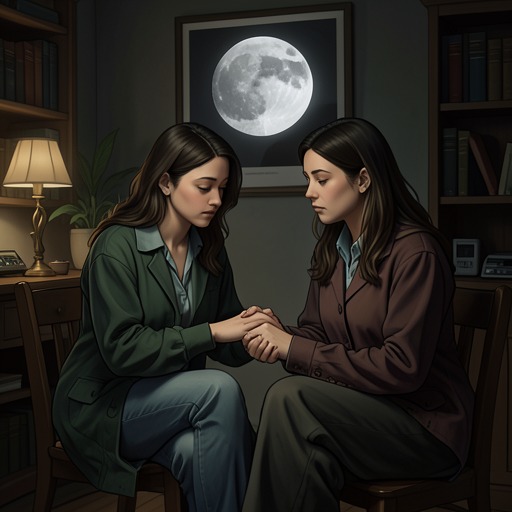
On Friday afternoon, while Jorja was working at the casino, Pepper called with the news that Alan had killed himself that morning. Jorja took the emergency call at a phone in the blackjack pit, shielding one ear from the casino’s voices, cards, and slot machines. She was shocked and sickened, but did not feel grief; pity was the only emotion she could summon. Pepper’s immediate concern was practical: she wanted Jorja to come and remove Alan’s belongings from the apartment.
The task took Jorja into the bathroom where Alan had died. Blood covered the beige tile and spattered the shower door, sink, towels, wastecan, and toilet; a dried stain behind the toilet formed a pattern like a Rorschach blot. Pepper said Alan had shot himself twice, first in the genitals and then in the mouth. The gruesome sequence made a terrible, literal counterpoint to Pepper’s report that his sexual drive had become obsessive. Jorja also felt guilt, wondering whether she could have done anything to save him, even as she recognized how little in their past gave her reason to grieve for him.
Alan’s funeral took place on Monday morning in Las Vegas. Only Jorja, Alan’s father, and five other people attended; even Jorja’s parents were absent. Alan’s former father-in-law blamed Jorja and remained barely civil, leaving open the possibility that he might see his grandchild again only if anger eventually gave way to that desire. The sparse attendance reflected the isolation Alan’s selfishness had helped create, while the funeral’s bright shafts of winter sunlight fell across the cemetery and the lowering casket.
What Remains
Jorja’s tears came after she had driven a mile from the cemetery. She did not weep for Alan’s suffering or for losing him. She mourned the destruction of the hopes with which their relationship had begun: love, family, friendship, shared goals, and a life together. She had not wanted him dead, but recognized that his death would make it easier to begin the new life she had been working toward. That recognition brought sadness, not guilt or cruelty.
Marcie also learned that her father was dead, though Jorja did not tell her that he had died by suicide. The seven-year-old cried briefly. His abandonment had already made him absent from her life, so much of her mourning, in Jorja’s view, had happened earlier. The moon drawings offered another focus: Marcie had spent the weekend coloring her collection, turning every photograph and all but fifty of hundreds of hand-drawn moons into fiery globes. Alan’s death thus leaves Jorja with the practical and emotional work of caring for their daughter, and leaves the lunar obsession visibly continuing in Marcie. Alan is gone, but the unexplained resemblance between his final fixation and his daughter’s remains unresolved.