Parker Faine
StrangersParker Faine is a successful American painter whose appetite for adventure proves as consequential as his artistic reputation. When Dominick Corvaisis’s sleepwalking grows alarming, Parker becomes his confidant and practical caretaker; as the mystery reaches Monterey and Elko County, he turns friendship into action, risking capture to uncover the treatment of the Salcoe family and eventually helping stop a nuclear attack. His arc makes loyalty more than a sentiment: it becomes a willingness to leave the safety of his studio and enter the danger surrounding his friend.
Identity and Character
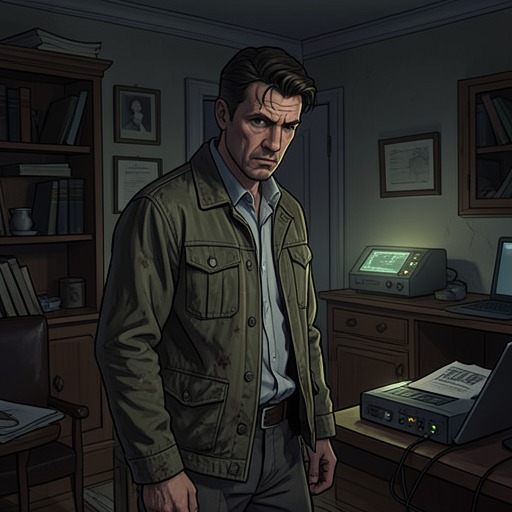
Parker is a burly, bearded artist with a forceful personality and a taste for theatricality. His career is unusually prominent: major museums collect his canvases, and he has received commissions to create works for the President of the United States and other luminaries. Yet the narrative sets professional stature beside an enduring playfulness. Parker retains a child’s curiosity, wonder, innocence, and sense of fun, qualities that shape how he approaches both art and danger. When he becomes involved in Dominick’s plans, he does not merely accept the risk; he finds adventure in the work.
His frankness is equally important. Dominick briefly wonders whether Parker might have sent him an anonymous note as a piece of amateur psychotherapy, but dismisses the suspicion: elaborate manipulation is not in Parker’s nature, and he is almost excessively forthright. The distinction helps establish the trust between the men. Parker may be exuberant and theatrical, but his loyalty does not depend on hidden schemes or strategic flattery.
Parker’s reluctance to become a Big Brother offers another view of the gap between his self-image and his conduct. At Dominick’s insistence, he joins the Orange County chapter of Big Brothers of America and is paired with two boys, Denny Ulmes and Nyugen Kao Tran. He protests that he is no father or surrogate-father material, describing himself as a heavy drinker, a womanizer, a procrastinator, a dreamer, and a self-centered egomaniac. He also claims that he hates dogs, despite the fact that children like them. The comic inventory is not proof that he lacks care; it shows how readily he treats his own shortcomings as a reason to resist responsibility, even as he allows Dominick to draw him into it.
Friendship with Dominick Corvaisis
Parker’s central relationship is with Dominick Corvaisis. On a Sunday in December, the two have lunch on the terrace at Las Brisas, overlooking the sea. There, Dominick tells Parker the embarrassing and distressing details of his escalating sleepwalking. Parker has already consumed several double-shot margaritas, but his attention remains sharp. His immediate response is to ask why Dominick did not tell him sooner. The scene establishes both the intimacy of their friendship and the practical consequence of disclosure: once he knows the extent of the problem, Parker takes it seriously.
Parker connects the sleepwalking to changes Dominick underwent two summers earlier. He argues that two personality crises within two years are unlikely to be unrelated, and insists they must be tied together somehow. When Dominick later visits Dr. Cobletz, Parker drives him back toward Laguna Beach and argues that living alone is unwise until the sleepwalking stops. He offers space in his own home and promises to keep an eye on him without hovering. He also casts himself, half-seriously, as the right person to help Dominick talk through the problem, claiming that if he had not become a painter he might have become a psychiatrist.
Parker’s concern becomes more urgent when he tells Dominick that, only minutes earlier, Dominick had phoned him shouting for help, saying that they were there and were going to get him before hanging up. The call makes the danger immediate, while Parker’s willingness to respond confirms that his role is not simply to speculate about the cause. He offers company, listens, and tries to keep Dominick from facing the crisis alone.
Their friendship also gives Parker a stake in the larger mystery. On Christmas night, Dominick arrives at Parker’s hillside home and shares information that connects his recent journey to the changes of the previous summer. Parker quickly recognizes that the trip was no ordinary vacation and suspects that the sleepwalking has returned. After reading two notes, he accepts that Dominick’s explanation may be true despite its extraordinary character. He does not claim certainty; he admits that the account sounds like Dominick’s imagination running wild, but cannot think of a better answer. His response combines skepticism with trust, allowing the evidence to be strange without dismissing his friend.
From Studio to Investigation
As Dominick’s inquiries become more dangerous, Parker helps maintain a discreet line of communication. After two disturbing Polaroid photographs arrive, the men decide that caution and paranoia have become difficult to distinguish. Parker collects Dominick’s mail and reports that it contains only bills and advertisements, with no further strange messages or photographs. They arrange to speak through pay phones rather than risk their regular lines. Parker waits at a different phone each night, and later explains that he drives miles out of his way, doubles back, and makes sudden turns to shake any possible tail.
The routine does not make him fearful or passive. Parker admits that he is enjoying the intrigue, comparing it to the games of cops and robbers and hide-and-seek that he liked as a child. At the same time, his playfulness has a clear practical edge: he searches for watchers while collecting the mail, though he never sees anyone observing him or detects a tail. When Dominick finally calls from the Tranquility Motel to say that he has reached the place, Parker has helped him remain connected while the investigation unfolds at a distance.
Parker’s involvement also becomes a route by which new witnesses and information enter the story. He learns that Ginger Weiss has written to Dominick after finding a copy of his book and recognizing his photograph; she believes she has met him before and that he is connected to what has been happening to her. Parker relays the news and recognizes the importance of the connection. His part is not to solve every piece of the mystery himself, but to keep information moving among people whose experiences may be related.
The Monterey Break-In
Parker’s most dangerous investigation begins when Dominick asks him to find Gerald Salcoe, a man who had stayed at the Tranquility Motel with his wife and twin daughters on the night of July 6. Parker flies from Orange County through San Francisco to Monterey and drives to the Salcoe home. The family has been unreachable by telephone and Western Union. Parker is prepared for either of two outcomes: evidence that they travelled safely to Napa-Sonoma, or signs that they were taken against their will.
When the house proves empty of its occupants, Parker turns to the neighbors. He nearly falls into what he thinks of as a trap set by Essie Craw, the Salcoes’ neighbor. Later, inside the Salcoe home, he searches for travel information but also remains alert to evidence of abduction. In one bedroom he finds the Salcoe twins lying motionless in a bed, their eyes open. At first he thinks they are dead. The beeping and green light from EEG and EKG monitors, together with IV lines running from racks to the girls’ arms, reveal that they are alive and being subjected to brainwashing. The room’s lack of personal objects suggests to him that it is a guest room arranged for monitoring, rather than the girls’ own bedroom.
Parker is discovered by one of the people involved. He escapes from the second floor, crashing onto lounge chairs and a glass-topped table before going over the balcony rail. He drops twelve feet onto the lawn, bruising himself and jarring his shoulder and back, but breaks no bones. The escape turns suspicion into direct knowledge: the memory operation is real, and children are among its targets. The danger he had understood intellectually now becomes something he has witnessed and survived.
Rather than return to Laguna Beach, Parker decides to go to Elko County. He reasons that Dominick is his friend, perhaps his best friend, and that friends share trouble and fight the darkness together. Returning to his painting would be possible, but he believes he would not be able to live with himself if he walked away. At the airport, he buys one of the last two seats on a West Air flight leaving for San Francisco in ten minutes. He half-expects federal agents to stop the plane before takeoff; once airborne, he turns to the immediate problem of finding another flight to Reno before anyone can track him there.
The FBI later identifies Parker as the intruder from the abandoned rental car and traces him from Monterey to San Francisco, where the trail ends. Its account also confirms the immediate consequence of his escape: the four Salcoes are moved in a medical van to a safe house so that the memory modifications can continue. Parker has disrupted the operation without yet freeing the family, but his discovery exposes the scale and method of the conspiracy.
Arrival in the Storm and the Final Confrontation
Parker’s attempt to reach the people in danger continues through severe weather. A small feeder flight descends through a storm front and lands at the Elko County airport shortly before it closes. With no rental cars available and the three taxis already overwhelmed, Parker asks other arriving passengers for a ride. He then collides with a priest, Father Stefan Wycazik, who also urgently needs to get to the Tranquility Motel. Their meeting joins Parker’s independent investigation to the group gathering around Dominick and the July 6 events.
During the cross-country journey through the snow, Parker tells Jorja about Calvin Sharkle and about Brendan Cronin passing his power to Emmy Halbourg and Winton Tolk. Parker wonders aloud whether the same might now be true of him. He also speaks of the Contact Impact Study Group and tells the group what their missing memory has concealed: something came down from the sky on the night in question. The revelation reframes his pursuit. The mystery is no longer only an investigation into sleepwalking and altered memories; it concerns an encounter that has changed the people who survived it.
Parker eventually reunites with Dominick at Thunder Hill. Dominick responds with a rush of affection and asks how his friend reached them. In the crisis surrounding the facility, General Bob Alvarado asks Dominick to use his abilities to keep the blast doors and smaller entrance from opening. Parker’s own decisive action comes at the bomb package. As Brendan struggles with the detonator, Parker pushes through the onlookers, drops to his knees, and urges him to trust instinct rather than intellectualize the problem. He puts his large hands toward the device and shouts, “Come out of there you fucker!” The detonator snaps out of its niche and into his hands.
That intervention gives concrete form to the power Parker had only wondered might have been passed to him. His artistic temperament, previously expressed as curiosity and a taste for adventure, becomes an instrument of resistance. The painter who once joked that he was too self-centered to guide a child now risks his safety for Dominick, the Salcoe girls, and the wider group of witnesses. His defining movement is from willing companion to indispensable participant: he keeps faith with his friend, follows the evidence into danger, and acts when the threat becomes immediate.