Pablo Jackson
StrangersPablo Jackson is a celebrated stage magician turned hypnotist whose most consequential performance is not an illusion but an act of restraint: he recognizes the peril behind Ginger Weiss’s fugues and refuses to force her memories open. His careful investigation gives her a way to understand her terror, while his murder leaves both the treatment unfinished and a crucial witness dead.
Identity and Public Reputation
When Ginger first meets Pablo, she already knows that he is a Black man in his eighties, information she had learned from a newspaper article. What surprises her is his physical vitality. He is slight and about five-foot-eight, but stands upright, moves with the stride of someone decades younger, and greets her with a youthful smile. His thick, white hair seems almost to glow, lending him an aura that suits the unusual history surrounding him.
That history includes a career as a once-famous European stage performer and the distinction of being Picasso’s godson. During World War II, he served as a liaison between British Intelligence and the French Resistance. In Boston, these experiences made him a fixture of social life: invitations came readily, and his subsequent work with police agencies only deepened his reputation. He brought a performer’s public presence and a long-studied private expertise to his hypnotic work, helping witnesses recall details of crimes that had eluded them.
Pablo distinguishes his practice from psychiatry rather than claiming that the two are interchangeable. The psychiatrists Ginger mentions are not specialists in hypnosis; he, by contrast, has studied it throughout his life and developed techniques that can succeed where standard methods fail. His authority rests on sustained study and experience, not simply on the mystique attached to his biography.
Work with Ginger Weiss
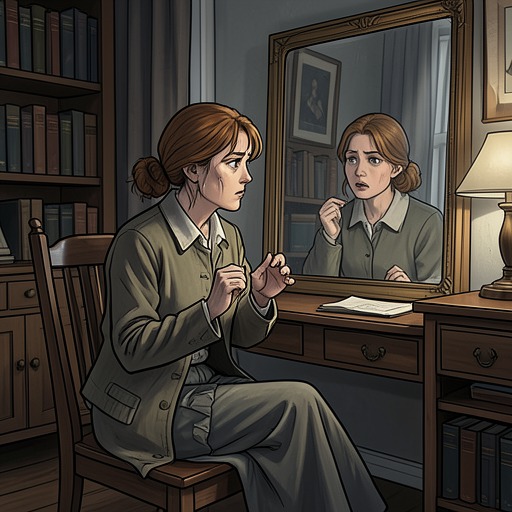
Ginger asks Pablo to hypnotize her and return her to the morning of November 12, at Bernstein’s Delicatessen. She wants him to keep her at the moment when the sight of black gloves frightened her and question her until she can explain why. The request is specific, but the terror it points toward is not: she is trying to reach a memory she has been unable to approach while awake.
Pablo guides her backward through time, describing the clock’s hands moving in reverse until she is at the place and moment of her first fear of black gloves. The session becomes physically dangerous. Kneeling beside her, he finds her breathing shallow and her hand cold; her pulse and heartbeat are both weak. The hypnotic regression has brought her close to a severe withdrawal rather than a usable recollection.
Afterward, Pablo identifies the fear as evidence of something traumatic buried deep in her past. He connects the black-gloved man and the dark-glass face Ginger had described with the motorcyclist whose appearance had panicked her on State Street. He suspects she is determined to keep the underlying incident buried at almost any cost and urges her to tell Dr. Gudhausen what happened. Most importantly, he refuses to hypnotize her again at that stage: another trance might provoke a withdrawal as severe as the one he has just witnessed.
Pablo does not abandon the problem. He researches cases resembling Ginger’s and searches for accounts of memory blocks designed to produce self-destruction when breached. He finds a relevant discussion of an imposed psychological condition resulting from brainwashing. In later conversations he discusses Ginger’s fugues and the dangerous session without identifying her by name or occupation, preserving her privacy while seeking help in understanding what has happened.
Between December 27 and January 5, Ginger visits Pablo’s Back Bay apartment six times, and he uses hypnotic therapy on each visit to probe the Azrael Block sealing off part of her memory. He knows that her apparent recollections of four days at the Tranquility Motel are false and that her true memories lie behind the block. A direct command to reject the false memories and break through to the real ones might work, but the block has been programmed to drive her into a coma—or worse—if confronted too abruptly. Pablo therefore looks for small openings and proceeds with deliberate patience, planning to work at the edges in a relaxed manner rather than shatter the barrier.
Murder and Immediate Aftermath
Pablo’s treatment is interrupted after he tells Ginger he is unavailable on Monday morning because he plans to visit a friend in the hospital. He asks her to return at about one that afternoon so they can continue working cautiously. When Ginger enters a library and sees him lying face down near the Sheraton desk, she first considers medical emergencies. Then she turns him over and discovers that he has been shot high in the chest.
Pablo’s eyes open briefly. Though unfocused, they seem to recognize Ginger, and he manages a single urgent warning: "Run." He dies before she can help him. Ginger checks for a pulse at his wrist and then his neck; finding none, she touches his brow with tenderness rather than the clinical detachment of a physician. She has known him for only about two weeks, yet his death strikes her with the force of a profound personal loss. The narrative connects this attachment to her readiness to give her heart, as she had with her father.
The shooter is not identified in the account. A later assessment says that the gunman was most likely one of the "hard-asses," but the suggestion does not establish who fired or why. Pablo’s final warning, rather than any explanation of the attack, is the immediate consequence Ginger carries away from the scene.
Funeral, Legacy, and Narrative Significance
Pablo’s memorial service takes place at eleven on Saturday morning, January 11, in a nondenominational chapel on the cemetery grounds where he is to be buried. The coroner and police pathologists do not finish with his body until Thursday, leaving five days between the murder and the funeral. At the cemetery, Alexander Christophson tells Ginger that Pablo knew the risks and accepted them, describing him as captain of his own fate. The remark recognizes Pablo’s agency without making his death less devastating to those who depended on him.
The funeral also marks the beginning of an absence that remains present. After the service, Pablo’s memory stays with Ginger through the afternoon and evening; alone in a guest room at Baywatch, she tries to read but cannot concentrate, caught between grief for him and anxiety about what will become of her. Later, she tells Dominick Corvaisis about her fugues, the regression sessions, the Azrael Block, Pablo’s murder, and her narrow escape. New memories in Dominick’s dream support the connection Pablo had been approaching: objects such as black gloves and a dark-visored helmet could trigger terror because they recalled the decontamination-suited personnel involved in her imprisonment and brainwashing at the motel.
Pablo’s findings thus outlive the treatment he could not complete. His caution preserves Ginger from a potentially fatal forced breakthrough, while his interpretation helps her recognize the pattern linking her apparently inexplicable fugues to repressed experience. After his murder, the witnesses also treat his death as part of the evidence against the cover-up surrounding their altered memories. His role joins private care to public consequence: a hypnotist who once helped crime witnesses retrieve forgotten details becomes, through his own killing, one of the facts that makes the suppressed story harder to contain.