Brendan Cronin
StrangersBrendan Cronin’s crisis of faith begins as a private collapse of certainty and becomes a test of what priesthood means when belief no longer comes easily. His later healing powers and encounter with an alien presence unsettle the explanations available to him, but his defining response remains a priest’s responsibility to care for others.
Identity and Crisis of Faith
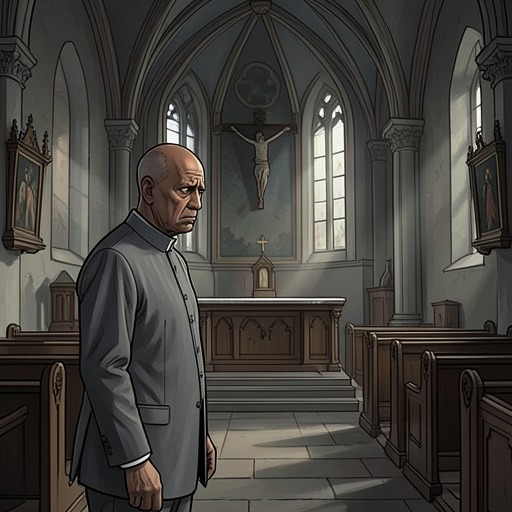
Four months before the events of December, Brendan began losing his faith. Doubt did not arrive as a single argument that he could defeat; it burned steadily through beliefs he had held for years. By the time he stood at the threshold of the sanctuary, the crucifix and altar no longer seemed inherently sacred. To proceed with the familiar rites while feeling that estrangement, he thought, would make him a hypocrite defrauding the congregation. In a wrenching break with ritual, he threw the chalice across the sanctuary. It struck the wall, rebounded from a statue of the Blessed Virgin, and came to rest near the podium where he had read the Gospels.
Father Stefan Wycazik, a priest experienced in helping troubled clergy, refused to treat Brendan’s distress as a problem that could be answered by encouragement or theological debate alone. He proposed an unconventional course of help, including amateur psychological treatment, and asked Brendan to give him until Christmas before accepting referral to a Jesuit psychiatrist. Wycazik also believed Brendan could still serve the Church in a larger capacity, though a priest placed on the Prefect’s danger list would remain suspect. By the time Brendan came to see him again, the crisis was visibly wearing him down: he was pale, his step had lost its bounce, and the two men had met repeatedly to seek a way back toward belief.
Service Among the Sick
Wycazik’s experiment took Brendan out of the parish and into St. Joseph’s Hospital for Children, where only Dr. Jim McMurtry knew he was a priest. The physician had promised secrecy and agreed that Brendan would receive the same work as any other orderly. That meant emptying bedpans, changing urine-soaked sheets, helping bed-ridden patients with passive exercises, feeding a partially paralyzed eight-year-old, pushing wheelchairs, encouraging despondent children, and cleaning up after two young cancer patients sick from chemotherapy. No one called him Father or spared him the tasks; addressed simply as Brendan, he felt like an impostor in a masquerade.
The work’s purpose came into focus on his seventh day, a Wednesday afternoon, as he brushed the hair of a ten-year-old girl crippled by a rare bone disease. The moment helped him understand why Wycazik had sent him there: the hospital was not an argument about suffering but a place where he had to meet it in the person of a child. Nearly all the children around him retained a strong faith, convinced that a caring Father watched over them from heaven. Their trust stood in striking contrast to Brendan’s own faltering belief, without resolving the questions that had brought him to the hospital.
Anger, Healing, and the First Signs of Power
The hospital work did not settle Brendan’s crisis so much as bring him into closer contact with suffering. Later, after Winton Tolk was shot during the Uptown sandwich-shop violence, Brendan confronted the injustice of the officer’s condition without the prayer that might once have steadied him. Thinking of Winton sprawled on the floor, he felt anger feed on itself; the perceived unfairness seemed to eat at him like acid. When he touched Winton’s neck and then the wounds in his chest, blood rising between his fingers, rage gave way to helplessness, and he began to cry. His response was not detached religious consolation but an anguished inability to accept that he could do nothing.
That inability became the setting for an unexplained healing. Father Stefan Wycazik later argued that Brendan had cured Emmy Halbourg and healed Winton through the power signaled by the swollen rings on his palms. Brendan did not accept the priest’s conclusion that the marks were a sign visited by God: he remembered a recurring dream of golden light, but said its awe and joy were unlike anything he had experienced in Christ, and that his education and prior beliefs could not explain what was happening. Wycazik, who had sought to restore Brendan’s faith through unconventional treatment, recognized the cures as evidence of a power; Brendan could acknowledge the importance of the events without accepting their religious interpretation.
The first manifestation of the healing gift was later associated with the hospital scene in which Brendan brushed the hair of the ten-year-old girl with a rare bone disease. Ginger Weiss proposed that pity, frustration, and anger at his inability to help her may have released a power Brendan did not consciously know he possessed. She also suggested that his acquisition of it was among the things he had been made to forget. Her account connected the girl’s care to the later emergency involving Winton, when Brendan faced another crisis and the wounded officer’s life was at stake. It offered a possible pattern, not an explanation Brendan could verify: compassion and extremity accompanied the gift’s emergence, while its origin remained bound up with missing memories.
The Call Beyond Chicago
The recurring golden-light dream gradually changed from an inexplicable private experience into a summons Brendan could no longer ignore. One night at the rectory, Father Stefan Wycazik woke to a pounding that seemed like an enormous heart, while explosive sounds and pulsing light recalled the mortar fire of Vietnam. Brendan slept through the disturbance, smiling faintly; when Wycazik woke him, he said he had been close to something and wished he had not been disturbed. Still half asleep, he described the experience as a call back into the dream’s golden light. The scene placed the two priests on opposite sides of the same disturbance: Wycazik heard danger and remembered war, while Brendan experienced an attraction so absorbing that he wanted to return to it.
Brendan’s sense of being summoned did not restore a simple religious certainty. He could not say that the dream came from God, and its joy felt unlike the joy he had known in Christ. Yet it seemed to him both strange and important, something for which neither his education nor his former beliefs had prepared him. On Christmas, after dinner with Father Stefan Wycazik and Father Michael Gerrano, he told Wycazik he needed to go to Nevada. Although he had expected to leave on Monday, cancellations opened seats on an earlier United flight to Reno; he boarded a day ahead of schedule, intending to continue to Elko by commuter airline.
At the Tranquility Motel, Brendan arrived in ordinary clothes rather than a black suit and Roman collar, but Ginger Weiss recognized him at once as the auburn-haired young priest in the photograph sent anonymously to Dominick Corvaisis. Her response was immediate: she felt drawn to Brendan as she had to Dominick, sensing that they shared an experience more shattering than the one she had shared with the Blocks and the Sarvers. Within the July event witnessed by the larger group, she understood, there had been a Second Event known only to some of them. She rushed to embrace Brendan despite the impropriety of greeting a priest and near-stranger that way.
The recognition was not merely emotional. Dominick Corvaisis showed the others the swollen red rings in his palms, marks that connected him visibly to Brendan’s own stigmata. Brendan’s confidence about their shared fate could at times unsettle Dominick: when Brendan spoke with serene certainty that they were meant to win, the assurance did not comfort him but stirred fear and muddied his feelings. The rings and the reunion therefore carried both promise and unease. They joined Brendan to the group and to the mystery drawing them toward Nevada, while making clear that neither the meaning of the marks nor the source of the call had yet been settled.
Power, Faith, and Responsibility
At the Tranquility Motel, Ginger Weiss offered Brendan a possible account of how his healing gift first emerged. She connected the swollen rings on his palms and his first healing to the moment he brushed the hair of the sick girl at St. Joseph’s: pity, frustration, and anger at being unable to help her might have released a power he did not know he possessed. Ginger further suggested that the acquisition of the gift was part of what he had been made to forget. The theory linked compassion and crisis to the power’s appearance, but left its source uncertain—and Brendan’s missing memories made the uncertainty consequential.
Brendan wanted the miracles to point toward a divine presence, even while resisting the claim that they proved God had acted through him. At the motel, he and Dominick Corvaisis concentrated on separate pepper shakers during an experiment with their abilities. Brendan’s hope that the extraordinary events might draw him back into the Church existed alongside his awareness that the test could reveal something other than religious intervention. When he later told the group that the power had been in him and Dominick since the July night, he rejected Ginger’s proposed biological-contamination explanation, though he could not supply another mechanism.
His gifts also made restraint part of his responsibility. At the Blocks’ kitchen, Brendan found Marcie coloring moons and murmuring to herself. Because he had healed Emmy Halbourg, he wondered whether he could use the same power to relieve Marcie’s psychological obsession. He chose not to try: until he could control the talent, he feared he might irreparably harm her mind. The hesitation marks a limit he takes seriously; the ability to heal bodies does not automatically make him competent to intervene in another person’s mind.
The power’s spread unsettled any easy distinction between miracle and danger. Brendan learned that Winton Tolk had revived a stabbed child in the Mendoza home, and that the healing ability Brendan had used on Winton had apparently passed to him. The same extraordinary gift that had saved lives could therefore be transmitted onward, while its implications remained unknown. At the motel, Brendan had spoken with confidence that the group was meant to win, but the prospect of powers multiplying did not settle what those powers were or what their arrival meant.
His spiritual longing remained vulnerable to the signs he had come to associate with the golden-light dream. After a night without the dream or its calling voice, Brendan admitted that beneath his stated disbelief he had continued to hope God was summoning him. He had been edging toward renewed acceptance of God and felt that he needed Him again; the silence seemed, to him, like abandonment. The power had opened a way back toward faith, but it had not secured that return. Brendan was left holding both a growing capacity to act and the unresolved question of whether its source was divine.
Healing, Death, and the Return of Faith
Under armed guard in the snow, Brendan considered using telekinesis to wrench weapons from the soldiers’ hands, but the diner demonstration had shown how badly his power could escape his control. Salt and pepper shakers had careened across the room and chairs had levitated violently; a failed attempt to disarm everyone might leave armed men firing in panic. When a stranger was shot, Brendan faced a more immediate test. He knelt beside the wounded man and placed his hands on two bullet wounds, but at first could not summon the healing he knew was within him. Feeling the man’s blood and life slipping away, he was overcome again by frustration and anger at his own helplessness.
The power answered as his anger sharpened. Brendan sensed that his healing capacity was growing rapidly: the bleeding stopped, a bullet pushed itself out of the man’s body, and the ragged wound began closing. He had become more consciously aware of what he could do, but success could not save Father Stefan Wycazik. Brendan found Wycazik in the Jeep with a fatal wound to the throat; the priest had already died before Brendan reached him. Brendan understood that healing required a reciprocal participation from the person being healed, and that Wycazik, dead within seconds, could no longer provide it. He could mend wounds and cure illness, but could not raise the dead.
The failure did not extinguish Brendan’s faith. Kneeling beside Wycazik, he prayed with conviction, believing the Virgin might intercede and that his own power could restore the priest. When that hope could not change the death before him, Brendan nevertheless insisted on remaining to perform a priest’s duty: Wycazik had died without confession, and Brendan would not leave until he had completed the rites. He faced the colonel without his former fear and accepted the possibility of being shot rather than abandon his dead mentor. At this point, faith is no longer a certainty that suffering will be reversed; it is the conviction that care and religious responsibility still bind the living, even when a miracle cannot undo loss.
The Gift's Origin and Its Cost
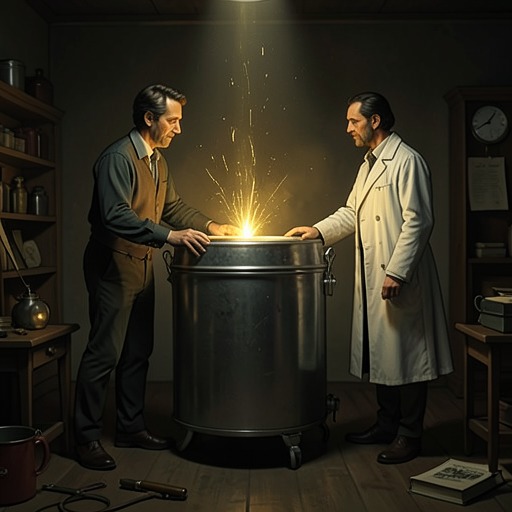
At the Thunder Hill Depository, the recovered memory gave Brendan a concrete answer to one question while leaving the larger meaning of his powers open. He remembered the golden light coming from two of the boxes and felt that it had exerted both an obvious and a subliminal attraction, compelling him to approach and place his hands on the rings. He had somehow understood that something beneath a lid was clinging to life—not for itself, but to pass on a gift. When he put his hands against the conductive rings, the dying being gave him that gift and then died. Brendan had not understood what was inside him at the time, and before he could learn to use the power, he and the others were taken into custody.
The memory also clarified that healing could transmit the gift. Brendan told Ginger Weiss, Dominick Corvaisis, and Jack Twist that Emmy Halbourg and Winton Tolk had both acquired powers after he healed them in Chicago. What had first appeared as a private, bewildering ability had become a chain of transmission, rooted in the encounter at Thunder Hill and continuing through acts of care. The revelation establishes the gift's origin in a dying visitor's deliberate act, but does not make Brendan's questions about faith disappear: the source is no longer merely an unexplained dream or a theory of contamination, yet its spiritual significance remains for him to confront.
Faith, Humanity, and the Unresolved Encounter
Ginger Weiss offered a theological interpretation that did not depend on the visitors resembling humanity. She suspected that Brendan Cronin’s crisis of faith was connected to a buried memory of encountering a race so different and apparently superior that it had shaken his belief in humanity’s place in the Church’s teaching. In her view, being made in God’s image concerned the capacity for reason, compassion, love, and friendship, not physical likeness. She intended to tell Brendan that the encounter’s significance might lie in the visitors’ capacity to care, rather than in their appearance or advancement. Her argument gave his crisis a possible connection to the erased encounter, but it remained Ginger’s interpretation, not a certainty Brendan had reached.
Father Stefan Wycazik, too, came to see Brendan as the center of events that exceeded ordinary human explanation. He told a physician that he sensed a Presence behind what had happened, one concerned more with Brendan than with Winton Tolk, the officer whose life Brendan had first saved. Yet the cures did not settle Brendan’s religious status: when Winton wondered whether Father Cronin might be a saint, the question registered the visible wonder of the healing without resolving whether its source was divine, alien, or something else. Brendan’s story keeps those explanations in tension, making his care for others more certain than the meaning of the power that enables it.