Tom Horner
StrangersTom Horner, a lieutenant serving as Colonel Leland Falkirk’s aide-de-camp, is presented through the work of surveillance and security. He carries recordings of the Tranquility Motel witnesses’ conversations to Falkirk, reports the movements of those under observation, and accompanies the colonel into Thunder Hill’s protected interior. Rather than receiving an independent personal storyline, Horner gives the government operation a capable human face: controlled, observant, and closely integrated with the systems that constrain the witnesses’ choices.
Position and Bearing
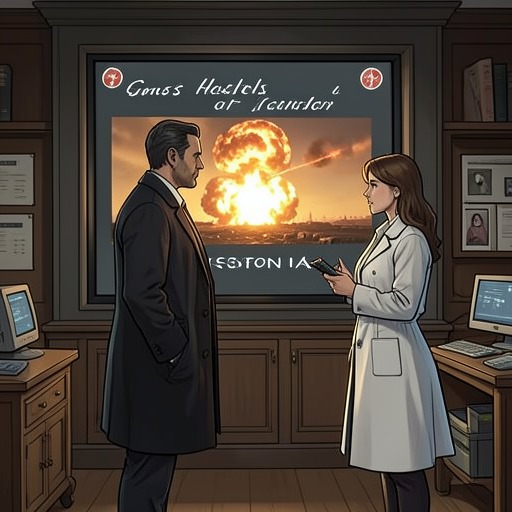
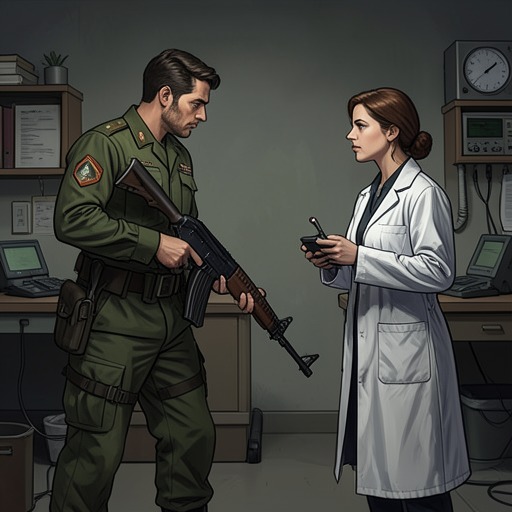
Horner’s formal place is clear: he is Falkirk’s aide-de-camp, a subordinate who brings information and developments directly to the colonel. His physical presence is memorable but not ornamental. He has enormous hands, yet handles a small tape recorder with remarkable dexterity, concealing it in his right hand before producing it, setting it on the desk, and switching it to playback. The contrast between his size and precision makes his competence visible in a compact gesture.
His voice is similarly controlled. When he identifies Jack Twist on the recording, he speaks in a soft rumble and offers Falkirk a measured assessment: Jack is known to be dangerous, but his immediate, warlike caution was more than the observers had expected. Horner’s manner contrasts with Falkirk’s anger at the witnesses’ progress. He conveys operational facts without matching the colonel’s agitation, helping establish the command relationship through tone as well as rank.
The Surveillance Operation
The recorder Horner brings contains a section of a conversation copied from the reel-to-reel machine used to record monitored telephone calls. It captures the witnesses discovering that Thunder Hill, rather than Shenkfield, is the source of their trouble, followed by Jack’s warning that their conversations may be overheard. Jack describes rifle microphones and an infinity transmitter that can open a telephone handset’s microphone without ringing the phone. Horner’s recording demonstrates that the threat is not hypothetical: the authorities have already captured the discussion that led the witnesses to change their plans.
Once the witnesses leave the motel office for the diner, Horner reports the limits of the operation as well as its reach. The group has removed the phones, and observers stationed south of I-80 have watched them move to the Grille, but those observers have failed to pick up the conversation with a rifle microphone. Horner relays this to Falkirk; the colonel recognizes that Jack understands the surveillance methods. The exchange makes Horner the channel through which Falkirk learns both what the operation has discovered and where it has been defeated.
Reporting and the Pursuit
Horner continues to monitor developments after Falkirk decides to postpone a move against the motel for the night. He comes to the colonel with news that the witnesses have finally left the diner. Jack has brought a Jeep Cherokee in from the hills behind the motel, and he, Jorja Monatella, and a priest have driven toward Elko. Horner’s report arrives at a consequential moment: Falkirk realizes that the three may have slipped away while he judged the witnesses settled for the night.
The episode shows the practical limits of a surveillance network that can record private conversations and place observers near a suspected route. It can deliver information, but it does not guarantee timely control of the people being watched. Horner supplies the report; Falkirk must interpret it and confront the possibility that his decision has cost him an opportunity. The distinction keeps Horner’s role specific: he is an efficient source of operational knowledge, not the commander who makes the final choice.
Access to Thunder Hill
Horner’s association with the surveillance apparatus extends to Thunder Hill’s own security. When he accompanies Falkirk toward an inner door, ceiling cameras track them. VIGILANT, the installation’s security computer, compares their appearances with stored holographic images, matching forty-two facial points. Had either man been an impostor or unauthorized visitor, the system would have sounded an alarm and filled the entrance tunnel with sedative gas. The inner door has no keypad; entry depends on a biometric scan, and Falkirk presents his left hand to the glass panel.
The security sequence places Horner inside the very system whose reach he helps extend beyond the base. At the motel, surveillance relies on monitored telephones and observers trying to listen from a distance; at Thunder Hill, cameras, stored identity images, and biometric access controls protect the installation itself. Horner appears on the authorized side of those defenses, accompanying Falkirk through a facility designed to resist infiltration and electronic interference.
Narrative Function
Horner’s characterization accumulates through procedural detail: the hidden recorder, the careful playback, his restrained voice, and his reports about the witnesses’ changing location. These actions make him more than a name in Falkirk’s chain of command, while the evidence does not supply a separate history or private motive. His importance lies in the narrative’s changing balance of knowledge. He helps Falkirk hear what the witnesses have said, but Jack’s warning prompts them to unplug the phones and move to a place the observers cannot monitor successfully.
That reversal sharpens Horner’s function in the pursuit. He is competent within an extensive apparatus, yet the witnesses’ awareness changes the conditions under which it operates. His reports keep Falkirk informed, but they also disclose a widening gap between watching people and controlling their movements. Through Horner, surveillance becomes a concrete sequence of devices, recordings, failed listening, and delayed news—and a contest in which the people being observed can still adapt.