Leland Falkirk
StrangersLeland Falkirk is the Army colonel whose effort to contain the Thunder Hill crisis turns a government cover-up into a campaign of escalating violence. A disciplined officer charged with managing the military response, he tries to control both what the public can learn and what he believes may be an existential threat. As unexplained phenomena intensify his fear, he comes to regard other people as possible carriers of an enemy influence, and his final attempt to destroy Thunder Hill ends with his own death.
Identity and Introduction
Falkirk first enters the story through the aftermath of the poisoning of detainees. While Dom is being treated, two men in decontamination suits discuss the incident within his hearing. They suspect Falkirk ordered the poisoning, but also acknowledge that they cannot prove it. Their exchange introduces him as a powerful and feared officer before the narrative shows him directly, and establishes a pattern that will define his role: decisions made under his authority are surrounded by secrecy, distrust, and uncertainty about what can be demonstrated.
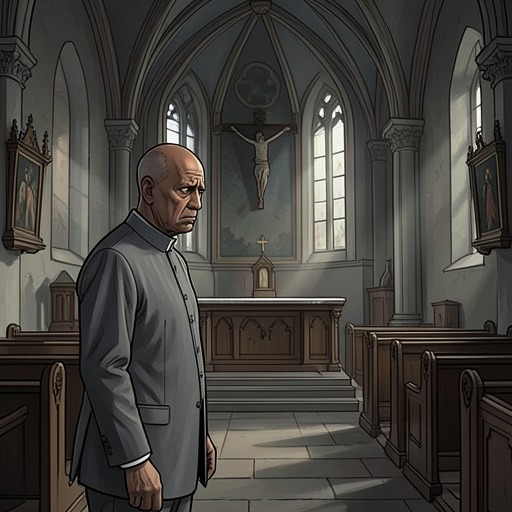
Other characters begin to recognize him through nightmares. Ned Sarver describes an Army officer who appeared in his dream as a man around fifty, with dark hair graying at the temples, gray eyes, a beakish nose, and thin lips. Ernie Block recalls another officer using Falkirk’s first name. When Dom and Ginger later examine the July 11 edition of the Elko Sentinel, they see Falkirk’s photograph and recognize the face from those descriptions. Dom also recognizes him from the summer two years earlier. The image makes a past encounter newly consequential: what had appeared in separate nightmares points toward the same real officer, whom Dom regards as formidable and frightening.
Command, Secrecy, and Suspicion
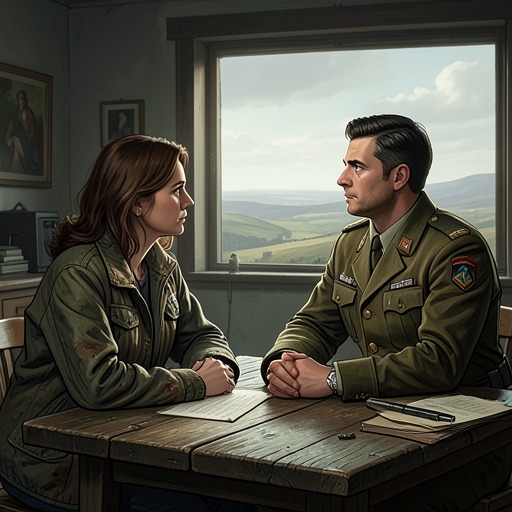
Falkirk is placed in charge of the military side of the operation. He accepts the assignment even when he considers it hopeless, but his authority does not make him feel secure. He keeps DERO personnel away from Thunder Hill because a visible deployment might attract the attention of nearby ranchers and invite questions about the Depository. Two summers earlier, he had used Shenkfield as a diversion; now he intends to remain there and use it again as a base for misleading the press and public. Shenkfield serves both as a position from which to manage information and as distance from a place he fears may no longer be safe.
His suspicion reaches into the Depository itself. Falkirk trusts neither its personnel nor the people connected to the crisis, and wonders whether those inside may have changed. He is also wary of its security staff. Major Fugata and Lieutenant Helms are said to be among the few who know what lies in the forbidden cavern, but the polygraph machines used to question staff prove unreliable. Falkirk rejects Fugata’s explanation that the replacement machine arrived damaged, treating the malfunction as evidence that the investigation is being obstructed. The search for a suspected traitor becomes, in his view, too slow; he wants the machine repaired and the supposed threat identified quickly.
The appearance of unusual powers sharpens this distrust rather than resolving it. Falkirk asks a doctor what to make of the miraculous cures associated with Brendan Cronin and Dominick Corvaisis and of other bizarre phenomena. He admits that he is frightened not only of the people at the Tranquility Motel but also of the doctor. The admission reveals a commander whose authority rests alongside profound uncertainty: he must decide whom to trust while believing that anyone, including those close to the operation, might be affected.
Delays and Escalation
Falkirk does not immediately order a move against the motel. He says that the situation in Chicago must first clear and that he needs answers about the psychic phenomena before risking his men. His delay reflects genuine caution about an unfamiliar danger, but it also leaves him trying to impose a military timetable on events he cannot understand. At Shenkfield, he postpones action for another day while waiting to learn whether the crisis at Calvin Sharkle’s house will be resolved. The pause does not lessen his determination; it gives his fears more time to harden into a theory of contamination.
He believes that public disclosure would interfere with efforts to protect humanity. When challenged, he argues that the stakes have gone beyond concealing news: if the government acts violently to contain what he calls an infection, politicians and members of the public may obstruct the response. In his reasoning, secrecy is no longer merely a way to preserve an earlier cover-up. It becomes a condition for waging a war against a threat he believes could destroy the human species.
After an unsuccessful conference call, Falkirk is left humiliated and furious. He does not want Lieutenant Tom Horner to know that he is about to act against General Maxwell D. Riddenhour’s orders. He nevertheless decides to close I-80 under the pretense of a toxic spill, isolate the Tranquility Motel, take its witnesses into custody, and transport them to the Thunder Hill Depository. There, with the witnesses and suspected personnel trapped underground behind blast doors, he plans to detonate two five-megaton backpack nuclear weapons. He understands that the action would kill him along with everyone else inside. His plan extends beyond the Depository: he also identifies the Tolk and Halbourg families and other surviving witnesses as possible remaining sources of contamination.
From Containment to Direct Violence
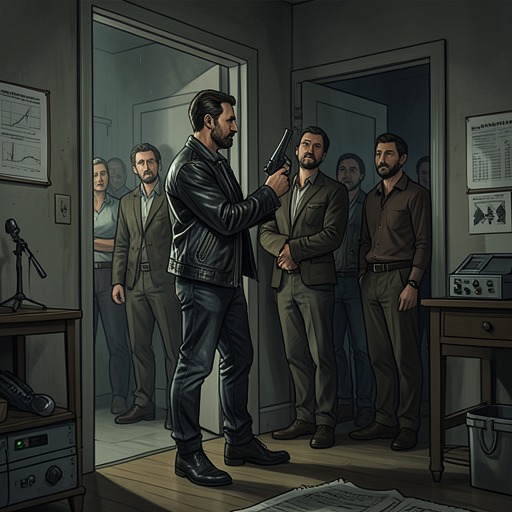
Falkirk’s suspicion becomes immediately dangerous on the road to Vista Valley. When a Jeep approaches, he orders one of his soldiers to fire without knowing who is inside. The soldier hesitates, judging the order out of line, but Falkirk presses him to obey by framing any approaching vehicle as a national-security threat. The scene shows how his authority works in practice: an assertion of danger is meant to make the identity and circumstances of the people in the vehicle irrelevant. Brendan is shocked by the order, while the soldier’s hesitation exposes a limit to Falkirk’s command.
Later, Falkirk confronts the group and draws a conclusion from the apparent limits of an individual’s power, directing that person to return to the others. His response shows that he reads even limits as useful information in assessing his imagined enemy. He increasingly interprets the witnesses’ apparent innocence as performance rather than evidence against his theory. In his view, they are possessed and pretending not to know what he believes they know. The possibility that he is mistaken does not loosen his conviction; it becomes, instead, another reason to distrust what he sees.
Final Confrontation and Narrative Significance
Falkirk’s private fears become clearer as he moves through Thunder Hill carrying a submachine gun. He intends to kill anyone who approaches and, if confronted by a larger group, to take his own life rather than allow himself to be changed. He connects this resolve to childhood and adolescence, when his parents tried to make him adopt their intense religious practices, including public displays of religious fervor and self-punishment. He says he resisted then and will resist now, presenting his identity and dignity as something he has spent his life defending. The history does not establish that the people around him are trying to change him; it explains why he experiences that prospect as a longstanding personal terror.
When he faces the group, he refuses to accept their claim to be human and accuses them of concealing possession. He tells them two backpack nuclear weapons are in place, one outside the door and the other in the main chamber, with less than three minutes before detonation. Even as he acknowledges that there may not be time for the feared transformation, he remains convinced that the threat is real and imminent. The witnesses ultimately prevent the catastrophe, but Falkirk does not return to negotiation or reconsideration. Insisting that he will not be changed, he kills himself before anyone can reach him or disarm him.
Falkirk’s arc gives the novel’s government response a human agent without making his suspicions into established fact. He begins as a name attached to an alleged poisoning and a face recovered from nightmares; later scenes show how secrecy, military obedience, and fear of the unknown converge in his decisions. His command of troops cannot give him command of what the phenomena mean. The final contrast is stark: he presents himself as defending human identity, yet his certainty that others have lost theirs drives him toward a plan that would destroy witnesses, colleagues, and himself.