24fps
Vineland24fps is a Berkeley-based guerrilla film collective that takes its name from the standard film rate of twenty-four frames per second. Its members travel toward unrest, record what official media leave out, and try to carry the resulting footage to safety. They understand the camera as a political weapon, but the collective’s history tests that belief: footage can bear witness and preserve evidence, yet it cannot by itself stop violence, and its images and archives can be appropriated or destroyed.
Origins, Equipment, and Working Method
24fps takes over what remains of the Berkeley-based Kollettivo Cinematografico Nichilista “Morte ai Porci.” The earlier group leaves behind an unusually practical inheritance: cameras, floodlights, an editing table, a hydraulic camera mount, and a refrigerator stocked with film. A handful of its most committed members also carry parts of its manifesto into the new collective. That inheritance gives 24fps both a technical foundation and an uncompromising political metaphor: the camera is treated as a gun, and assembled images as a kind of judgment on those in power. The metaphor is inflammatory even within the group; members dispute its language and its comparison of political targets to pigs.
The collective works on the road as well as in the editing room. Its loosely coordinated convoy includes ordinary sedans, vans, an Econoline equipment truck, and a battered but fast Sting Ray used as a scout car. The vehicles keep in touch by CB radio. The crew goes looking for trouble, records disorder when it finds it, and rushes its documentaries and testimony to a safer place. Close-ups are central to its method. The members believe that power leaves evidence in human faces: a filmed expression can expose the people and institutions behind official assurances and political rhetoric. For 24fps, the close-up is not decorative; it is a way of making evasion visible.
Division of Labor and Political Witness
The work is collective, but its members take distinct roles. Frenesi Gates is closely associated with the camera and with filming demonstrations and political encounters. DL, responsible for security, tends to stay away from the lens. She manages schedules, keeps film available, scouts meeting points and escape routes, and keeps a metal bar under the car seat. If the crew is pursued, she stays behind to slow its pursuers. This practical labor is the less visible counterpart to the images that Frenesi makes: the collective’s ability to document an event depends on someone planning how the crew will get out alive.
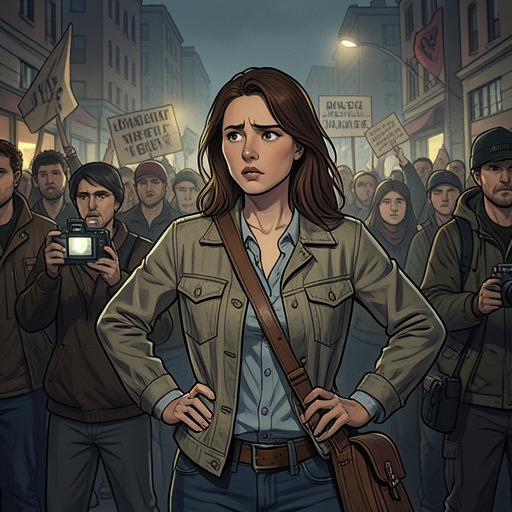
The group’s purpose is to document events neglected or misrepresented by established broadcasters. During the Berkeley protest, Frenesi films a paramilitary formation advancing along Telegraph Avenue. When the reel runs out, she finds herself trapped between police and demonstrators, with shuttered shops and no nearby side street through which to escape. DL arrives on a red-and-silver Czechoslovak motorcycle and carries Frenesi, her camera, and her bag of reels out of the danger. The episode shows how filming can place a witness directly inside the confrontation, and how the collective’s record-making relies on people willing to take risks beyond the camera’s frame.
At the College of the Surf in Trasero County, those risks become more severe. The campus, where the collective has gone to document a crisis, is sealed off; retreat routes are blocked, telephones cut, and the news media kept at a distance. After the final offer to surrender, 24fps has exclusive access to the unfolding events, provided anyone survives to get the film out. The group’s presence turns a dangerous political confrontation into a possible record for viewers beyond the campus, but exclusivity is no protection against the danger it documents.
The Rock and Roll Republic and Compromised Access
The collective arrives at the College of the Surf the day after students declare the Rock and Roll Republic, or PR3, independent. The declaration follows the discovery that the college was a real-estate venture disguised as a public educational gift, with plans to develop its coast after five years. Students conclude that the state and the courts will not provide a fair remedy and proclaim a break with California. Helicopters already circle the campus, while the 16mm Arriflex on its Tyler mount represents the most advanced aerial-surveillance technology Frenesi knows. On the ground, she and her Scoopic are among the forces recording the new republic.
The collective’s ideals become entangled with Brock Vond. Frenesi gives him copies of everything she films, telling herself that the footage is intended for everyone and that he is entitled to see it like any other viewer. At first he pays only her laboratory expenses. Then he begins suggesting what she should film. The change is consequential: the person receiving the record becomes a participant in shaping what the camera records, and Vond gains influence over Frenesi’s life through a seemingly defensible exchange. The films’ political value does not guarantee that their use remains under the filmmakers’ control.
As the republic approaches its end, 24fps continues documenting the crisis. Frenesi and the crew make a recording of Weed Atman at Rex Snuvvle’s house, with Ditzah Pisk Feldman filming close-ups and Howie handling the lights and camera. The audio survives even when the crucial action does not appear clearly on film. In the recording, Rex accuses Frenesi of betrayal; a door opens and closes, footsteps and a vehicle are heard, and a gunshot follows. When the crew reaches Weed, he is lying dead on the pavement. The camera later records Rex posing with his pistol. This material is not an uncomplicated triumph of documentary method: the recording preserves traces of the killing, while the missing visual moment and Frenesi’s presence implicate the collective’s own work in a betrayal its camera can show but cannot undo.
The collective also films the final hours of PR3. The end comes not as one decisive assault but as scattered violence through a night of darkness and fog, with electricity and water cut, buildings and cars burning, and tear gas and gunfire appearing in different places. The crew scavenges sensitive 7242 film from the college’s film department, opens its lenses as wide as possible, and lights scenes with whatever lamps it can use. The low light compromises depth of field, but the camera keeps facing events that threaten to overwhelm the people operating it. Their footage records a republic breaking apart in fragments rather than as a single, easily summarized battle.
Fragmentation, Surveillance, and the Archive
After the campus crisis, DL returns to Berkeley with Howie and Sledge Poteet. They discover that they are more or less all that remains of 24fps. DL is disoriented, her hearing persistently ringing and her vision intermittently blurred. It takes time to learn where Frenesi has gone; people have seen her leave with a convoy, but those who try to follow lose their way among back roads and prohibited turns. The collective’s dispersal is also an informational problem: its members cannot readily locate one another or establish what has happened to their missing colleague.
The group’s surviving archive gives later access to its history. Prairie Wheeler encounters a dossier on Frenesi assembled from years of records gathered from different sources: official documents and FBI memoranda sit beside underground newspaper clippings, radio interviews, and a large body of material connected to 24fps. She can also call up photographs of Frenesi filming demonstrations and standing beside movement figures. The dossier makes the collective visible across time, but it is no neutral account: its contents have been accumulated haphazardly, and official surveillance records coexist with the group’s own images and testimony.
Years later, members of the old collective learn that several people have disappeared from computer records or become unreachable. Ditzah worries about the security of the 24fps archive, and DL finds a crude listening device in Ditzah’s editing room after using a radio to search the house. Their suspicion that surveillance may be expanding is bound to the collective’s earlier experience of records being collected, followed, and used by others. When DL and Takeshi return to Ditzah’s neighborhood, they find the house surrounded and the archive burning outside. Film reels, plastic spools, and bundles of papers are consumed together; workers sweep surviving scraps back into the flames. The destruction makes literal what the collective’s history has repeatedly suggested: testimony can outlast an event only if its material record survives.
Legacy and Limits
The collective’s members eventually scatter. Krishna follows a voice into darkness; Mirage returns to Arkansas and gives away her astronomy books and astrological materials; Zipi and Ditzah join an anarchist commune in Oregon. In a later conversation, Frenesi tells DL that the cameras had seemed to the crew like cannons, while the members were behaving like children at war with toy weapons. Her judgment does not erase the value of what they filmed; it marks the gap between making evidence and possessing the power to change what it records.
That gap defines 24fps. Its crews take risks to record repression and preserve images that official media may ignore, and their documentary practice gives later generations access to the faces, voices, and fragments of events otherwise liable to disappear. Yet the collective cannot command the uses of its footage, guarantee that every decisive act will enter the frame, or protect its archive from surveillance and arson. Its cameras are weapons only in a limited sense: they can expose, remember, and accuse, but they cannot make the filmed world answer to the image.