Takeshi Fumimota
VinelandTakeshi Fumimota is an insurance-company professional turned itinerant karmic fixer whose life binds corporate intrigue, a brush with death, and an improvised practice of repair. He longs to escape the organization that employs him, yet repeatedly finds himself entangled in its business and the consequences of other people’s injuries. His iridescent card, passed from hand to hand as a karmic IOU, distills that paradox: debts persist, but they can also be acknowledged and repaid.
Corporate Life and the Wish for Freedom
For years Takeshi remains within the corporate embrace of Wawazume Vita & Non-Vita, moving through Tokyo on business. The company represents a settled life he has long wanted to leave behind. His private ideal is to become a ronin, a samurai without a master: not simply to change jobs, but to be free of the obligations and loyalties that make a person answerable to an institution.
That desire for independence does not make him an uncomplicated outsider. Takeshi continues to travel for work, and his assignments draw him into situations that exceed ordinary corporate business. In one such case, he stands at the edge of a giant animal footprint where a Chipco research laboratory had stood the day before. The building has been destroyed so completely that the loss is described as a total insurance claim; there are no casualties because the destruction coincides with an evacuation drill. The timing is conspicuous, but the surviving account leaves the mystery unresolved. Takeshi is positioned at the boundary between routine insurance work and a world in which the facts themselves seem engineered.
The Card and Zoyd’s Flight
The card that later reaches Prairie originates years earlier, during the final, turbulent period of Zoyd Wheeler’s marriage. Zoyd has flown across the Pacific in a desperate attempt to repair the relationship, an effort that he understands as reconciliation and his wife understands as another intrusion into her life. By chance, he has taken a job playing keyboards aboard a Kahuna Airlines Hawaiian cruise flight departing from Los Angeles.
During the flight, masked soldiers move methodically among passengers who are drinking, unconscious, or sick. A disguised, apparently hippie-styled man joins Zoyd at the keyboard, wearing a blond wig, a flowered outfit, plastic leis, dark pilot’s glasses, and a straw hat, and carrying an old banjo-ukulele. Zoyd recognizes him as Takeshi. As the soldiers search for someone else, Zoyd notices that they react whenever he strikes a particular B-flat chord, reaching for their radio headsets. He repeats the note until the intruders withdraw, confused. The episode gives the encounter the shape of a rescue without explaining all its mechanics: Zoyd later understands that the strange musician has saved his life, while Takeshi’s own role remains wrapped in disguise and improbable circumstance.
Takeshi produces an iridescent plastic business card whose colors shift in response to stimuli that may not be perceptible to everyone. Its appearance makes it seem less like ordinary contact information than an amulet. Zoyd receives it in exchange for a favor. He tries calling out to the man afterward, but gets no answer; the card instead passes through pockets, wallets, envelopes, drawers, and boxes, surviving years of parties, drug-induced lapses, laundries, and Northern California winters.
When Zoyd fears he may never see his daughter again, he remembers exactly where the card is and gives it to Prairie, as though she should be its future custodian. Later, DL asks Prairie whether she has an old Takeshi Fumimota card. DL explains that Takeshi calls such objects giri chits, or karmic IOUs: he may speak grandly of a world monetary system based on them, but he honors one when it is presented. The card therefore links Zoyd’s old, chaotic encounter to the work Takeshi and DL now undertake, and turns a keepsake into a usable claim.
Tokyo, Minoru, and the Unsettling Return
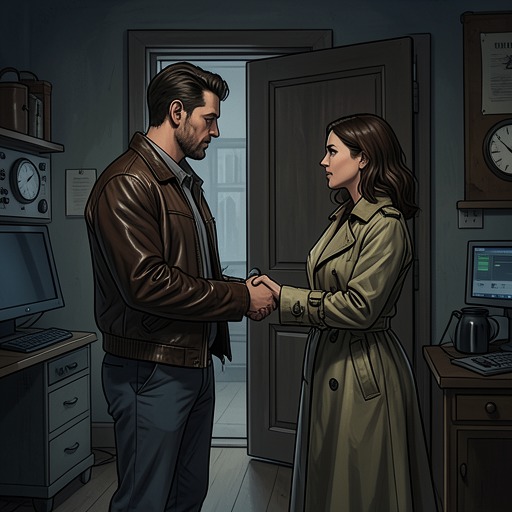
Takeshi’s Tokyo story also places him in contact with Minoru, a longtime work partner who can move through official and international networks. In 1978, Minoru urgently pulls Takeshi toward a meeting at the Hilton International in Shinjuku. A symposium there brings together judges, American district attorneys, Interpol officials, and other travelers. Minoru believes he can find people who know about the case he is handling and may even obtain a copy of a purchase contract bearing the buyer’s address. Takeshi appears reluctant to go: he keeps a hand on the taxi door handle, yet forgets to jump out whenever the cab slows. Minoru’s urgency and Takeshi’s hesitation make their partnership a practical alliance under strain, not a simple pairing of equal enthusiasm.
At Haru no Depaato, Takeshi inserts a plastic card into a slot. The machine draws it in, makes a sound he experiences as a groan, checks it electronically, and returns it. Beyond the entrance, he finds an unexpectedly empty place, then hears voices and moves toward a gathering of women. The scene leaves the nature of the encounter uncertain, but it marks a rupture in his ordinary understanding of events. The next morning, when he tries to contact Minoru through the Subministry of Counterterrorism, officials stall him and imply that the person he knows no longer exists in the form he remembers. Subsequent calls are left on hold. The institutional language of disappearance echoes Takeshi’s own wish to escape corporate life, but here erasure is imposed from outside rather than freely chosen.
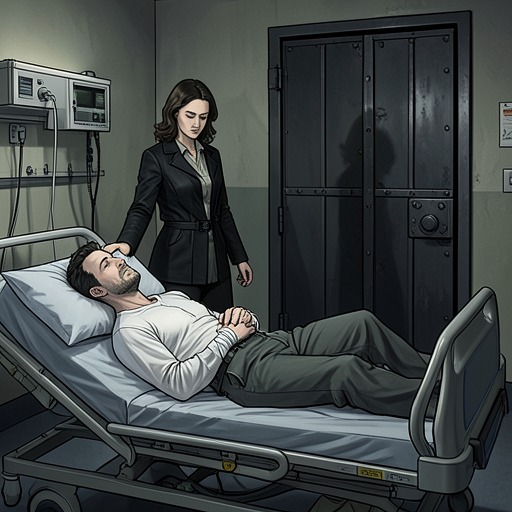
When Takeshi reaches the Ritiro delle Ninjette, DL recognizes him as the man she recently killed. Sister Rochelle intervenes before their meeting can turn into another confrontation. She orders DL, under threat of severe penalties, to serve as Takeshi’s devoted henchwoman and work off the grave wrong she has done him. The order makes their partnership an enforced settlement: Takeshi is present after being killed, DL is assigned responsibility, and their future work is cast as an attempt to balance an account that neither can simply forget.
Building a Practice of Karmic Repair
An unexpected stop by Shade Creek, later recalled to Prairie, becomes the beginning of Takeshi and DL’s karmic-repair business. The surrounding Thanatoid population offers an abundance of clients, although many cannot pay much because heirs and assignees have taken or control the resources that might otherwise cover their claims. The practice thus begins with an irony: there is no shortage of people in need of redress, but the injured often have little power to purchase it.
As the Chipco laboratory case becomes less urgent, Takeshi and DL take on increasingly complicated disputes involving land and water rights, gangs and extortionists, vigilantes, landlords, lawyers, and property speculators. Their work shifts from one mystery to a broad engagement with historical and continuing injustice. In a later consultation space, an open clinic is advertised as free and available without appointments. Takeshi, in a suit and tie, and DL, in a silk martial-arts uniform, sit before a large map of Vineland County with a portable blackboard, coffee maker, microphone, and amplifier. They listen, record, question, and take notes. The arrangement is part office, part public hearing: karmic repair depends not on a private revelation but on hearing people describe what has been done to them.
Takeshi also turns the practice toward technology. A long-prepared scheme involving sound chips, developed amid obscure commercial battles and in agreement with the import-export company Tokkata & Fuji, culminates in synchronized devices playing the opening of Bach’s Wachet Auf. The music reaches watches, clocks, and personal computers around Shade Creek and Thanatoid Village, awakening the Thanatoids. The episode connects Takeshi’s commercial and technical ingenuity to a collective consequence: what began as a hidden arrangement in the marketplace becomes a sound shared across an entire community.
Raids, Compulsion, and the Limits of Repair
The practice operates amid surveillance and political violence. After Takeshi and DL visit what remains of Ditzah Pisk’s house, Prairie finds their office overturned. On the way there, the partners have noticed a formation of neutral-colored Chevrolet sedans carrying men with matching features and exempt license plates; in Ditzah’s neighborhood they encounter a roadblock. The danger around them is not abstract. It travels in coordinated vehicles, arrives at a particular address, and leaves the archive’s security fears vindicated.
Takeshi’s ability to organize karmic work does not mean he is free of unresolved debts himself. The practice has been computerized, making its accumulated business easier to handle, but the account also recognizes the danger of becoming fixed on one injury and on those who have escaped punishment. Remembering is not the same as forgiving; a debt can remain active even after the person who owes it has moved on. That tension shadows the method Takeshi helps build: accounting may enable repair, but it can also sustain obsession.
His own habits show a less orderly side. During a period when he is using more shabu than usual, Takeshi and DL raid a chicken farm so he can steal feed containing amphetamines. His pocket telephone begins to buzz; two thousand chickens erupt in noise, the alarm sounds, and the pair flee without the intended prize. They return to the Zero Inn, where a party is underway and the music is anything but slow. The episode punctures the image of Takeshi as a composed technician of karmic balances. He can design elaborate systems and still be caught in immediate appetite, improvisation, and comic failure.
At another point, Sister Rochelle confronts him while he is strapped onto the Macchina Puncutron and cannot escape. An inkjet printer travels over his exposed body, mapping trigger points in colors and numbered marks while an older nun takes notes and explains the apparatus to novice students. Rochelle uses the occasion to deliver one of her allegories, this time about hell. Takeshi’s body, usually the instrument through which he travels and works, has become a chart under someone else’s control. The scene reverses his role as an investigator and organizer: he is subjected to a system of measurement, while the lesson offered around him frames bodily vulnerability as a moral problem.
Takeshi’s trajectory does not resolve into the freedom of the masterless ronin he once imagined. Instead, he moves from corporate duty into a partnership founded on debt, then builds a practice that brings other people’s grievances into public view while remaining vulnerable to institutional violence, addiction, and unfinished injury. The giri chit is the clearest emblem of that unsettled life. It survives its first owners, travels through years of disorder, and can still be honored; but its promise is not that every debt disappears. It is that a claim, once carried forward, may yet find someone willing to answer it.