Isaiah Due Quattro
VinelandIsaiah Due Quattro is Prairie Wheeler’s boyfriend, a green-Mohawked drummer, and a fast-talking entrepreneur whose plans repeatedly turn violence into a marketable attraction. He offers practical loyalty to Prairie and Zoyd Wheeler, but his schemes also reveal the book’s uneasy overlap between rebellion, entertainment, and commerce: he can imagine both a family amusement center built around simulated combat and a practical supply of weapons for recovering Zoyd’s home.
Identity and Introduction
Prairie explains that Isaiah’s name comes from a biblical verse about turning war into peace, a pacifist choice made by his hippie parents, friends of Zoyd Wheeler, in 1967. The name’s inheritance is pointedly at odds with the young man’s interest in weapons and violent entertainments. Prairie also reports that Zoyd has recently heard comments about her weight from Big I, a nickname that makes him sound like an authority even as the scene presents his opinions as part of the couple’s everyday banter.
When he arrives to meet Zoyd, Isaiah’s long Mohawk is painted acid green, with magenta tips: the colors Zoyd favors, and colors Prairie has used for gifts to her father. Zoyd wonders whether she has chosen them to ingratiate herself with him. Isaiah greets Zoyd with unusual formality, calling him Mister Wheeler rather than the insults they traded at their previous meeting, when a disagreement over music escalated into a broad assault on one another’s values. The shift does not erase their antagonism; it gives their relationship a new, deliberately polite surface.
Isaiah’s presence is physical and theatrical. He approaches Zoyd with the rough, familiar gestures of a veteran, though Zoyd has not served in Vietnam, and hums Jimi Hendrix’s Purple Haze before speaking. His manner makes friendship feel like a performance that must be continually improvised. Yet behind the bluster, he can be attentive to other people’s limits, and his practical interventions become important as the plot moves from talk to danger.
Business Schemes and the Market for Violence
At Prairie’s gathering, Isaiah pitches Zoyd a proposed chain of violence centers, beginning with a single site designed like a small amusement park. The plan combines a firearms range, paramilitary simulations, gift shops, food service, and video-game rooms for children; standardized facilities and trademarks would allow the business to expand through licensing. Violence is not presented as an aberration to be hidden from family life but as the centerpiece of a family-oriented commercial outing.
His proposed attractions make the scheme’s logic explicit. One would send customers through a tropical war course, where they would swing from ropes, fall into pools, and fire at figures made to appear as indigenous guerrillas. Another would let visitors shoot multiracial representations of people cast as urban nuisances, staged among dark alleys, shabby clubs, neon signs, and pop music. A third would place hated celebrities on old televisions moving along a conveyor belt, letting customers fire at the screens as the sets’ tubes burst. The range of targets and settings turns aggression into a packaged experience, with the careful diversity of the targets serving as a cynical form of market protection rather than a rejection of violence.
Isaiah overwhelms Zoyd with projected profits until Zoyd realizes he has been listening open-mouthed. The proposal appears to require little money from him, but its financing would depend on Zoyd endorsing promissory notes. When Zoyd asks who will provide the loan, Isaiah says the Bank of Vineland will. In return, Zoyd would receive the contracts for construction and fitting out the centers. The offer ties Isaiah’s entrepreneurial confidence to Zoyd’s labor and credit, making the pitch both an opportunity and a financial risk. The scheme is presented as a proposal, not as a business that has already been built.
Music, Performance, and Improvised Rescue
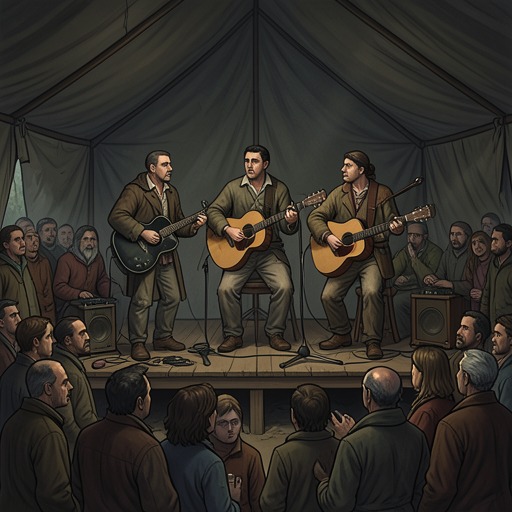
Isaiah also plays percussion in the local band Billy Barf and the Vomitones, which has been struggling to find engagements. Zoyd points him toward Ralph Wayvone junior, whose sister’s wedding is only days away and whose booked band has abruptly canceled. The recommendation gives the group a job and sends Isaiah, Prairie, and the other musicians into a world where their stage identities and appearances will be tested against the expectations of an exclusive wedding venue.
At the estate, the band’s members and their companions disguise themselves with borrowed wigs, clothes, and makeup. Billy Barf considers adopting a fake Neapolitan accent, but Isaiah takes him aside because the imitation is inauthentic and risks ethnic insult. The intervention distinguishes Isaiah’s showmanship from simple carelessness: he can recognize when a performance crosses into mockery and quietly redirect a friend before it becomes part of the act.
A confrontation with a large security man brings another side of his improvisational skill into view. When Billy Barf is left choking because he has forgotten the quick-release clips on his guitar strap, Isaiah frees him, giving him room to stagger back and breathe. He then reframes the crisis as a relatively minor misfortune rather than the catastrophe the security man expects, pointing to the bruises and the likely complications for Billy’s music career and personal life. The man admits he had been preparing for a shootout. Isaiah’s talk defuses a situation that other members of the band are ready to answer with guns, knives, or threats. When Billy asks Isaiah to help him leave, Isaiah reminds him that the guests liked Volare: he thinks in terms of the performance and the job even while his friend is frightened.
Prairie’s Protection and the Road Ahead
When Hector Zuñiga is taken away in the padded van of the television-disintoxication unit, Isaiah and the other Vomitones arrive. After Zoyd and Prairie explain what has happened, Isaiah asks whether Prairie might travel with the band for a while, to get a change of air. Zoyd warns him that the musicians can be like the armed forces and asks whether he will accept responsibility for her. Isaiah answers quietly that he will protect her. The promise is made in the middle of a chaotic departure, but it establishes a personal obligation that later shapes his choices.
The band’s wedding engagement brings Prairie into contact with DL. When Prairie says she must trust DL, Isaiah is the person she proposes introducing. He is on the band’s bus, preparing for a long night’s overtime, when he shares the news that Ralph Wayvone junior has hired them to play at the Cucumber Lounge, possibly as its regular band. The better prospect gives Isaiah a reason to return to Vineland, but he does not simply assume Prairie will come with him. He puts a hand on her shoulder and asks whether she is leaving with them.
Prairie explains that she must remain with DL and that the amulet her father gave her has led her to a Japanese man who is supposed to help her. Isaiah hesitates because he had promised Zoyd to protect her. Prairie reassures him that DL is trustworthy and tells him to explain the amulet to her father. She also points out that staying near the band could bring trouble: their bus has already been reported at checkpoints. Isaiah accepts Prairie’s account and her judgment of DL. Later, as Prairie rides with DL, she asks Isaiah to tell her father what happened; DL offers to watch the house with her if she wishes. Isaiah’s protective promise therefore does not become a claim over Prairie’s decisions. It becomes a responsibility he has to reconcile with her choice to continue on a different route.
Weapons, Politics, and Narrative Role
Much later, during an interval in the band’s performance, Isaiah joins Zoyd and Van Meter on Van Meter’s porch. Zoyd explains that Van Meter has recruited men and that they need something for the men to use, preferably something capable of automatic fire. Isaiah says he knows of a batch of .22-caliber AK rifles, can ask about the price, and notes that they would have to be collected in Contra Costa and modified. Van Meter replies that the Ordine Harleyita are headquartered in Walnut Creek, so reaching them would pose no problem. Isaiah is thus drawn into a plan to help Zoyd recover his confiscated house, this time not through a business loan but through the logistics of weapons and allies.
The proposed deal falters. Isaiah later reports that the firearms arrangement is going nowhere, and says it may not be a great loss: after appearing on Phil Donahue’s television program, the Ordine Harleyita have received offers to endorse products and appear in television shows and miniseries. Their new celebrity has made them consider themselves too important to spend time helping Zoyd recover his home. Isaiah’s report links the failed plan to a broader political disappointment. The people who might have supported Zoyd have been drawn toward commercial visibility instead.
Isaiah makes the generational criticism explicit. He argues that Zoyd’s generation believed in its revolution and was willing to risk its life for it, but failed to understand television. Once television took hold of them, he says, they were finished; like the Indigenous people he invokes, they sold their alternative America to their real enemies for very little. Zoyd answers that his reserve plan is to take the case to 60 Minutes or a similar program. Isaiah warns that if the truth about Holytail emerges, anyone who looks like a figure in the drug world could end up in court. His warning complicates his critique: television is both the medium that absorbs dissent and a possible instrument in Zoyd’s strategy, while exposure itself carries risk.
Isaiah’s arc is not a conversion away from violence or commerce. The surviving episodes instead place him between competing forms of performance: the violent attractions he hopes to sell, the music and disguises through which his band finds work, the promise he makes to protect Prairie, and the televised fame that diverts potential allies from Zoyd. His most revealing contrast is between his own inventive fluency in spectacle and his recognition that spectacle can capture a political generation. He sees the trap clearly, even as his plans repeatedly work within the same world of weapons, audiences, branding, and attention.