Professor Wawazume
VinelandProfessor Wawazume is an insurance executive, Takeshi Fumimota’s former employer and mentor, and a continuing source of commissions after Takeshi becomes independent. His importance lies in the uneasy overlap between commercial procedure and unexplained events: he helped write Chipco’s insurance policy, relays technical findings about the footprint left where its laboratory stood, and urges a tactic that may put Takeshi in danger. The relationship joins practical dependence to mistrust, with the Professor’s eccentricity never quite separating from the possibility of compromised business interests.
Identity and Professional Position
Professor Wawazume leads Wawazume Vita & Non-Vita, an insurer whose business connects him to international corporate affairs. The title Professor accompanies his position in the company and his role as Takeshi’s mentor; the account does not establish that he is an academic. When Takeshi leaves the company to work for himself, the Professor continues to send him a substantial amount of work. Their professional tie therefore persists beyond the formal employment relationship: Takeshi has gained the freedom to operate without the company badge, but remains economically connected to his former employer.
The details of Takeshi’s new life make that independence concrete. He rents a cramped room on the outskirts of Ueno, shares the rent with others, and keeps only a locked filing cabinet, a telephone, and a framed photograph the Professor gave him when he left the firm. The photograph shows the Professor outside a Shinjuku bar, staring at a famous woman in gold lamé, enlarged in a paparazzi image that catches him looking conspicuously foolish. It is an affectionate but undignified keepsake, and a reminder that the former employer remains present in Takeshi’s private working space even after the company’s insignia has been put aside.
The Chipco Footprint and the Insurance Policy
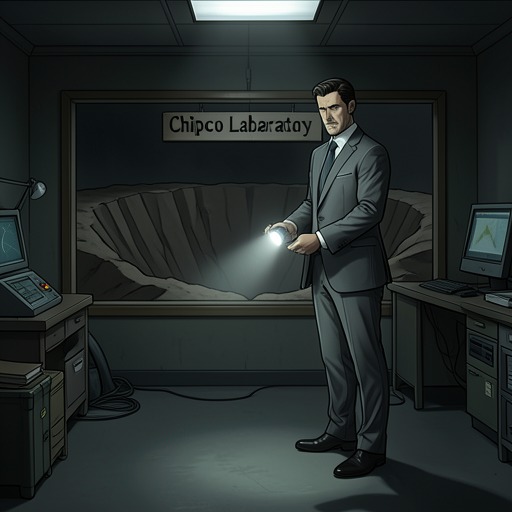
The Professor’s business becomes central to Takeshi’s investigation of the destroyed Chipco laboratory. The building has been replaced by an enormous footprint-shaped crater; the loss occurred during an evacuation drill, and no one was killed. The Professor points out that Chipco had recently added a policy clause covering damage caused by animals of any species. That language gives the company a possible insurance explanation for a fantastic event: a huge creature could have emerged from the sea, stepped ashore, and crushed the laboratory, with the retreating tide erasing other tracks.
The Professor’s role is more consequential than that of a distant adviser. When Takeshi and Minoru compare the destruction with an earlier Himalayan incident, they establish that the Professor himself drafted the policy, as in that earlier case. This recurring connection makes the insurance paperwork part of the mystery rather than neutral background. The men consider the possibility that Chipco is deeply involved in a much larger struggle and that the Professor might be receiving a kickback. The possibility remains speculation, not a confirmed finding: the evidence implicates the structure of the transactions and raises suspicion about the Professor without proving that he took money or arranged the destruction.
The insurance explanation also competes with other possibilities. The footprint could be a fabricated professional job, perhaps involving special-effects makers, explosives experts, Vietnam veterans, or a faction of the Japanese organized crime network. Takeshi judges the work sophisticated enough to require an artificial foot measuring 20,000 centimeters from heel to claw tip. The Professor’s clause appears to anticipate just such an animal claim, but the coincidence does not resolve whether the footprint is an actual creature, a staged event, or a device in a corporate scheme.
Advice, Intelligence, and Risk
During a later telephone call from Your Mama Eats, the Professor informs Takeshi that Minoru, the explosives expert, has disappeared and has not returned to work. Takeshi recognizes that Minoru knew something important and regrets not finding out what it was. The Professor responds with an apparently playful proposal: Takeshi should spread the word that Minoru told him everything shortly before vanishing. Takeshi immediately understands the consequence. Whoever made Minoru disappear may now come after him. The advice offers a way to draw out the hidden actors, but transfers danger from the missing colleague to Takeshi; the Professor treats that danger as an advantage in the plan.
The same call brings a technical report from the company’s laboratory. Working around the clock, its programmers have applied a standardized reflexology analysis to electromagnetic traces left across the muddy footprint. Their method treats the soles of the feet as a map of the body’s principal nerves and organs. Although rain erased some traces, enough remained to produce a snapshot of activity in the creature’s major organs, including its brain, at the instant the footprint was made. The report finds the pattern consistent with a saurian creature about one hundred meters tall. This remains an interpretation of traces rather than proof of what made them, but it pushes the case beyond ordinary property damage and into the fantastic.
The Professor also begins to relay an unexplained change in Chipco’s Tokyo stock performance. His warning is cut off when Takeshi’s low-cost communications satellite drifts below the horizon in the middle of their conversation. The abrupt loss leaves the information incomplete: the Professor has alerted Takeshi that the company’s market behavior has become strange, but the reason and the evidence behind his warning are not disclosed. His ability to provide intelligence is real, yet the conversation repeatedly leaves Takeshi with fragments rather than a settled account.
A Mentor in an Uncertain System
The Professor’s connection to the Himalayan incident sharpens the sense that he operates inside a long-running contest whose scale exceeds Takeshi and Minoru. The earlier episode involved an attack on inanimate objects, Czech-made Semtex, and what the men regard as a fictitious motive. Recalling it, they compare themselves to workers gathering spent brass after a firefight while a planetary struggle unfolds overhead, with power accumulating and lives losing value. They imagine that Chipco is implicated and that the Professor might benefit from it, but neither man can determine where the Professor stands in that struggle.
His character is therefore defined less by a revealed secret than by an unresolved double position. He is the former employer who still commissions Takeshi, the mentor who supplies leads, and the policy writer whose work may have helped create the terms of Chipco’s suspicious claim. His playful manner can accompany advice that exposes Takeshi to pursuit; his access to company analysis brings the investigation forward while his interrupted stock-market warning withholds its explanation. The result is a portrait of professional intimacy under pressure: Takeshi remains connected to the Professor through work, a personal keepsake, and shared investigations, but each connection also reminds him that independence has not placed him outside the corporate game.