Zoyd Wheeler
VinelandZoyd Wheeler is a marginal, improvisational father whose public antics make him visible to the authorities even as he tries to keep his family life beyond their reach. His annual window-smashing performance begins as a means of preserving his mental-disability benefit, but the spectacle becomes an opening for Brock Vond to threaten his home, his freedom, and his access to Prairie Wheeler. Zoyd’s comedy does not make him invulnerable: when the state turns his vulnerability into leverage, his deepest fear is separation from his daughter.
Identity and Introduction
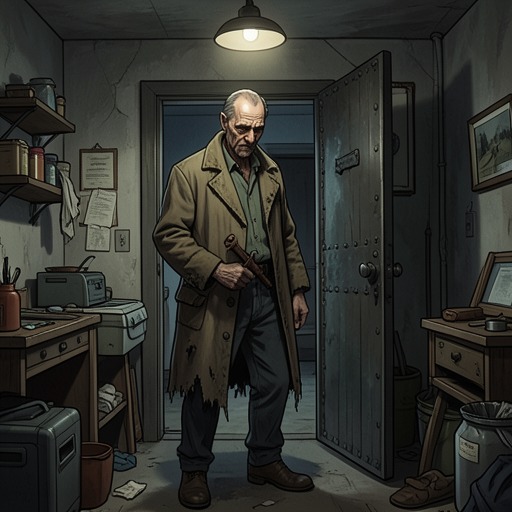
On a summer morning in 1984, Zoyd wakes late beneath the sunlight filtering through a climbing fig. In a dream, homing pigeons arrive with messages for him and depart before he can catch them; awake, he connects their elusiveness to a letter accompanying his latest mental-disability payment. Unless he performs a public act of madness within about a week, the letter warns, his benefit will be revoked. This administrative deadline is the immediate cause of his familiar public performance. His life is precarious not because he lacks resourcefulness, but because even his claim to support requires him to make himself legible as a spectacle.
The morning supplies a small inventory of his circumstances: construction tools sound on the hillside, country music comes from a car radio, and he has nothing left to smoke. On the kitchen table, beside an empty Count Chocula box, he finds a note from his daughter. The contrast between the impersonal demand from the benefits system and the ordinary traces of Prairie Wheeler’s presence establishes the two pressures that shape him: the need to satisfy official scrutiny and the work of caring for his child.
The Annual Performance
Zoyd prepares for the performance as a practical, if absurd, operation. At Vineland’s shopping center he buys a colorful evening dress from a secondhand women’s clothing shop, paying with a check that he and the cashier expect to bounce. At a service-station restroom he changes into the dress, works his hair into disorder, and practices a sufficiently deranged expression in the mirror. He also prepares a portable band saw, mixing some of the oil from a reserve can with gasoline for its tank. The costume and props make madness into a deliberately assembled public image, suited to the cameras and the authorities who must witness it.
When the moment comes, Zoyd checks his appearance, tosses his hair, and charges headfirst through a window. The impact feels strangely soft: there is no familiar crash of breaking glass, only a muted shattering. He then feints further charges at the cameras, making faces, while the police complete their paperwork. The apparent danger is a trick. Hector Zuñiga bites a jagged piece of the broken pane and chews it without injury; Zoyd recognizes the effect from a magazine account of windows made from transparent sugar. The young Ralph Wayvone has substituted the fake glass for real crystal, turning Zoyd’s supposedly reckless act into a managed illusion. Zoyd’s performance depends not only on his own theatrical skill but on other people’s stagecraft.
The aftermath also shows how the spectacle enters his domestic life. Zoyd waits to see himself on The Tube until Prairie Wheeler has finished watching a Clara Bow television drama. She admires his printed dress and asks to keep it for her futon when he no longer needs it. Her response converts his embarrassing public costume into a familiar household object: to the audience, he is the man crashing through a window; to his daughter, he is her father, and even the dress has a possible second life at home.
Fatherhood and Frenesi Gates
Zoyd’s past with Frenesi Gates is refracted through the stories he later tells Prairie Wheeler. Years afterward, Prairie asks whether a particular song made Frenesi fall in love with him at first sight. Zoyd answers that the song and his good looks did the work. Yet when their marriage was collapsing, he accused Frenesi of having been in search of cover, suggesting that he might have been interchangeable with another man. The affectionate anecdote and the bitter accusation remain side by side: Zoyd can give his daughter a romantic version of the beginning while remembering a relationship shaped by concealment and loss.
The larger history confirms how incomplete Zoyd’s knowledge of Frenesi’s past was. After participating in the setup of Weed Atman’s murder, Frenesi could not return to 24fps and had become part of the federal informant system. In the year after she left, she married Zoyd and gave birth to Prairie; Brock Vond knew nothing of either development, and Frenesi did not volunteer it when she and Brock met again. Zoyd later tried, by piecing together her history, to follow the trail back to Brock, Weed Atman, and Brock’s return. His account of the marriage therefore stands between two versions of Frenesi: the woman he remembers as his wife and the political past he gradually discovers.
His attachment to Prairie is made concrete in the crisis that follows. When Zoyd returns home with her from a walk to the pier at Gordita Beach, Hector Zuñiga is waiting beside an enormous block of marijuana. Zoyd first carries the sleeping child into the next room, placing her in her bassinet with a bottle and teddy bear, before returning to face the apparent setup. Later, as officers lead him away, it is the image of Prairie turning her comic little face away that breaks through his composure. In custody, he cries at the thought that the next day she will be at her grandmother’s house and may ask where her father is. The prospect of separation, rather than the spectacle of arrest itself, gives the scene its emotional weight.
Hector Zuñiga and Brock Vond
Hector Zuñiga has repeatedly tried to make Zoyd a police informant, returning with increasingly extravagant proposals. Zoyd has so far kept his record technically clean, though he suspects that one day he may give in simply to end the pressure. Their connection is therefore more than an adversarial pursuit: Hector knows Zoyd’s habits and vulnerabilities, and he can approach him through the domestic life he is trying to protect. At one point Hector tells him that he has spoken with Frenesi and that she is not doing well, bringing Zoyd’s absent wife back into their conversation without resolving what has happened to her.
Hector eventually explains that the force surrounding Zoyd’s home is not merely a group of local or drug-enforcement colleagues. It is a militarized Justice Department task force commanded by Brock Vond, the man who had taken Frenesi from him. The revelation changes Zoyd’s understanding of the raid: he had mistaken its agents for Hector’s professional allies, but Brock’s presence points toward the old history with Frenesi. Hector also tells him that proceedings have begun to confiscate his home and that the marijuana found there will be represented as vastly more than the small amount actually present. The huge block in the house makes the threat visible, while the inflated quantity supplies the pretext for converting an accusation into the loss of his home.
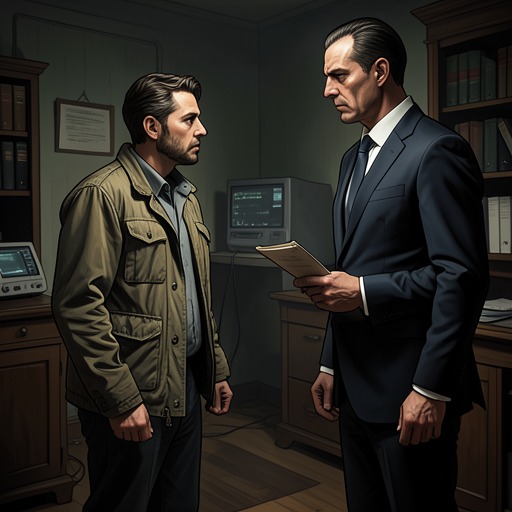
After Zoyd is arrested and processed, Brock appears in his cell and directs him to turn his head, show his profile, and move his upper lip. The examination reduces a personal crisis to an official inspection, but Zoyd quickly understands that Brock is after Prairie. Brock stresses that imprisonment can cost a parent custody and uses the possibility of supervised visits, even at a future wedding, to make the threat tangible. Zoyd asks why anyone seeking to adopt Prairie would not go through a judge instead of putting him in trouble. Brock answers with a story about a woman who tried to escape her destiny by marrying and having a child, casting Frenesi’s family life as an obstacle to her supposed responsibilities. Zoyd counters that, on this planet, people may choose to have a child and live as they please. Their exchange exposes the conflict beneath the drug charge: Brock treats Prairie as part of a larger claim on Frenesi, while Zoyd insists on the family’s right to exist outside that scheme.
Surveillance and the Cost of Staying
Zoyd believes he has negotiated a way to stay in contact with his daughter, but the arrangement is also a means of tracking him. As Hector explains it, the disability payment serves as a signal: while Zoyd continues collecting the check, the authorities know where he is and will leave him alone; if he misses even one payment, they will treat the interruption as evidence that he is trying to disappear. The same benefit that began with the demand for a public performance now becomes an instrument of ongoing surveillance. Zoyd is allowed a narrow measure of security only by accepting that the state will monitor his movements.
When Zoyd later explains what he believes he has agreed to, Sasha Gates objects that he cannot truly disappear. She identifies the arrangement as a pact between men over a woman’s fate: Brock wants to keep Frenesi away from her daughter, and Zoyd is being asked to help maintain that separation. Zoyd admits that he does not think he could keep mother and daughter apart, and asks whether Sasha could. His answer marks the limit of his accommodation. He may be frightened, compromised, and dependent on the system’s benefit, but he does not accept the idea that Prairie should be used to determine Frenesi’s fate. The character’s central tension remains unresolved: the same improvised survival strategies that keep him afloat leave him exposed to an authority capable of turning his home, his disability status, and his fatherhood into instruments of control.