Brock Vond
VinelandBrock Vond is a federal prosecutor whose defining method is to make private attachment serve public power. His relationship with Frenesi Gates links an intimate history to a machinery of political surveillance and coercion: the man who helped take her from Zoyd Wheeler later pursues her, uses knowledge of her relationships to influence her, and presses her toward a role in the destruction of Weed Atman and PR3. His final campaign in Vineland County turns that same method into a military spectacle, until the termination of REX 84 abruptly removes his authority and the story carries him toward a folkloric land of the dead.
Identity and Method
Vond is introduced to Zoyd as a federal prosecutor and a former intimate rival. Hector Zuñiga identifies the force approaching Zoyd as a militarized Justice Department strike unit commanded by Vond himself, not simply a group of drug agents. The revelation changes the meaning of the armed deployment: Zoyd recognizes the name as belonging to the man associated with Frenesi’s departure and the long distress that followed. He suspects the renewed pursuit has something to do with her and their shared past.
Vond’s authority is not limited to conventional prosecution. In the Nixon-era episodes, he operates a grand jury that moves from place to place and pursues pacifists and radical students through subpoenas and indictments. When 24fps tries to film its hearings in Oregon, he repeatedly changes the time and venue at short notice. The collective follows him from a courthouse to a motel, a fairground exhibition hall, a college auditorium, a high-school auditorium, a drive-in arena, and back to the courthouse. The pursuit makes his proceedings difficult to document, while the camera’s persistence turns him into both the object of official power and the subject of a counter-record.
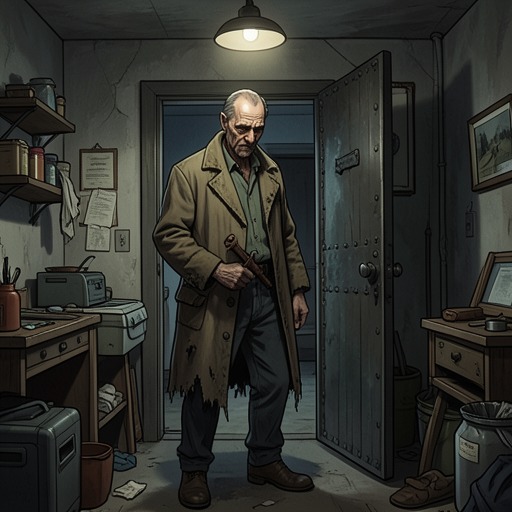
The novel gives Vond a carefully managed public appearance. Frenesi sees a high forehead, fashionable octagonal glasses, a Bobby Kennedy-style haircut, and a tanned face; the narration describes him as more photogenic than handsome. He notices that she is filming him and recognizes that the camera is trained on him alone. Their brief exchange makes filming reciprocal: Frenesi records Vond, and he suggests that he may someday record her. His charisma is thus not separate from his power. It helps him present the coercive state as a person one might be drawn toward, even while his actions reveal the danger behind that attraction.
Political Operations
Vond’s political strategy is often indirect. Rather than invade PR3, the independent mini-state formed after a mass uprising, he proposes using discretionary funds to make its members compete and quarrel over money. He describes the plan as an experiment that could model the cost of bringing down an entire country. The proposal treats political life as something that can be destabilized from within, with financial inducement doing work that open military intervention might make too visible.
His attention to Weed Atman follows the same logic. Vond regards Weed as the structural point whose removal could loosen the larger movement: in his account, Weed is the person whose relationships and credibility hold others together. Frenesi later observes that the plan has worked: Weed has lost credibility, with only a small faction still attached to him. The political consequence is not merely a private betrayal. The loss of Weed’s standing weakens the collective structure around him and helps clear the way for PR3’s collapse.
Vond describes the coercion used against Weed as therapeutic treatment, claiming that he countered abstract ideas with a dose of reality until Weed began to accept the government’s account. The euphemism is revealing: state violence is presented as correction, and a forced change of position as a return to reason. Vond’s own explanation makes clear that the goal is not neutral inquiry but the production of compliance. His prosecutorial vocabulary, discretionary funding, and private leverage all belong to a broader practice of turning institutional pressure into apparently practical decisions.
Frenesi Gates and the Camera
Vond’s relationship with Frenesi is at once personal and political. Zoyd remembers him as the man who took his wife and later wonders where he is, fearing that ignorance of Vond’s plans helped drive him across the Pacific on an aircraft whose safety he now doubts. Years later, Zoyd challenges Frenesi with the contradiction between her history of resistance and the possibility that she might support Vond. He asks whether she has ever met him face to face, placing their relationship at the center of his attempt to understand the past.
For Frenesi, the end of the 1960s brings a dangerous confusion between liberation and capture. As political repression becomes harder to ignore, she imagines that the coming era might be her own golden age of music and revolution. She has acquired a legal freedom to act outside ordinary rules, but the narrative presents her sense of independence as entangled with a private form of servitude. Vond’s appeal and the political world he represents are not cleanly separated: her attraction to a new life can be drawn into his designs.
Their connection becomes a means of leverage when Vond invokes his knowledge of Frenesi’s relationships, including details about her intimacy with another man. He uses that knowledge to unsettle her and to frame himself as already present inside the supposedly private space she shares with others. The episode shows how surveillance and emotional manipulation reinforce one another: what Vond knows is power, and the disclosure of that knowledge narrows Frenesi’s sense of choice.
The camera gives this conflict a recurring image. Vond contrasts a world containing a camera, which he associates with fiction and illusion, with one containing a gun, which he calls reality. His formulation pressures Frenesi to choose between documenting power and acting within its violent terms. Earlier, she had filmed him as he moved his hearings beyond easy observation; later, his argument tries to make that act of witnessing seem unreal or insufficient. The contrast does not simply define two worlds. It exposes the political stakes of who gets to record events, who is forced to act, and which version of reality will prevail.
Repression, PREP, and the Vanishing
Vond’s power expands from prosecution into the design of a political-reeducation program. PREP is his ambitious project and a possible route to career advancement, intended as a precursor to a broader law-enforcement framework. His inspection of the camp is also personal theater: he arrives in a government Mercedes driven by Roscoe, moving past rows of barracks under security lights. The visit links his bureaucratic ambition to a physical system of confinement, where political opponents can be held and processed under the language of reeducation.
The novel also shows the historical atmosphere that makes such power easier to deny. After a night of violence at the College of the Surf, dozens are injured and hundreds arrested; officially, nobody is dead, though people are missing. At the time, the possibility that a North American government agency had killed civilians and then lied about it remains difficult to accept. Vond’s press-conference reference to the missing as a kind of abduction helps keep the truth suspended between official explanation and unresolved absence. His public performance is part of the operation: the state can define the terms in which its violence is remembered.
When Vond returns to Vineland County, DL describes him not as a figure safely confined to the past but as a present-tense force behaving like an occupying army. A week of aerial patrols makes the comparison literal. Vond flies with a squadron of three black Huey helicopters, appearing over quiet clearings or skimming roads after innocent motorists. He is pictured in aviator gear and Vietnam-era boots, with a flamethrower at his hip. The helicopters turn a local landscape into an occupied zone and make Vond’s authority visible from above.
At the airport, the same mobilization is expressed through routine processing: incoming passengers are stopped and questioned one by one, while names and numbers are entered at a keyboard; some are allowed through and others held inside an enclosure. Yet the operation depends on an official exercise that can be switched off. When Reagan ends REX 84, the field headquarters relays the order to dismantle the camps, return convoys to their bases, demobilize action teams, and withdraw Vond’s authorizations. The abrupt cancellation reveals both the scale of the machinery he has commanded and its dependence on a higher political decision.
Relationships and Narrative Significance
Vond’s connection to Zoyd is defined by displacement and suspicion rather than direct intimacy. Zoyd associates him with the loss of Frenesi, imagines him near her even years later, and cannot treat the new deployment as an ordinary law-enforcement action. For Prairie Wheeler, that same history is inherited as a mystery. DL tells her that Vond once used a grand jury to pursue pacifists and radical students, and that at least one indictment against her mother remains valid. DL suspects that Vond’s seizure of Prairie’s home may be intended to put pressure on Frenesi by giving him leverage over her daughter.
Vond also tries to dictate the terms of Frenesi’s relationship to her past. When Zoyd asserts that Frenesi is no longer Vond’s concern, Vond rejects the claim and insists that he will decide what to do about her. The moment condenses the possessive logic running through their relationship: he treats her as a matter over which he retains jurisdiction, just as his political operations treat communities as systems to be managed. His private claim and his public office echo one another without becoming identical; the force of the character lies in how readily one authorizes the other.
The final turn refuses a conventional account of Vond’s fate. After the federal operation ends, the vehicle he had been using is gone, and he climbs into a tow truck beside Blood. As the road changes from pavement to dirt and the trees draw closer, Vato tells an old Yurok story about a man who follows the young woman he has lost into the land of the dead. In the tale, the man breaks the ferryman’s boat, stopping the dead from crossing for ten years. The novel does not resolve Vond through a straightforward report; instead, it places his disappearance beside a story about pursuit, loss, and passage across a final river. That folkloric ending shadows his career in the state’s machinery with a different kind of reckoning, one that official orders cannot control.