Sasha Gates
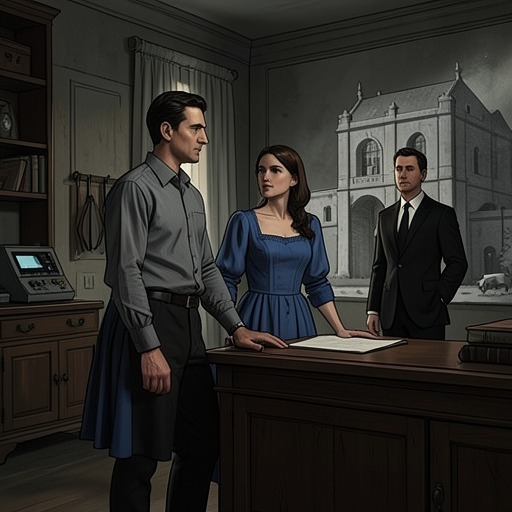
VinelandSasha Gates is a labor radical whose history of organizing, strikebreaking, and political repression gives her a formidable sense of what power costs. Yet her political convictions do not settle her intimate relationships: she is awkward with her son-in-law, furious with her daughter, and eventually forced to confront how much of their shared past remains unresolved. Her story joins public struggle to domestic life, most clearly in her cooperation with Zoyd Wheeler to keep Prairie Wheeler out of foster care and in the long-delayed reunion with Frenesi Gates.
Identity and Political Background
Sasha grew up in a family marked by labor organizing and violence. Her father, Jess Traverse, organized lumber workers in Vineland County and neighboring counties. He was crippled when a redwood, secretly cut partway through, fell during a baseball game. The incident was staged to send a warning to the people who saw it, and Sasha’s mother, Eula Becker, later argued that the family’s continued presence in the area kept the memory of the tree, and of why it had been felled, alive. Sasha inherited a politics formed not only by principle but by the consequences that followed when workers challenged employers.
She migrated to Los Angeles, found work, and sent what she could back home. There she lived in a working-class neighborhood where memories of the 1934 general strike remained vivid, and she spent time among longshoremen and mechanics who had fought police during the strike. Her work took her through shops, offices, shipyards, and aircraft factories. She also joined efforts to organize agricultural workers in California’s valleys, living among Mexican and Filipino migrants and Dust Bowl refugees, sleeping outdoors and standing watch against vigilantes and hired attackers. Gunfire was part of that experience; Sasha wrote home about it, while Eula replied with a dry skepticism that reveals a family accustomed to political danger.
Sasha’s account of wartime politics is not a simple story of conviction rewarded. The wartime no-strike pledge divided people who suspected that capitalists were using the war to mobilize the country under a leader they compared with Hitler or Stalin, even as many of them genuinely admired Franklin D. Roosevelt. Sasha was so shaken by the contradiction that she stopped working for a time to think it through. When Frenesi Gates asked about other women in the movement, Sasha recalled that many were occupied with work, children, family obligations, or private life rather than political solidarity. The recollection presents her activism as lived experience, not inherited legend: commitment did not erase fatigue, disagreement, or the uneven demands placed on women.
Motherhood, Memory, and Political Inheritance
Frenesi was born shortly after World War II, and Sasha and Hubbell Gates named her after Artie Shaw’s frequently broadcast recording of “Frenesi,” which accompanied the last days of the war and the beginning of their romance. Frenesi imagined her parents’ first meeting in an exuberant dance-hall scene, but Sasha corrected that idealized memory. She urged her daughter to imagine what it meant to be a woman with political ideas in the middle of a global war, amid men who treated women as objects of desire. Her recollection punctures the romance without denying that the past could also be vivid and compelling.
Sasha’s own political history became part of Frenesi’s childhood through stories of strikes, organizing, and repression. Frenesi also learned that politics could enter the home indirectly: her parents’ work, unemployment, and fear of blacklists shaped what was said and what was left unspoken. Later, watching old films with them, Frenesi recognized the political injuries hidden behind familiar images. Names in screen credits could provoke anger or disgust from her parents, and a set’s construction could reveal a history of strikebreaking. Sasha and Hubbell made political history visible to their daughter in the ordinary act of watching television, while the family’s reactions made clear that the past remained active rather than safely finished.
The television also became part of Sasha’s domestic landscape. In Frenesi’s recollection, screens sent blue light into the dark, while large unfamiliar birds gathered on palm trees or windowsills and sang along with advertisements. Sasha sat on the veranda after dusk, knitting and talking with Hubbell or a neighbor; the quiet of that scene contrasts with the political conflict that had shaped the family. The contrast matters in Frenesi’s later visits: she repeatedly drove slowly past her parents’ old house in Los Angeles, as the FBI had done during her childhood, hoping to glimpse Sasha. When new toys and cars showed that the household had changed, Frenesi had to seek help to find her mother in a nearby apartment. She never learned whether Sasha had remained in the old house hoping she would return, or what finally prompted the move.
Estrangement and the Attraction of Authority
Sasha recognized in Frenesi a troubling attraction to the emblems of authority: uniforms, military spectacle, and images of power. She suspected that her daughter had inherited this fascination, and she confronted the contradiction in herself as well. Sasha had spent her life resisting oppression, yet she wondered whether her own rebellions were partly a way of denying a physical susceptibility to martial display and social dominance. The text does not resolve that contradiction into a diagnosis. Instead, it makes the resemblance between mother and daughter uneasy: political opposition and attraction to power can coexist within the same family history.
Frenesi initially reacted to Sasha’s theory with anger, later found it irritating, and, after the two had entered a second decade of silence, met it with little more than a weary response. That long estrangement gives weight to even indirect attempts at contact. When Frenesi returned to Los Angeles for business, she searched for Sasha without being able to find her; when they eventually met again, the encounter carried the accumulated force of all those missed possibilities.
Sasha’s anger also shaped her response to Frenesi’s affair with Brock Vond. She was furious that her daughter had entered a politically compromising relationship and, in Sasha’s view, had again evaded the work of protecting her own material interests. When Zoyd came to Honolulu looking for Frenesi and asking whether Sasha knew Brock, Sasha refused to be drawn into betraying her daughter. She claimed to know nothing and pointed out that Frenesi had no reason to confide in her. Her silence was not indifference: she was angry with Frenesi, but she also understood that answering Zoyd could make her an instrument against her daughter.
Alliance with Zoyd and Care for Prairie
Sasha was never at ease with Zoyd. Their meetings tended toward a mechanical handshake and an embarrassed laugh, and she privately regarded him as conspicuously inadequate for Frenesi. Yet when Frenesi left, Sasha and Zoyd found themselves on the same side of a practical danger. Neither wanted Prairie placed with foster parents, a possibility they believed likely if a judge had to choose between a lifelong communist grandmother and a father with a history of drug use. Their shared interest prevented a custody battle and required them, despite their discomfort, to coordinate their lives.
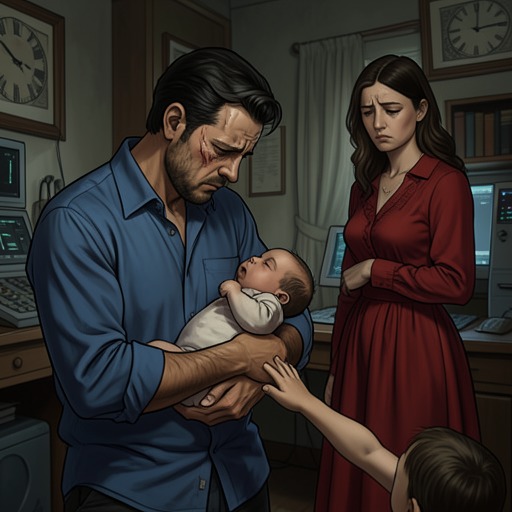
That uneasy cooperation was visible even when Prairie was a baby. Sasha came to the airport to see Frenesi off and took turns with Zoyd holding the sleepy child. For a short time, the two adults behaved as if they were rehearsing future arrangements for Prairie’s care. The moment did not erase their differences, but it showed the basis for a working alliance: responsibility for the child outweighed their mutual awkwardness.
Years later, Sasha appealed to that responsibility when Brock Vond’s coercion threatened to keep Frenesi away from Prairie. She reminded Zoyd that an agreement between two men should not decide a woman’s relationship with her daughter, and asked whether he was willing to help keep mother and child apart. She then proposed Vineland as a place where he and Prairie could live. The annual gathering of the Traverse and Becker families still brought relatives together there; Frenesi had loved visiting the woods as a child, following streams and later wandering for days with food and a pack. Sasha presented the area not as an abstract refuge but as a landscape with family ties, access by U.S. Route 101, and a growing community of migrants from Los Angeles. Zoyd worried that work there was limited to fishing and lumber, since he was a pianist, but Sasha urged him to make a life through ingenuity.
Return and Reunion
Sasha remained connected to Vineland through the yearly Traverse and Becker gathering, even after Frenesi stopped attending following high school. Zoyd’s dealings with the relatives were complicated by his nonunion, sometimes strikebreaking work, which sat uneasily with their labor history. They let him into their homes partly because they cared about Prairie and partly because they attributed his long hair and way of life to his mental disability. Their judgment of the absent Frenesi was also complicated: she had not visited for years, and the divorce did not improve either parent’s standing with the family.
At one gathering, Sasha arrived at the Vineland Palace Hotel in a conspicuous Cadillac with Derek, a younger companion she had picked up after ending an earlier romance. Her arrival brought her face to face with Frenesi in the hotel’s Bigfoot Room. The two women sat opposite each other, unable to look away, and the force of the encounter was so complete that Derek withdrew for a long time. They had not fully recovered from the shock by the time others described the encounter; what they did, rather than cry, shout, or embrace, was dance. Their reunion did not restore the world they had left behind, but it ended the years of separation in a gesture that needed no explanation.
The reunion continued through the family’s ordinary, comic rituals. Sasha called out for a check of Prairie’s dimples and playfully squeezed the young woman’s cheeks, trying to draw her back into childhood. She recalled that Prairie had watched an episode of Gilligan’s Island as a baby, at about four months old, smiling, gurgling, and rocking as if she wanted to enter the television and land on the island. Frenesi resisted hearing the story, while Sasha persisted in telling it. The memory makes television, already tied to the family’s political past, intimate and familial: here it is the screen that held a baby’s attention and the story a grandmother uses to claim a bond across years of absence.
Narrative Role
Sasha’s role is not simply to embody an older generation of left-wing politics. Her memories show the labor movement’s costs in strikes, blacklists, unemployment, injury, and fear, while her family relationships test the limits of political certainty. She can condemn Frenesi’s relationship with Brock Vond and still refuse to help Zoyd turn suspicion into betrayal; she can resent her daughter’s flight and still offer a place for Zoyd and Prairie to live. Her most consequential acts are often practical forms of care: protecting Prairie from foster placement, offering a possible home in Vineland, and remaining part of the family network that makes a later reunion possible.
The contradictions she identifies in Frenesi also reach back toward herself. Sasha’s resistance to authority exists beside her recognition that the signs of authority can exert their own allure. Rather than resolving this tension, the narrative lets it echo across generations, from the stories Frenesi heard as a child to the attraction that complicates her adult life. Sasha’s eventual dance with Frenesi therefore carries both joy and history: the two women meet again not in a recovered innocence, but with the losses, judgments, and memories of their separation still present.