Rex Snuvvle
VinelandRex Snuvvle is a graduate student whose search for a buried history of the Vietnam War gives revolutionary politics the shape of a personal faith. He pursues the fate of Vietnamese Trotskyists whom official narratives and rival political movements have obscured, while investing his hopes in Weed Atman as a possible partner in making that history matter. Yet Rex’s ideals are tested by the people and material attachments around him: his mentorship falters, his prized Porsche becomes a collective offering, and his faith in the People's Republic of Rock and Roll grows guarded. His story turns on the distance between imagining revolution and accepting what it asks of a person.
Background and Historical Pursuit
Rex studies Southeast Asian history while being taught the government’s version of the Vietnam War. He has nonetheless encountered truths that he is afraid to discuss openly, admitting that he fears retaliation. The danger of speaking does not stop him from investigating: he becomes intensely preoccupied with the fate of the Vietnamese Bolshevik-Leninist Group, a section of the Fourth International.
The group had trained and sent roughly five hundred Trotskyist cadres from France to Indochina before 1953. Because they stood to the left of Ho Chi Minh, Rex understands their disappearance as more than an archival gap: no one seems to know what became of them. A handful of exiles in Paris remain, and Rex begins corresponding with them in paranoid secrecy. He comes to believe that these Bolshevik-Leninists represented the only authentic Vietnamese revolution so far, betrayed by every party, including the Fourth International itself.
That investigation acquires an almost devotional cast. Rex imagines the missing men and women, most of whose names he will never learn, as a lost tribe: heroes of a defeated cause who may never return in bodily form. He nevertheless allows himself to picture them as a prophetic voice or a rescue mission arriving briefly from elsewhere, bringing hopes that could become written programs and real chains of cause and effect. Their survival as an idea matters because it would mean history remains open to change.
Mentorship and Diverging Paths
Rex casts himself as Weed Atman’s mentor. He imagines advising and educating Atman through a dialogue that would examine American reality by the light of that distant political tradition. But when Atman leads students away from danger during a campus crisis, he remains almost silent afterward. At a meeting of the newly formed campus committee against the police, Atman wanders around the point rather than giving Rex the searching political conversation he had imagined. Rex invokes Talleyrand’s warning about the advantage of saying and doing nothing, while Atman appears distracted by the rock and roll broadcast from across the border.
Their divergence becomes sharper as Atman’s politics change. Rex plans to go to Paris and contact what remains of the Vietnamese section of the Fourth International; Atman predicts that the effort will fail because Rex is Anglo-Saxon and will not be trusted. Rex rejects the racial assumption behind that prediction. The exchange also marks a reversal in their relationship: the once deferential Atman has become sharp with his mentor, whom he believes has not fulfilled the promise Rex saw in him.
Rex expects a degree of sacrifice from Atman that Atman no longer seems willing to make. For Rex, revolution resembles a progressive renunciation: first intoxicants and ordinary pleasures, then sleep, intimacy, freedom of movement, and money, with imprisonment and a life without relief as the ultimate prospect. He tells Atman that he sees no sign of such renunciation. Both recognize this as evidence that their destinies are splitting apart.
Bruno and the Collective Gift
Rex’s attachment to his red Porsche 911 makes that split visible in material form. He calls the car Bruno and treats it as far more than transport: it is a cherished possession and intimate companion. He knows the locations of round-the-clock car washes in four counties, has slept beneath the vehicle with a plastic toolbox for a pillow, and tends its engine with an intimacy that the narrative renders as an erotic bond. Bruno is a private world Rex has built and maintained, not an abstract possession that can be surrendered without grief.
That world changes when the foreign office of the People's Republic of Rock and Roll seeks allies outside its borders and negotiates with the Black Afro-American Division. The visiting delegates arrive in black boots, dark camouflage, and star-emblazoned velvet caps. Their discussions with the local community dwell on histories and racial realities before they reach the present political alliance Rex wants to discuss. He grows impatient: he wants to talk about revolution, while the delegates turn to a game aimed at the white residents around them. Rex protests that they are fighting a common enemy, but the appeal does not settle the disagreement.
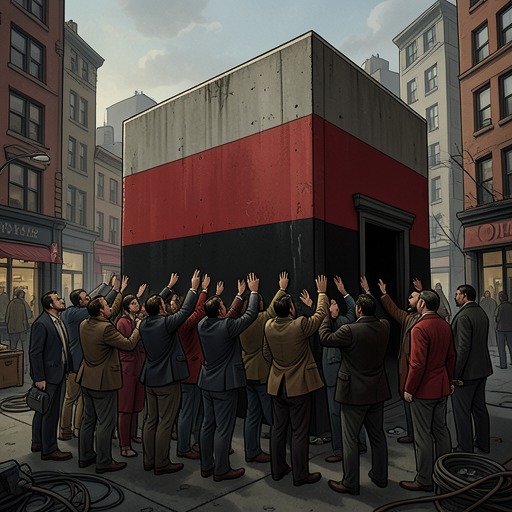
When Elliot X asks what Rex drives, Rex answers that he owns a Porsche 911. The request that he give it to the delegation turns his rhetoric of solidarity into a concrete test. Rex hands over the keys. The residents vote unanimously to make the car a collective gift, and the delegates begin negotiating over who will drive it first. At sunset, white and Black delegations meet in the parking lot for the formal transfer. Rex is already deep in regret and struggles to contain his sobs as he says goodbye to the car with which he has traveled across deserts, mountains, valleys, cities, and suburbs.
The change is not only ownership but identity: Bruno is immediately renamed UHURU, an acronym for Ultra High-speed Urban Reconnaissance Unit. Its new name places the car within a collective political purpose, even as Rex experiences the handover as the loss of a companion. Frenesi tries to console him by affirming that he did the right thing; Rex can only answer to himself that he feels awful. The scene gives sacrifice both its public meaning and its private cost.
Disillusionment and Departure
Rex’s faith in revolutionary politics does not survive as uncomplicated certainty. He no longer has illusions about infiltrators, half-hearted revolutionaries, or the future of the People's Republic of Rock and Roll. He also recognizes the risk in treating the enemy’s cruelty as proof of one’s own goodness. He warns Atman that the people defending the established order may be deeply dangerous, but that this alone does not make their opponents wholly virtuous. His judgment is a rebuke to political innocence as much as to the forces of power.
The warning carries particular weight because Rex sees Atman and Frenesi entangled in circumstances that make a lecture inappropriate. Instead of insisting on his own political diagnosis, he tells Atman, who is still at the summit, to bring his ideas forward and discover a new theorem. The appeal shifts from doctrinal instruction to intellectual creation: Atman must produce something rather than remain suspended in indecision or borrowed positions.
Rex is preparing to leave for the land of the May events. The departure closes his immediate role as Atman’s frustrated mentor without resolving the questions he has pursued: what happened to the vanished Vietnamese cadres, whether political solidarity can survive racial and personal divisions, and what form an honest revolution might take. He leaves having surrendered Bruno to collective use, but not having made sacrifice into a guarantee of political virtue. His final challenge to Atman preserves a possibility that his own disillusionment cannot settle: a new idea may still be made.