Hubbell Gates
VinelandHubbell Gates is a Hollywood electrician, husband of Sasha Gates, and father of Frenesi Gates whose quiet, compromised working life stands in contrast to the political conflicts that define his family. He is neither the fearless labor hero he imagines others expect nor wholly indifferent to injustice: he joins a picket line when confronted with strikebreaking, later gives up the struggle, and carries the shame of that retreat into a story he tells his vulnerable daughter. His late-night visit after Frenesi gives birth brings that history into the present, turning an old man’s account of compromise into an imperfect act of comfort.
Identity and Background
Hubbell’s family life is threaded through Hollywood’s political upheavals. Sasha works as a script reader and becomes a singer; Hubbell works as an electrician on film sets. Their daughter grows up around blacklists, layoffs, aliases, silences, and the strain between adults who have been betrayed by one another. Frenesi learns that when Sasha is out of work and Hubbell loses a film job, it is best not to get in their way. The pressure of politics reaches the household not as an orderly lesson but as a set of consequences and guarded conversations.
The couple’s beginning has a lighter cast. During the war, Sasha is hired to sing at the Full Moon. Hubbell, then a third-class electrician’s mate, serves aboard a newly built Sumner-class cruiser bound for the Pacific. The ship reaches Okinawa and is struck by a kamikaze after fifteen minutes of battle, forcing it back to Pearl Harbor for repairs. By the time it is ready to sail again, the war is over, and Hubbell is eager for romantic adventure. Frenesi is named for the Artie Shaw record repeatedly played in the war’s final days, when her parents are falling in love. Her imagined version of their first meeting gives the romance a crowded dance floor, wartime ships in San Francisco Bay, and a night suspended between danger and youth.
Labor, Politics, and Compromise
Hubbell does not share Sasha’s political intensity, a difference both can describe with rueful humor. Sasha remembers him as the first man who listened while she thought aloud; Hubbell says he would have listened to anything if it meant spending time with her. She takes that attention for evidence of political understanding, while his mind, by his own account, is occupied by ordinary thoughts of a sailor on leave. Only years later does she recognize how little political conviction he had. Frenesi watches her parents revisit the past in arguments that can end with shouting and things thrown, and sees how the family’s political history has become entangled with personal grievances and competing accounts.
Yet Hubbell is not simply a bystander. On his first visit to Warner Bros., he discovers that the job he was summoned for is part of a group of IATSE strikebreakers. The men sought are tougher than he is, but he stays long enough to understand what is happening. He crosses the street and offers to join the picket line, believing that he fought in World War II to prevent just such abuses. A bolt thrown from a soundstage roof knocks him unconscious. The injury confirms his sense that he has chosen the right side, even as the struggle becomes more violent around him.
The conflict pits IATSE, aligned with studio interests, against CSU, the union led by Herb Sorrell. The blacklist makes the outcome feel predetermined: technicians can restore their prospects by leaving CSU and joining IATSE. Hubbell stays with the losing side for a time, naively assuming that other people see events as plainly as he does. He speaks openly, while others appear to agree and then report what he has said to investigators. When calls go unanswered or he hears that someone has named him before a committee, he is left with the bewildered regret of a man still expecting the world to work differently.
His own account to Frenesi explains the personal stakes behind that retreat. He measures himself against Jess Traverse, Sasha’s father, a union organizer killed when a deliberately weakened redwood fell on him during a baseball game. Hubbell believes that Jess accepted the risks of taking a stand, while he himself feared death and thought first about getting his wife and daughter through the day. That fear is not an abstract political position: he recalls that a powerful Brute light could be dropped on a worker as readily as the tree fell on Jess. He describes himself as unable to match the courage of the heroes around him, even when he knows which side he wants to support.
Marriage and Work in Hollywood
After the war, Hubbell and Sasha drive to Hollywood with Frenesi as a child between them, singing and passing a benzedrine inhaler back and forth. They live in Wade and Dotty’s garage amid a Los Angeles housing crisis that leaves others in trailers or tents. In San Pedro, they listen to bebop at the Finale Club, in the neighborhood once known as Little Tokyo before its Japanese American residents were sent to wartime incarceration camps. Sasha admires Hubbell’s willingness to face police violence: he is beaten and arrested during demonstrations, and she stays up to get him released. He works when he can as an apprentice hoping to become a lighting technician, while repairing lamps and toasters and learning from older electricians.
Those mentors teach him to keep one hand in his pocket while working with electricity, a practical safety measure that Sasha also reads as a symbol of his political reserve. Hubbell recounts her disappointment that he seemed to hold something back, while insisting that she wanted him to be purer than he was. Over time, his work changes his loyalties. The Brute light gives him a power and brightness he comes to depend on; his old comrade Wade crosses to the other side but remains his friend. Hubbell eventually joins IATSE and retires as soon as he can. He describes the decision as surrendering his most valuable possession, his anger, for the sake of work that manufactures convincing but insubstantial images: studio interiors, nightclubs, hotel rooms, and rain on a train window. The film sets are shadows, he concludes, but the wages and deductions attached to them are real.
The Visit to Frenesi
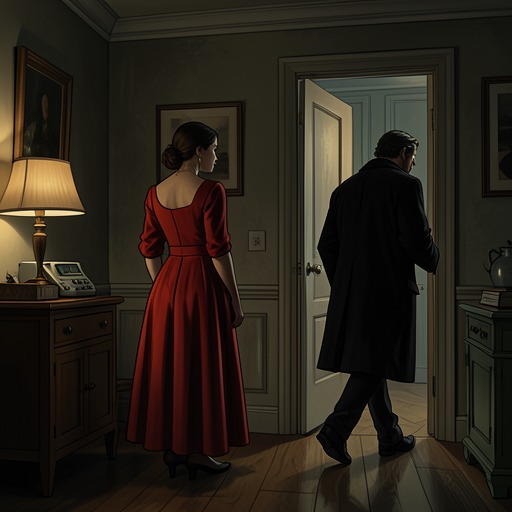
Hubbell’s most consequential appearance comes after Zoyd Wheeler calls to say that he has become a grandfather. The news reaches him during the opening of a furniture store near Sacramento, amid a band, food stalls, and children bouncing on waterbeds. He leaves the event and makes a complicated journey by local and intercity buses, then waits past midnight near Hacienda Heights before a taxi will take him to Sasha’s home. He has been told that Frenesi is in trouble. Sasha explains that she has stayed with her daughter but needs sleep; Zoyd, she says, left soon after the baby was born.
Hubbell goes to Frenesi’s old bed, where she lies with the curtains drawn, looking exhausted and unlike herself. He does not try to force her into a conversation about what has happened. Instead, he uses his habitual form of therapy: he sits down and tells the story of his own misfortunes in a steady, nearly unbroken flow. He has used the same monologue with strangers on buses, dogs in a yard, and himself in front of the television. Here its purpose is more tender. He speaks without dramatic pauses, hoping not to provoke either a positive or negative reaction, and senses that Frenesi is gradually calming.
His self-reproach gives way to a memory of the young couple who drove to Hollywood together, then to the choices that wore their solidarity down. He admits that he feared the consequences of political courage, followed the safer route into IATSE, and eventually retired. By looking at his daughter as he talks, he recognizes the darkness around her mouth and jaw and the secret in her expression that she will not tell him. The account does not make him a hero or resolve the silence between them; it lets him offer the one thing he can, the company of someone willing to admit his own failures.
Family Bonds and Narrative Role
Hubbell’s relationship with Frenesi is marked by affection that cannot undo what remains unsaid. He checks whether she is asleep and calls her Young Gaffer. He considers another affectionate title, My Best Girl, but reserves it for Sasha. The small exchange places his daughter within a family history of attachment and distance: Sasha is still the person he names as his favorite, even as he sits beside Frenesi in a moment of extreme vulnerability.
The visit also frames the changes still ahead without making them his achievement. Frenesi’s postnatal despair will ease; she will come to love the infant and reconcile with Sasha, though not by returning to exactly what their relationship was. Her deeper wish is to recover the earlier intimacy with her mother, the long conversations without reserve. Hubbell can soothe her for a night, but he cannot disclose the secrets she keeps or repair the turn in her life that she herself cannot explain. His narrative importance lies in that limit. He embodies a generation shaped by labor struggle and political repression, one capable of solidarity but also of retreat, and his candid, rambling account makes that history intimate without pretending that confession can erase its consequences.