Sister Rochelle
VinelandSister Rochelle, the Senior Attentive of the Kunoichi Attentives Sisterhood Mountain Retreat, governs a community where welcome is conditional on responsibility and discipline. She is neither a simple gatekeeper nor a limitless source of refuge: she makes newcomers account for their place, and she treats sustained attention as the work required to belong. Her relationships with Prairie Wheeler and DL reveal two sides of that rule. Prairie is asked to earn her keep; DL, a returning former student and antagonist, is made to confront the consequences of a life lived in motion.
Identity and Authority
Sister Rochelle heads the retreat and speaks for its regulations. When DL arrives with Prairie, the sisters receive them at the guesthouse, but Rochelle’s first attention is directed toward the newcomer. She watches Prairie while appearing not to do so, then asks whether the law is interested in her. The question establishes that shelter is not detached from the world outside: the sisters must consider the risks and responsibilities of giving someone refuge.
Rochelle reminds DL that the Sisterhood’s oath does not permit her to house a person unable to take responsibility for her own input and output. Its language makes refuge reciprocal rather than automatic. DL has an obligation to the community, and Prairie cannot assume that being brought to the retreat entitles her to stay without contributing. Rochelle’s authority therefore operates through rules stated plainly, but also through the expectation that those rules be taken seriously.
Prairie Wheeler’s Arrival
Prairie does not answer Rochelle’s scrutiny by pleading. She proposes a practical exchange: perhaps she can study and work, choose an affordable rate, and pay through labor. Rochelle responds by asking whether she can cook. The ensuing conversation establishes that the retreat’s food is notoriously bad; previous changes of kitchen staff have not improved it. Rochelle presents the persistent failure as an instance of karmic invariance, set against the Sisterhood’s high degree of discipline. The joke is also an opening: Prairie’s willingness to work gives her a possible way to participate.
Rochelle lets Prairie see the retreat not only as a place governed by rules but as a working household with ordinary needs. Prairie examines the food in the kitchen before leaving, including the cooking mortadellas, and later asks whether she could learn Rochelle’s ability to seem almost invisible in the recreation room. Rochelle explains that she has memorized the room’s shadows, their movements, and the placement of its objects and empty spaces so completely that she can blend into it. She identifies concentration as necessary, then asks why Prairie would want the skill. The exchange makes attention both a practiced discipline and a question of purpose; Prairie’s tentative answer is that it might be useful.
Rochelle also recognizes that Prairie has come seeking news of her mother. The retreat subscribes to outside information services and keeps its own computerized archive, which contains a substantial dossier on Prairie’s mother. Rather than disclose it immediately, Rochelle offers to speak with Prairie after dinner. The offer gives Prairie a route toward information without turning the archive into something she can simply demand. In Rochelle’s hands, access is possible, but it is governed by timing and by the relationship being formed.
A Returning Student
DL’s connection to Rochelle is longer and more difficult. Since adolescence, DL has repeatedly gone to the retreat, left, and returned, developing what the narration describes as a durable love-hate relationship with the Attentives, particularly their Superior. When DL comes back in a severely unsettled state, Rochelle recognizes that she needs rest and assigns her a cell, postponing their conversation until the next day. The respite does not settle DL: she cannot sleep and spends the night moving between the kitchen and the regression room, watching old films and smoking cigarettes gathered from ashtrays.
By morning, DL is exhausted and unable to name what she has done. Rochelle makes room for a confession, though not without registering the interruption to her newly successful business ambitions. She listens, then asks whether DL is certain she did not draw back at the last moment. DL cannot be certain. Rochelle’s response turns the uncertainty into a question of attention: the decisive moment required the convergence of timing, memory, consciousness, passion, and inhibition. Her concern is not merely whether DL feels remorse, but whether she was present to the consequences of her own act.
Rochelle then addresses the recurring pattern behind DL’s return. She says that sincerity alone cannot sustain membership: DL has kept leaving and coming back without continuity or perseverance. Rochelle describes this movement as running to avoid falling, rather than as a journey toward something beyond it. Her rebuke is severe, but it is not a dismissal. When DL says she believed the sisters would take her back whatever she had done, Rochelle points out that permanent exclusion would require only a direct order to leave. The implication is that readmission remains possible, but it must become more than another temporary refuge.
Karmic Service and the Puncutron
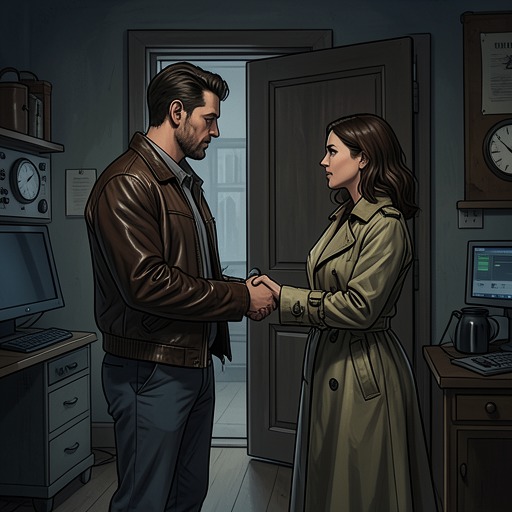
Rochelle’s approach to repair becomes concrete when DL and Takeshi Fumimota meet at the retreat. She interrupts their exchange, judges that DL has wronged him, and assigns her a year of service to him as a means of balancing the karmic account. DL stipulates that their arrangement include no sex; Rochelle sets its duration at a year and a day, connecting it to the amount of life DL’s earlier act had cost Takeshi. She also reminds DL of an unpaid account at the retreat’s store. Karmic reckoning here is not abstract: it involves time, labor, obligations, and an outstanding bill.
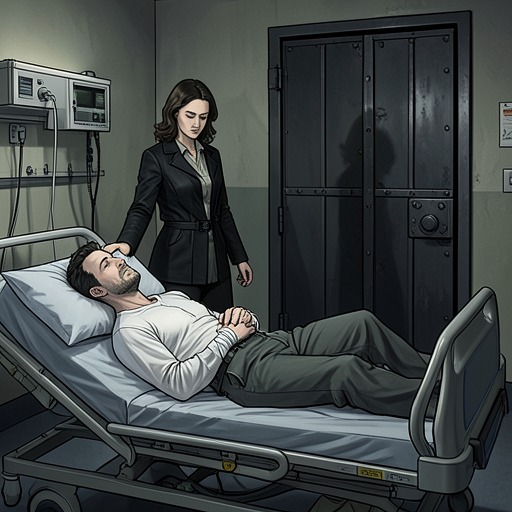
Rochelle then directs the sisters to restore Takeshi to life and asks DL to witness the process. They take him to the retreat clinic, housed in a converted barn and organized into treatment rooms around the enormous Puncutron. The machine stands two stories high and is described as one of California’s freely sold therapeutic devices, supported by some in the medical community and opposed by the Food and Drug Administration. Rochelle takes charge of its controls. She presents the treatment confidently, while the clinic’s scale and equipment make the promised repair look at once institutional and uncertain.
The Puncutron session is followed by intensive treatments, including herbal therapy and brain-wave recalibration, some involving DL as well. Rochelle’s intervention thus does more than impose a penalty: it places the two people whose lives have been joined by harm within a continuing process of treatment and shared work. Their prescribed arrangement remains limited by its terms, but the retreat makes it a setting in which they must attend to one another over time.
Teaching and Narrative Role
Rochelle also teaches through stories. While Takeshi is watching an episode of Bionic Woman, she lowers the television’s volume and tells him a different account of Eden: in her version, Eve and Lilith precede the later insertion of Adam, and the Serpent is the first man. The episode places her beside, rather than simply against, the television that occupies the scene. She redirects attention from a familiar broadcast to an alternative telling, offering a story that unsettles the usual order of its figures.
Across these encounters, Rochelle’s authority combines observation, rule, and practical care. She assesses the risks of sheltering Prairie, offers her a way to contribute, and opens a carefully timed path to information about her mother. With DL, she is more exacting: she acknowledges the possibility of return while insisting that belonging requires continuity, and she translates remorse into a defined term of service. Her methods do not erase uncertainty or guarantee that repair will succeed. They make responsibility visible as a daily practice—work, attention, and time—rather than a feeling that can stand in for change.