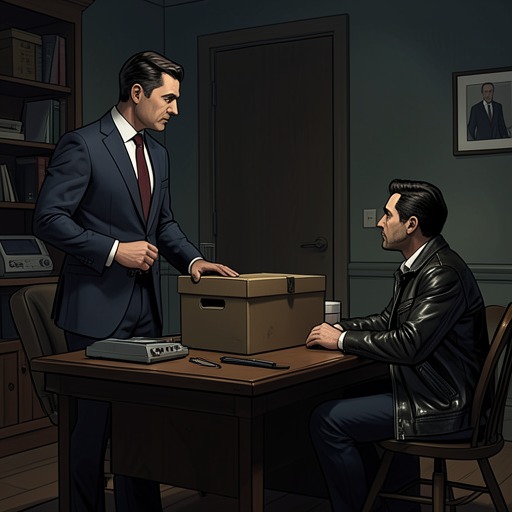
Carmine Torpidini
VinelandCarmine Torpidini, nicknamed Two Ton, is a trusted lieutenant in Ralph Wayvone senior’s organization and an enforcer who turns its preferences into immediate pressure. He first appears as the messenger who rejects a band’s improvised Italian repertoire, then makes that demand physical by using the lead musician’s guitar strap as a noose. Later, he offers to recapture DL after she flees a failed attempt to kill Brock Vond, and he answers Takeshi Fumimota’s call with information about the intended target. Across these scenes, Carmine is less a planner than an operative: he carries messages, applies force, and stands ready to restore control when an operation goes wrong.
Identity and Position
Carmine is introduced as a trusted lieutenant of Ralph Wayvone senior, dispatched to speak for his employer during a performance by Billy Barf and the Vomitones. His nickname, Two Ton, is paired with a description of his large, pear-shaped head; later, he shakes his head and cracks his knuckles as the confrontation with the band intensifies. The combination of a memorable physical presence and a subordinate role makes him immediately legible as an enforcer. He does not merely deliver a request: he has the authority, and the willingness, to make compliance a matter of bodily risk.
His speech repeatedly refers to Ralph Wayvone senior as Mister Wayvone, marking him as a representative who reports upward rather than acting as the principal. Yet the scenes give him discretion in carrying out that service. At the performance, he first conveys the musical preference; when the group’s answer exposes a deception, he escalates without waiting for another instruction. Later, he can ask whether DL should be seized again, while the decision to let her go belongs to the Wayvone figure monitoring events. Carmine’s position is thus both subordinate and operationally consequential.
The Band’s Performance and Exposure
At a wedding performance, the Vomitones initially play a mild mix of popular standards, rock-and-roll classics, and Broadway numbers. During the first break, Carmine arrives with Ralph Wayvone senior’s request: the younger guests have enjoyed the contemporary sound, but the older guests would prefer something more Italian. The band responds with a medley of Italian songs, including music associated with Mondo cane and Il volo della Fenice, and Billy Barf sings Al di là in a nasal tenor style.
Carmine returns dissatisfied. The songs Ralph Wayvone senior wanted were communal favorites such as C’è la luna and Way Marie, along with an operatic piece, Cielo e Mar, that would suit his brother Vincent’s voice. The comic escalation rests on the mismatch between the band’s performance and the family’s expectation: the musicians have prepared Italian-themed material, but the request is for songs the family can sing together, including one that showcases a relative. Carmine’s return, flushed and breathless, is described in terms that suggest he may be anticipating the kind of dirty work for which he is regularly paid. His impatience is therefore more than a dispute over a set list; it carries the threat of violence behind an apparently social request.
When Billy says the additional arrangements are in the van and starts to remove his guitar, Carmine takes it from him and spins it so that the strap tightens around Billy’s neck like a garrote. He then points out that the musicians are not Gino Baglione and the Paisans, as their act implies. Billy’s Italian wig has slipped far enough to reveal his vivid blue hair, and Carmine treats the disguise as a possible case of fraud that could end in court. The accusation gives the confrontation a legal vocabulary, but it is Carmine’s physical coercion—not any formal process—that makes the danger immediate.
Isaiah Due Quattro frees Billy by releasing the strap’s snap fasteners, allowing him to stagger backward and breathe. Carmine’s action has made the guitar, an instrument meant for performance, into an improvised restraint; the band’s silence as they watch their leader being strangled makes the shift from entertainment to intimidation unmistakable. The musicians’ actual ethnic backgrounds also undercut the act’s claim to authenticity: the group includes Anglo-Saxon, Irish-Scottish, and Jewish members, but no Italians. Carmine exposes the masquerade, but his response shows that the threatened fraud is also a pretext for enforcing the family’s will.
Work for the Wayvone Operation
Carmine’s role is not confined to the wedding. During the episode in which DL considers working for the Wayvone organization, its employment is presented in unusually polished terms: contracts are described as the best in the business, missions come with a veto, there are no weekly quotas, and accounting checks occur quarterly. This language makes the organization sound orderly and professional even as DL’s circumstances reveal the coercive power behind the offer. Carmine is present in the broader operation that has brought her there, though the evidence does not assign him the pitch or the proposed terms. His established function as an enforcer gives the polished assurances a sharper context: contractual language coexists with capture and the threat of being made to comply.
After DL attempts to kill Brock Vond and runs from the scene, surveillance cameras follow her through corridors where, in her perception, familiar hostile faces seem to gather around her amateur effort. The Wayvone observer watches both her flight and Takeshi Fumimota’s stunned departure. Carmine asks whether DL should be caught again. The answer is no: the organization will leave her alone for now, confident that she will understand how much she owes it and can be found later. Carmine’s offer makes recapture an available practical response; the decision to defer it reveals a different method of control, one that allows an obligation to stand in for immediate custody.
Contact with Takeshi and Narrative Function
Carmine also supplies the telephone number through which Takeshi reaches him after landing in San Francisco, exhausted and disoriented after three sleepless nights. Carmine answers in person and greets him as Fumimota-san. In the ensuing exchange, Takeshi asks what more Carmine can tell him after already consulting a doctor. The information conveyed identifies DL and the true target: a prominent anti-drug figure, recently featured on the Donahue Show and in Vogue. The prominence of the intended target contrasts with Takeshi’s state of confusion and helps explain why the assassination scheme is not a private quarrel alone.
Together, the scenes define Carmine through service and escalation rather than through a private history or a sustained change of outlook. He transmits the Wayvone family’s tastes, turns a musical dispute into physical intimidation, offers to retrieve an escaped captive, and provides a contact point and intelligence to Takeshi. His function is to make distant decisions tangible: a preference becomes a demand, a demand becomes a constricting guitar strap, and a pursuit becomes an option waiting for approval. The humor of the fake Italian act does not soften that pattern; it makes the violence more jarring by showing how quickly an absurd performance can become a real threat.