Weed Atman
VinelandWeed Atman is a mathematics professor whose accidental leadership helps transform a campus disturbance into the People’s Republic of Rock and Roll, while his later death exposes the limits of both political trust and the camera’s claim to power. The novel first presents him as an unassuming man whom others elevate into a symbol, then as a supposed informant whose cooperation was extracted by Brock Vond, and finally as a Thanatoid who remains caught between death and a hoped-for reckoning.
Identity and Accidental Leadership
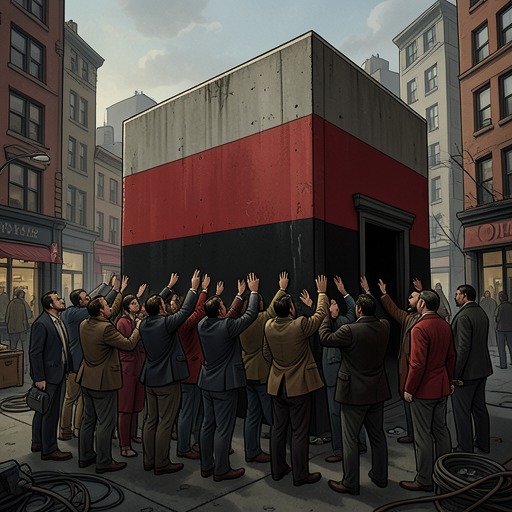
At the College of the Surf, Weed Atman is known as a mathematics professor, but his public importance begins less with a political program than with his height. During a confused confrontation on campus, students mistake his size for authority and call on him to explain what is happening. He tries to clarify that he is merely tall; the crowd has already chosen him as someone to follow. In the surrounding account, the students’ attachment to him becomes a retrograde personality cult, remarkable precisely because Atman is neither especially charismatic nor conspicuously forceful. His prominence begins by accident, as other people make an emblem of him before he has decided what role to occupy.
The disturbance begins in an unlikely setting. The College of the Surf was designed to serve wealthy Southern Californians and train compliant students for professional and technical work. When protest breaks out, security forces prove unable to contain it alone. In the middle of the disorder, Atman arrives distracted by an essay on group theory. Students urge him to lead them; for the first time since climbing a rock face at Yosemite the previous year, he acts without reflection and guides them out by a route behind the Greg Noll Laboratory and Olympic Auditorium. Most disperse, but a smaller group follows him to Las Nalgas and the home of Rex Snuvvle.
From Campus Disturbance to the PR3
The group that reaches Rex’s home carries different histories and political concerns. Rex, a graduate student in Southeast Asian Studies, has become preoccupied with the fate of Vietnamese Trotskyists and the possibility that their revolutionary cause was betrayed. Atman’s accidental role as guide brings him into the orbit of this developing community. His importance there grows as the students begin to examine the institution around them rather than accept its official purpose.
That inquiry uncovers the College of the Surf as a real-estate venture disguised as a public gift. The students conclude that the state and the judiciary are implicated in the arrangement and will not provide a fair remedy. After an all-night assembly, they declare independence from California and name their new state the People’s Republic of Rock and Roll, also known as PR3. The 24fps convoy arrives the following day. The campus becomes a place of continual organizing, public slogans, and helicopter surveillance. Atman’s role is part of the founding story, but the evidence distinguishes his accidental emergence as a leader from the larger movement’s collective decisions and investigations.
Accusation, Coercion, and Betrayal
Years later, Atman’s place in that community is recast as evidence against him. After Frenesi Gates and Rex publicly accuse him of being an FBI informant, Frenesi experiences herself as separated from her own life, as if she were watching it through a film. Atman, too, becomes less a person in her perception than a character on a screen. The accusation is not an abstract political disagreement: Rex says the group is being jailed and dismantled, and insists that Atman has worked against them all along. Frenesi maintains that Atman himself disclosed his connection to the FBI.
Brock Vond later confirms the essential truth behind the accusation while altering its meaning. He describes visits by Atman to San Diego for what he calls therapeutic sessions, explaining that the authorities used pressure to make Atman accept their version of reality. Vond’s account makes clear that Atman did work for the authorities against the movement, but not as a freely chosen, simple act of infiltration. The relationship between truth and betrayal is therefore deliberately compromised: Frenesi and Rex identify a real connection, yet Vond’s revelation shows how that connection was forced into being. The state’s coercion does not erase the consequences for Atman or the movement, but it changes what his alleged treachery means.
Weed Atman’s Death and the Recorded Image
Atman’s final confrontation with Rex unfolds in a house where the cameras are running. Rex returns carrying his fringed bag, whose concealed weight has already made it an ominous presence. Atman sits on the floor in an imperfect lotus position, wearing sandals and plaid socks and drinking inexpensive wine. He senses that Frenesi has been sent to tell him something, while she tries to reassure him that his troubles are nearly over. The room next door erupts into conflict. Jinx hurriedly takes the children away, and Atman stands between Rex and the departing family.
The surviving account of the scene is fragmented across image and sound. Ditzah Pisk films close-ups with an old Auricon camera; Howie operates the Scoopic. When Howie changes reels, the moment of the shooting is missed visually, though Krishna’s recording captures the shot. Howie and Frenesi move outside with the equipment and a light, and the film eventually finds Atman dead. Rex then faces the camera, handles the pistol, and accuses Frenesi of having been the one who should have died. He places the weapon beside Atman and poses for the lens. Frenesi keeps the light trained on him, then switches it off. The recorded sequence preserves the confrontation but cannot make the camera a reliable instrument of rescue: it documents the aftermath and the participants’ gestures, while missing the decisive instant itself.
Years later, Frenesi recognizes the failure of the group’s confidence in filming as a form of power. She reflects that the cameras had seemed like cannons, but that this belief did not protect Atman or prevent other deaths from being concealed. In the recorded scene, documentation and danger coexist. The footage retains evidence of Rex’s actions and Frenesi’s presence, yet the decisive violence remains largely outside the visible frame.
Thanatoid Existence and Unfinished Justice
After death, Atman appears again alongside Ortho Bob Dulang, and both seem unusually cheerful. He tells Prairie Wheeler that he nearly became her, then explains his understanding of the Bardo: the dead must find a new body within a limited time. Atman says he made the common mistake of searching for Frenesi. He could not find her before the time ran out, and so returned instead in his present condition. His account links Prairie to an afterlife possibility, but does not establish that she is a replacement chosen by Frenesi or that a karmic debt has been settled.
As a Thanatoid, Atman describes himself as able to wander, observe how matters are proceeding, and sometimes try to push events along, yet ultimately powerless. His sense of unfinished grievance sometimes draws him back toward Frenesi; he admits to disturbing her and causing conflict in her household, but says that he has lately left her alone. He can forget, he says, but cannot forgive. That persistent resentment complicates any easy reading of his return as reconciliation or spiritual release.
Atman also describes a recurring dream of a train journey that continues whether or not he is dreaming it. He lies on a bed of ice while two indistinct companions attempt, at each stop, to persuade a magistrate to order an autopsy and expose his murder. At every station, armed men turn the train away, and the authorities later deny having seen it. The dream gives his death a continuing public dimension: his companions seek official recognition of what happened, while the institutions that might provide it repeatedly refuse them. Atman’s posthumous presence thus extends the novel’s conflict over coercion, evidence, and impunity beyond the moment of his killing. He survives, but survival does not restore agency or deliver justice.