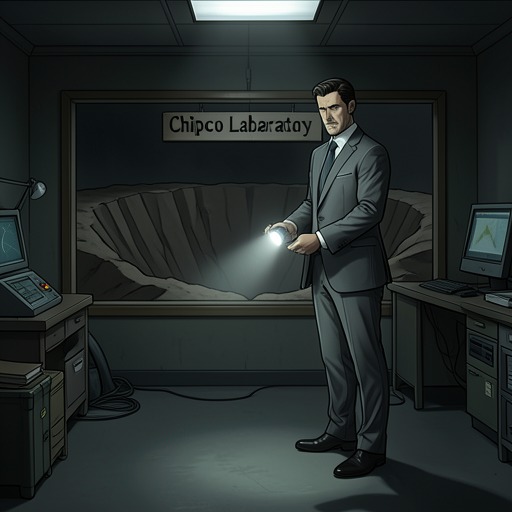
Minoru
VinelandMinoru is an explosives expert and longtime work partner of Takeshi Fumimota, a technically capable but eccentric figure whose professional history spans dangerous devices, international travel, and an unresolved trail of past operations. At a vast crater associated with the destruction of a Chipco laboratory, his recognition of a modified fragment gives Takeshi a crucial clue. Later, after they revisit an earlier incident in Lhasa, Minoru’s sudden conviction that someone must be found immediately pulls Takeshi into a search whose consequences reach Brock Vond.
Identity and Work
Minoru works with explosives and is known to Takeshi as an experienced artificer. Takeshi’s recollection presents a contrast in their working habits: Minoru sometimes undertakes the dangerous task of disarming bombs himself, but at other times is firmly in the position of ordering somebody else to do it. The distinction makes him neither a remote administrator nor simply a hands-on technician; his work moves between direct exposure to danger and the authority to assign it. The narration describes him as no genius, but as an exceptionally specialized savant with figurative X-ray vision, a characterization that joins eccentricity to practical perceptiveness.
His work has taken him abroad. Minoru tells Takeshi that they had not flown together since their visit to Lhasa, and the two later recall a first nuclear mission on which Minoru was nicknamed the Kid. These glimpses establish a shared professional past without fully explaining its operations: their memories supply fragments of earlier assignments, old colleagues, and dangerous work, while the present-day case remains unresolved.
The Chipco Crater
At the bottom of a deep crater, Takeshi finds Minoru among technicians arguing beneath the rain-heavy sky. The setting has cut the workers off from the surface: Takeshi cannot see the rim of the pit, and helmet lamps cross like blades of light as the technicians move about. Minoru, however, remains still, examining a small fragment held in his cupped hands. His focused attention turns an obscure piece of material into evidence.
The fragment initially looks familiar to Takeshi as something from the Eastern bloc. Minoru rotates it so that its alteration can be seen, and identifies the modification as South African. The exchange does not by itself settle what caused the destruction or who was responsible, but it changes the fragment from debris into a specific technical clue. Minoru’s expertise is expressed through this act of recognition: in a crater full of noise, uncertain explanations, and competing impressions, he attends to the material object that others might overlook.
An evacuation order arrives by radio, and a Chipco helicopter descends toward a makeshift landing ramp. Its underside has been disguised to resemble the footprint of a monster, a prank that has fooled the observers on the ground. Minoru boards with Takeshi, asking whether the promised drink is real and whether they might get Singapore Slings. The transition from the crater’s danger to a casual drink is characteristic of their partnership: technical uncertainty and physical risk coexist with dry humor and ordinary habits.
Lhasa and the Unresolved Case
On the journey back toward Tokyo, Minoru returns to the episode in Lhasa. He sees an analogy between that Himalayan incident and the present case: both involved an attack on inanimate objects, a Czech detonator and Semtex explosive, and what he calls a fictitious motive. Takeshi asks whether the current event might be self-sabotage; Minoru responds by asking who drew up the insurance policy. Their exchange shows them testing explanations through the practical details of explosives, targets, and financial arrangements, rather than accepting the apparent motive at face value.
The Lhasa recollection opens into older professional memories. Minoru recalls his first nuclear mission, and Takeshi recalls his nickname, the Kid. They also remember Kutsushita, whom they had thought dead from drinking, only to learn that he had gone to Tibet to save his soul. The memory tour produces no solution to the present case. Instead, it reveals how the two men’s working lives are layered with prior incidents whose meanings and outcomes remain only partly known.
The Urgent Search
After reaching Tokyo, Minoru makes two telephone calls. His manner changes: he becomes visibly unsettled, then returns to Takeshi and insists that there is someone they must see at once, warning that it may already be too late. He grabs Takeshi by the tie and drags him to a taxi, overriding Takeshi’s protests. The urgency is a sharp reversal from their earlier joking over drinks and from the leisurely recollection of past assignments.
Minoru directs the taxi to the Hilton International in Shinjuku, where an international gathering of judges, American district attorneys, and Interpol figures might provide information about the case. He expects that the people assembled there could tell him what he needs to know and perhaps obtain a copy of the sales contract bearing the buyer’s address. This plan suggests that the technical evidence at the crater is only one strand of the investigation; Minoru is now pursuing records, contacts, and the identity of whoever acquired the relevant property or material.
The expected contacts are all occupied with scheduled evening engagements, and Minoru and Takeshi go to the bar to wait. A bellhop eventually summons Minoru. He leaves and does not return. His disappearance leaves Takeshi alone in the hotel, where, after losing his way back from the restroom, he enters a rear sitting room and overhears Brock Vond discussing the need to assemble troops and find a plausible figure for a car’s back seat. Minoru does not reappear in this sequence, and the narrative does not explain what became of him. His urgent effort to pursue the case thus ends at the moment the inquiry exposes Takeshi to a covert operation led by Brock Vond—a consequential interruption that makes Minoru’s sudden departure as unresolved as the case that drove him to act.