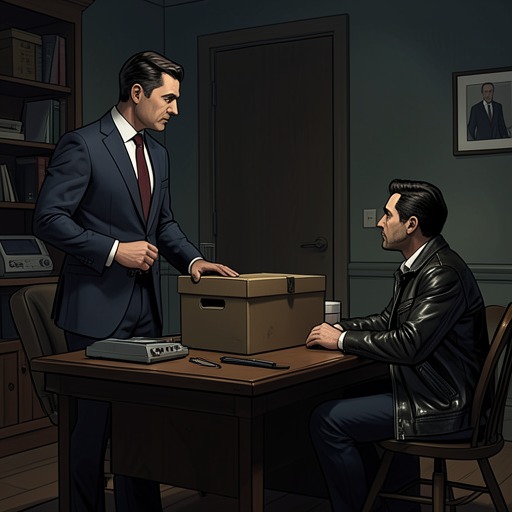
Ralph Wayvone senior
VinelandRalph Wayvone senior occupies an uneasy space between the coercive power associated with his wealth and a private temperament drawn to peace, ordinary pleasures, and other people’s company. His hillside estate and lavish family wedding display the scale of his influence, but the man who emerges from them is not simply a caricature of an executive: he listens to children, doubts the importance of his own work, and hopes that old political entanglements can remain in the past. When DL tells him that Brock Vond is active again in Vineland County, that hope becomes harder to maintain.
Identity and Setting
Ralph Wayvone senior is the head of a wealthy family and the central figure of the Wayvone estate, a roughly half-dozen-hectare property on a hillside south of San Francisco. The 1920s house presents a modest face to the road, then expands behind it into an immense, white, Mediterranean Revival villa that descends the slope over eight levels. Arched windows, red-tile roofs, a belvedere, verandas, gardens, and courtyards make the estate both a home and a visible expression of family standing. Its cultivated grounds include figs, olives, apricots, peaches, plums, bougainvillea, mimosa, and periwinkle; for Gelsomina’s wedding, pale jasmine has been planted across the hillside.
The property’s scale does not make Ralph immune to the lure of quiet. After emerging from a pool nearly as large as a reservoir, he wears Brooks Brothers swim trunks and wraps himself in a towel taken from the Fairmont Hotel. At the wall’s edge, with the surrounding highways and El Camino Real unusually silent, he savors what he regards as a small holiday in time: a fragile interval of peace rather than another display of possession. The contrast between the estate’s grandeur and his private appetite for stillness is central to his characterization.
Temperament and Public Image
To outsiders, Ralph resembles an executive whose idea of power is a secretary kneeling beneath his desk. The narrator complicates that stereotype: he has more consideration for other people than is necessarily useful to him. He genuinely likes the children who gather at family occasions, pays attention to them, and is liked in return. Their response suggests that his warmth is not merely a performance for business associates; the children recognize it and flirt with him in their own way.
Friends who speak frankly to him, and his therapist as well, see a different shortcoming. They tell him that a man in his position ought to be more obsessed with power, or at least behave as though his work mattered. Ralph, however, does not seem to experience his career in those terms. His own image of himself is prosaic: he remains fit for his age, visits the baths regularly, plays tennis, and has had extensive dental work. He eats moderately and observes the rules of etiquette. These habits place self-maintenance and routine beside the vast corporate power associated with his name, without resolving the distance between how others read him and how he understands himself.
Family, Business, and the Wedding
Ralph’s family gathers around Gelsomina’s marriage to a Los Angeles university professor from a family with whom he has conducted business without complaints and, as he sees it, honestly. His wife is Shondra. Dominic, whom Ralph calls the film producer, has flown in from Indonesia, where he is overseeing a monster movie whose budget requires continual revision. The younger Ralph Wayvone junior is expected eventually to take over Ralph Wayvone Enterprises, but for now he manages the Cucumber Lounge in Vineland County.
The wedding is an extravagant undertaking, costing Ralph more than the villa itself. After the sung Mass, the reception is planned around tournedos Rossini, lobster, caviar, lasagna, ziti, and a complicated wedding soup made by his sister-in-law Lolli. The wines range from homemade red to Cristal champagne, and hundreds of relatives, friends, and business acquaintances are expected. For all its abundance, the celebration depends on a last-minute musical replacement: the first band has become stranded in Atlantic City over gambling debts, so Ralph Wayvone junior hires Gino Baglione and the Paisans without having heard them. The episode places Ralph’s wealth alongside the disorder that money cannot prevent; even a meticulously provisioned celebration contains an unpredictable element.
The Past Returns
At the wedding, DL introduces Prairie to Ralph and discloses that Prairie has recently been involved with Brock Vond, once Ralph’s pinochle companion. Ralph reacts with dismay, saying in effect that he had only just begun to forget. He has been advised by his therapist to leave the past behind, and he turns to DL as if to ask whether that advice is right. His response makes clear that Brock belongs, for Ralph, to a history he would prefer not to reopen.
DL rejects the comfort of that chronology. Brock, she explains, is not safely in the past: he is again in the present, disrupting Vineland County and behaving like a small occupying army. Ralph answers defensively that he has nothing to do with the marijuana growers. When the drug hysteria began, he says, he cleared out and changed businesses; he also believes that the Republican secretary at the U.S. Department of Justice does not have it in for him. His claims are less a solution to DL’s warning than an effort to mark the boundary between his affairs and the county’s crisis. He wants his changed business and political distance to protect him from the return of an old conflict, while DL’s account insists that events have already crossed that boundary.
Character and Narrative Function
Ralph’s wedding brings together the different scales on which he lives: the private man who treasures a silent interval by his garden wall, the patriarch funding a reception for hundreds, and the businessman who measures his exposure to political upheaval through his connections and changes of trade. His generosity toward children and his preference for peace coexist with the assumptions and protections of wealth; neither cancels the other. That coexistence keeps him from becoming either a simple villainous magnate or an uncomplicated refuge from the novel’s conflicts.
His exchange with DL is a pointed reversal of the wedding’s apparent ease. The celebration can arrange food, wine, guests, and music, but it cannot keep Brock Vond’s renewed operations outside the gathering. Ralph’s wish to forget is understandable in light of the life he has made, yet the warning makes forgetting itself politically consequential: the past he wants to treat as finished has returned as a present danger to the place and people around him.