Ed Bisch
DopesickEd Bisch was a Philadelphia IT worker whose eighteen-year-old son died after taking OxyContin. His response transformed private bereavement into an early national campaign: first an online memorial and information clearinghouse, then a network of families confronting Purdue Pharma and pressing for changes in prescribing and public awareness. The arc of his activism joined two forms of evidence—the names of dead young people and the systems that connected their deaths.
Identity and the shock of loss
In February 2001, Bisch was thirty-nine and living in a working-class Philadelphia neighborhood when his daughter called in alarm: she had found her brother unconscious and turning blue in the bathroom. Bisch hurried home and found emergency workers on the front lawn. His son, a high-school senior and soccer player with decent grades, had planned to attend a local culinary school. The family had expected to fly to Florida for a father-and-son fishing trip six days later.
Bisch had noticed that his son was unwell, but had not recognized the signs of opioid withdrawal. He had suspected drinking or marijuana use, not pills. When he asked what his son had taken, he learned about OxyContin only after the death. The gap between what he knew about his child and what was happening to him became part of the larger problem Bisch would try to expose: families often encountered the drug’s name only after its consequences had become irreversible.
After emergency workers carried his son away, Bisch searched online for information and discovered that his son’s death was the region’s thirtieth opioid overdose in three months. The number made an isolated family tragedy look like a public pattern. Yet, as Bisch later recalled, the internet was still new and discussion boards were more common than dedicated websites. He responded by building a place where scattered reports and bereaved families could find one another.
OxyKills.com and a public record of grief
Bisch created OxyKills.com as a warning to other families. Within weeks, the message board had developed into a scrolling collection of memorials, cautions, and overdose statistics. Reports from local medical examiners and the Drug Enforcement Administration helped make it a clearinghouse for emerging information about OxyContin-related deaths. Bisch also posted news coverage, including reporting that the drug’s sales had reached one billion dollars in 2001, exceeding Viagra’s sales.
The site gave bereaved parents a place to memorialize children whose deaths might otherwise have remained separate and largely unrecognized. Families from Florida to California contributed accounts; the running memorial included young athletes, mothers, and former beauty queens, many no older than twenty. Bisch answered a relentless stream of messages—at times receiving around a hundred emails in a week—and the work consumed him. The website was not merely a repository of statistics: its accumulation of names made the scale of loss legible through individual lives.
The site’s name changed after heated exchanges with Purdue Pharma. The company provided Bisch with a $10,000 grant for equipment to support drug-awareness presentations, and he was persuaded to rename the site OxyAbuseKills.com. He later regretted accepting the change and believed he had been misled. That episode complicated the work of an activist who needed resources to warn the public while confronting a company with far greater institutional power.
From online memorial to organized opposition
Bisch’s online work helped bring him into contact with Lee Nuss, who had also lost an eighteen-year-old son. Nuss was initially too grief-stricken to reach out herself; her daughter asked Bisch to speak with her. The two parents discovered that they had grown up less than a mile apart in Philadelphia’s Fishtown neighborhood. Their shared bereavement became the basis for an alliance, rather than simply another parallel story on the website.
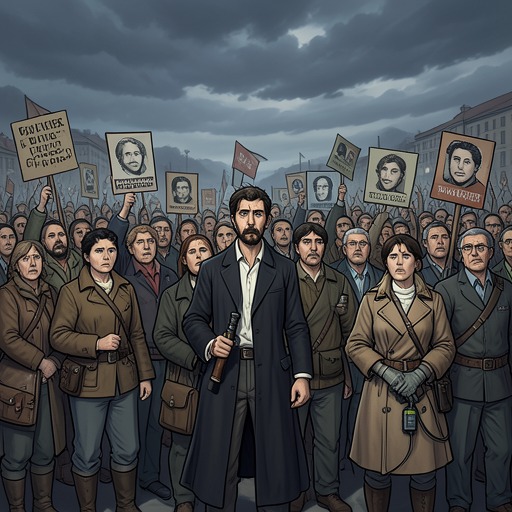
After reading Barry Meier’s 2003 book Pain Killer, Bisch and Nuss joined Art Van Zee and Sister Beth Davies in an informal alliance. They launched Relatives Against Purdue Pharma, or RAPP, carrying the message board’s work into political organizing and public protest. The group lobbied for statewide prescription monitoring programs, which would allow doctors to review patients’ prescription records and guard against doctor-shopping. Its members also sponsored drug-prevention workshops in schools and demonstrated outside Purdue Pharma’s headquarters with large photographs of their dead children.
The campaign placed grieving families in direct conflict with some chronic-pain patients, who praised the medication for helping them function and sleep. Bisch suspected that some people posting contrary views on the website were paid advocates hired by Purdue Pharma; the account notes that he was correct in some cases. RAPP’s work therefore involved disputes not only about corporate conduct, but also about how the drug’s benefits, risks, and public image were represented.
Courtrooms, rallies, and a continuing campaign
Bisch carried the campaign into legal and public events. In 2005, he drove twelve hours from Philadelphia to Tampa to sit beside Lee Nuss at Karen White’s civil trial against Purdue Pharma. White’s case was the first against the company to proceed beyond summary judgment. She sought $138,000 in lost wages and $690,000 for emotional pain after her dismissal; the case mattered to RAPP members, who hoped it would establish that Purdue Pharma’s marketing had crossed a legal line.
Bisch saw the imbalance in the courtroom as emblematic of the challenge facing the families. Purdue Pharma had ten lawyers on its side, apart from staff, and was represented by King and Spalding; White had one attorney. Her lawyer estimated that the company spent $500,000 defending the case, though a company spokesman did not confirm that figure. The trial made visible the distance between the families’ personal losses and the resources available to the corporation they were challenging.
At a 2003 drug-abuse-prevention conference in Orlando, RAPP members travelled from Rhode Island and New Jersey to protest because Purdue Pharma was exhibiting there. In the rain, Bisch read aloud the names of 260 people memorialized on his website. An unidentified woman turned on a sprinkler, soaking the protesters; a hotel executive denied that the hotel had arranged it. The scene condensed the campaign’s method and vulnerability: the parents brought their dead into a professional setting where the company promoted its product, and Bisch gave the memorial names a public voice.
At a later rally in Abingdon, Bisch again led a procession of grieving relatives, this time fifty people walking from a small park to the courthouse. He carried a block-lettered sign whose altered spelling made its accusation unmistakable. Lee Nuss walked nearby beside an enlarged photograph of her son, while a large memorial magnet on her car carried his name and those of others. More than a decade later, images of that rainy rally would recur in accounts of the crisis’s beginnings. Bisch’s lasting narrative role lies in that movement from the screen to the street: he helped turn a family’s sudden loss into a visible record, a network of bereaved relatives, and sustained public pressure for accountability.