Debbie Honaker
DopesickDebbie Honaker’s story follows a path from routine gallbladder surgery to opioid dependence and, eventually, treatment with Suboxone. Its significance lies in the sequence: prescriptions given in the course of ordinary medical care, advice from a neighbor, severe withdrawal when the medication ran out, and increasingly desperate efforts to obtain pills. Honaker’s account makes dependence visible not as a single decision but as a changing condition shaped by clinical practice, economic strain, and the need to avoid becoming sick.
Identity and Setting
Honaker was a twenty-seven-year-old married mother in Lebanon, Virginia, when she underwent gallbladder surgery in the early 2000s. Her experience unfolded amid layoffs and shutdowns in the factories and mines around her town. She and her husband later wondered whether events might have gone differently if her surgery had not coincided with that economic contraction; the account presents the timing as a question they returned to, not as a simple explanation for what followed.
The broader medical setting also mattered. OxyContin’s 1996 introduction coincided with a movement to treat pain as the fifth vital sign. Hospitals and accreditation bodies were adopting new pain-assessment standards, while patient surveys and reimbursement pressures encouraged clinicians to take pain complaints seriously. Purdue Pharma promoted OxyContin as a safe, reliable option for a wide range of pain. In training, the company characterized doctor-caused addiction as extraordinarily rare. That climate helps explain the authority attached to a prescription in Honaker’s account, without reducing her individual experience to company messaging or medical policy alone.
Prescriptions and the Onset of Dependence
After surgery, Honaker received a thirty-day prescription for OxyContin 10-milligram tablets, followed at a postoperative checkup by another month’s supply, this time of 40-milligram tablets. When she reported continuing pain at the incision, her surgeon prescribed 7.5-milligram Percocet for breakthrough pain. The instructions were to take it as often as every two hours, alongside the twelve-hour OxyContin, rather than only when pain required it. She was even expected to set an alarm to take Percocet during the night.
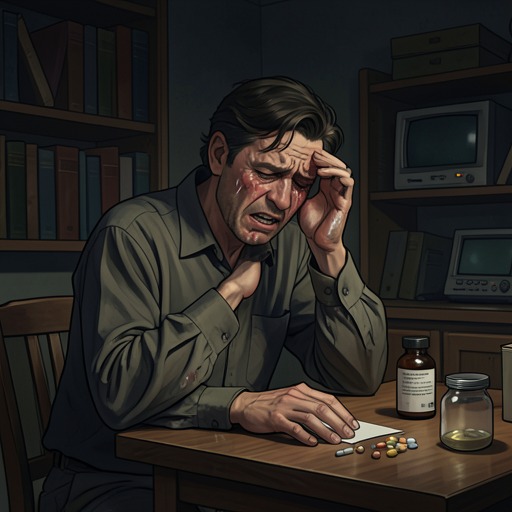
Honaker later described the force of those instructions as a matter of trust: she did not say the doctor had compelled her, but she and her husband understood that following the schedule was what they were supposed to do. The account then records a shift from prescribed use to advice-seeking outside the clinic. When her pain continued, she visited a neighbor known for abusing pills, who told her that crushing and snorting them would make them work better. When her prescriptions ran out, Honaker experienced severe withdrawal. She recalled vomiting, diarrhea, aches, irritability, shaking legs, and an inability to sleep, and said the need to make the pain stop could lead a person to do almost anything.
Within months, she had learned how to obtain opioids through emergency-room visits, presenting a false indication of kidney-stone pain and falsifying a urine sample. She left with Percocet. The progression was consequential: by the time she began taking money her husband had set aside for the electric bill to pay for pills, she was, in the book’s account, fully addicted.
Seeking Pills and the Costs at Home
Honaker also visited a Lebanon physician whose opening question, as she recalled it, was what she wanted. The Virginia Board of Medicine suspended that doctor’s license in 2014 for excessive prescribing and poor record keeping. The board noted that five patients had died from overdoses while under his care, although those findings came more than a decade after Honaker first visited him. Honaker’s experience with that practice thus sits within a documented pattern of prescribing concerns, but the source does not establish that the later disciplinary action was a response to her case.
Her efforts to maintain access to pills extended beyond her own prescriptions. She stole painkillers from her husband’s elderly grandmother and bought pills from people who obtained OxyContin prescriptions through Medicaid and then sold them. Honaker described the sellers’ financial bind: they needed to choose between basic expenses, including food and electricity, and their other needs. Her account connects pill diversion not only to dependence but also to household economies under pressure.
She also encouraged a laid-off neighbor with a painful hip to seek a prescription from a local pain doctor, drove her to the appointment, and coached her on what to say. Honaker remembered that the neighbor was reluctant and needed medication for diabetes and high blood pressure as well. The episode shows how the knowledge of obtaining pills could pass between people facing different kinds of need, while the resulting prescriptions became part of a fragile means of getting by.
Treatment and What Her Story Reveals
When the book describes Honaker at an addiction clinic in Lebanon, she was receiving medication-assisted treatment with Suboxone alongside Crystal Street. The medication, when appropriately prescribed and used, staves off withdrawal and reduces cravings without producing a high. Honaker and Street, both middle-aged, had each been jailed; they described lives marked by unstable work and the consequences of addiction. Honaker’s account distinguishes between seeking drugs for intoxication and seeking them to avoid withdrawal: by the end of the progression she describes, preventing sickness, rather than getting high, had become the immediate aim.
That distinction gives the story its central reversal. The same process that began with directions to take pain medication regularly ended with a narrowing of purpose around maintaining access to opioids. Treatment with Suboxone offered a different means of preventing withdrawal, but the account does not present it as a complete resolution or supply a later outcome for Honaker. It locates her instead within a wider struggle over whether medication-assisted treatment is accepted as treatment, and whether people living with addiction are regarded as patients or moral failures.
The book’s reporting began in 2012, when many families affected by heroin in Roanoke’s suburbs were too ashamed to speak publicly; five years later, nearly all agreed to be named, with exceptions for people concerned about work or safety. That changing willingness to be identified frames Honaker’s testimony as part of a larger effort to make private family experiences reportable. Her account also illuminates the gaps between health care and criminal justice that the book follows: prescribing, withdrawal, emergency-room tactics, theft, jail, and clinic-based treatment appear not as separate subjects but as stages and pressures in one life. The evidence leaves her receiving treatment, with no claim that the story had reached a final recovery or ending.