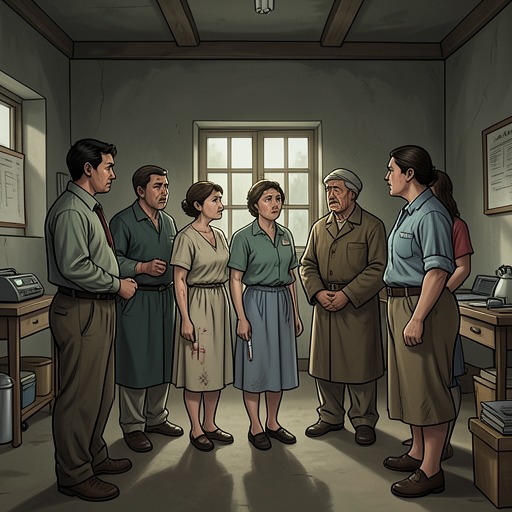
Sue Ella Kobak
DopesickSue Ella Kobak is a lawyer and activist whose work against Purdue Pharma grew from a lifetime of commitment to Appalachian communities. As Art Van Zee’s wife and closest editorial ally, she helped turn his medical warnings about OxyContin into a public challenge to the company. Her history of labor activism gave that challenge a longer frame: in her view, Purdue’s offer of money and its claims of innocence repeated an old pattern in which powerful outsiders profited from the region and left local people with the damage.
Identity and Background
Kobak was a coal miner’s daughter, raised in Poor Bottom Hollow, a Kentucky coal camp just over the mountain from Lee County. She trained as a lawyer and was already an activist when mutual friends introduced her to Van Zee, the physician who had come to the region in 1976 to work in a medically underserved community. Their first real date was an NAACP rally in Bristol, Virginia, called in response to a planned Ku Klux Klan rally. The gathering ended with people holding hands and singing “We Shall Overcome.”
They married a few years later. Their wedding included a three-legged goat as the flower girl, while the couple’s shared commitment to the region soon became part of their public identity. Many locals called them “Doc and that woman,” a label Kobak associated with her refusal to change her name. The phrase compressed two aspects of her position: she was known through her partnership with the doctor, but she did not surrender her own name or public voice within it.
Organizing Against OxyContin
When Van Zee and Kobak recognized that their community’s experience was not isolated, they moved from alarm to organized action. Under the auspices of the Lee Coalition for Health, a grassroots group of ministers, social workers, and other community-minded residents, Van Zee held public meetings. Kobak, described as a former VISTA volunteer, edited and coached his letters to Purdue Pharma. Those letters documented injection patterns, frequent overdoses, abscesses, and increased hepatitis C.
In August 2000, Van Zee wrote to Purdue medical director David Haddox, urging the company to investigate prescribing patterns in the region and warning that the affected areas might be early signals of a wider crisis, as San Francisco and New York had been in the early years of HIV. Purdue answered by sending adverse-event report forms. At a forum for local doctors and families, Van Zee also brought in Yale substance-abuse experts to explain the physical and psychological distress of opioid withdrawal and the chronic, relapse-prone nature of opioid addiction. Kobak’s contribution was not simply to support these warnings privately: she helped make them legible as evidence and carry them into public debate.
Confrontation with Purdue Pharma
A meeting with Purdue executives and local families sharpened the conflict. One father described his son’s turn from a good student and outdoorsman to stealing from the family to buy black-market OxyContin. He argued that the company should have recognized Lee County’s problem, given the volume of pills it was sending there. Instead of offering the compromise Van Zee had hoped for, the executives presented a proposed full-page newspaper advertisement denying that Purdue had targeted high-disability or Medicaid areas, saying it had not known of the drug’s abuse potential, and disputing that OxyContin could be quickly reformulated.
Kobak understood the meeting as a setup intended to force the advertisement on the group. She confronted Haddox directly, accusing Purdue of having harmed Appalachia more than the coal industry had even attempted to do. When Haddox objected, she insisted on her standing as an Appalachian scholar whose family had deep roots in the region. She left with the others; the advertisement never ran. Her anger was not an interruption of the argument but its clearest expression: Purdue’s corporate account of the crisis could not be separated from local memory of extraction, injury, and outside power.
An Older History of Resistance
That memory had been forged in earlier fights. During the nine-month Pittston coal strike in 1989, Kobak stood beside striking miners while carrying her six-month-old baby. Sister Beth Davies lay on the ground to block coal trucks; Kobak stood with the workers and their families. Their lives had been threatened over the years because of their activism, including work opposing the effort to make an injured miner sign away all company liability. In this history, the prospect of confronting a wealthy corporation was neither new nor abstract.
After a meeting with Purdue, pharmacist Greg Stewart proposed accepting the company’s $100,000 contribution toward county treatment and law-enforcement efforts as partial repayment for what it had made from the community’s suffering. Van Zee and Kobak agreed at first and drafted an acceptance letter. Kobak explained that coal companies had taught her how firms could take from a region and leave behind broken bodies. Sister Beth Davies opposed the donation, reading it as another effort to buy peace. The episode exposed a genuine strategic disagreement: accepting resources might help local services, but it might also allow a corporation to present a payment as an answer to harms the community was still confronting.
The Cost and Continuance of the Work
Kobak’s support for Van Zee’s campaign did not make its demands costless. In 2000, she gave him a copy of Purdue’s New Drug Application for Christmas, a document he later used to explain the FDA’s 1995 approval of OxyContin to Barbara Van Rooyan, whose son had died after taking the drug. The application recorded that crushing the tablets could cause immediate rather than controlled release, that withdrawal symptoms had appeared during clinical trials, and that much of the oxycodone in a crushed pill could be recovered for injection. The gift became a working instrument in Van Zee’s investigation, but the work around it repeatedly entered the couple’s home. Kobak recalled that they tried to go a day without saying “addiction” or “OxyContin” and never managed it. She admired her mild-mannered husband’s determination to stand up for the region while increasingly resenting how much time the struggle took from their family.
Years later, the community work remained intertwined with the couple’s life. Van Zee was still working sixteen-hour days and remained in contact with Sister Beth Davies about patients with opioid-use disorder, while Kobak chafed at the continuing demands on him. In reflecting on what offered hope, she returned to a principle the book associates with her repeatedly: “The answer is always community.” Her role in the story rests in the practical force of that belief—in coaching the warnings, confronting a company in public, drawing on an older history of resistance, and continuing to inhabit the personal costs of a struggle that never stayed at the clinic door.