Cheri Hartman
DopesickCheri Hartman is a psychologist whose work with the Hope Initiative placed her between people in crisis and a treatment system that often could not receive them. Working with families, local police, and health professionals, she tried to divert people from jail, find residential beds, and make medication-assisted treatment available. Her efforts show both the intimacy and the limits of local response: care depended on persistent personal intervention, while money, treatment rules, provider shortages, and stigma repeatedly narrowed the choices available.
Identity and Place in the Community
In 2016, Hartman joined Jamie Waldrop and Janine Underwood, along with local police officers, in an effort to steer Roanoke residents with substance-use problems away from jail and toward treatment. She and her husband, psychiatrist David Hartman, confronted bureaucratic obstacles, political indifference, and resistance to buprenorphine as a treatment for opioid-use disorder. Their work belonged to a wider volunteer response in a region where families had few reliable ways to navigate care and where shame could keep addiction hidden.
The book places Hartman’s local work against a broader crisis of economic and medical conditions. In Martinsville and Henry County, unemployment rose above 20 percent, food-stamp claims more than tripled, and disability rates increased by 60.4 percent. The account also identifies the collapse of work and the widespread promotion of painkillers as forces that helped fuel the epidemic. Hartman’s interventions addressed the immediate consequences of that crisis, but the obstacles she encountered were not simply individual failures to seek help: they were built into the availability, affordability, and organization of treatment.
Building Routes into Care
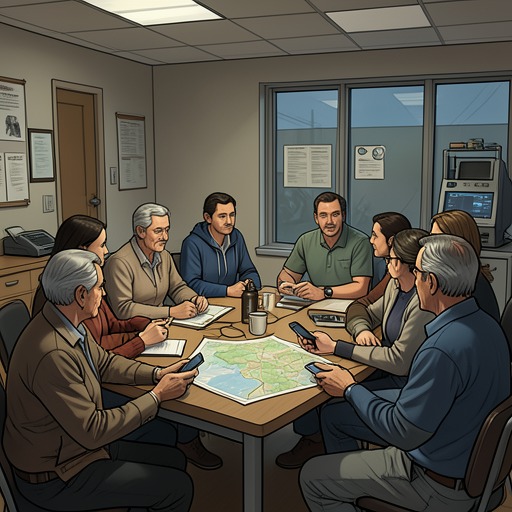
The Hope Initiative developed practical ways to help people move through a fragmented system. By early 2017, its volunteers had assembled a five-page spreadsheet listing thirty-six rehabilitation and aftercare providers across the southeastern United States. The list allowed them to search for a placement according to a patient’s finances and the facilities’ available beds. At a monthly clinic session, people could meet trained volunteers who would help troubleshoot care, while social-service workers assisted eligible patients with Medicaid applications. Some volunteers also arranged outpatient medication-assisted treatment, although the group itself was divided over its use.
Hartman’s work with Jamie Waldrop and the hospital system focused on the especially vulnerable interval after an overdose. Karen Kuehl was studying Ontario protocols in which patients revived in emergency rooms were automatically referred to outpatient medication-assisted treatment and counseling. Hartman helped Kuehl pursue a similar handoff in Roanoke. Their plan ran into a shortage of medication providers and detoxification and treatment beds, as well as financial, legal, and bureaucratic barriers. Hospital social workers did refer some revived patients to Hope, but the intended, coordinated transfer remained difficult to establish.
Those barriers mattered because patients’ willingness to enter treatment could be brief, while the system’s response was slow. Hartman also worked in a setting where access to urgent psychiatric care and addiction treatment did not align neatly: Tess Henry moved between jail, a women’s shelter, and psychiatric wards, while people seeking longer-term care faced waiting lists and funding problems. Hartman’s contribution was not a single institutional solution but sustained coordination among volunteers, families, clinics, and professionals as they tried to keep a treatment opportunity from closing.
Supporting Tess and Joey
Hartman’s work with Jamie Waldrop extended to Joey Gilbert, whose substance use, mental-health difficulties, and unsafe living circumstances made finding a suitable placement particularly complicated. Hartman and Waldrop worked together to locate a residential-treatment bed under Hope’s policy that volunteers would work in pairs. The arrangement distributed both the practical tasks and the emotional burden of helping someone through repeated crises.
After several interventions, including a visit to Joey in an emergency room, the two women persuaded her to move away from a drug dealer. While helping Joey pack, Waldrop found clothing belonging to Tess Henry, a reminder of how the lives of people in the same struggling network could overlap. Hartman also persuaded her psychiatrist husband to take Joey on again as a Suboxone patient. Joey’s divorced parents shared the expense of medication, visits, and laboratory work, while Joey, who lacked insurance, applied for charity care through a hospital-run clinic.
Medication did not remove the difficulty of finding residential care. In March 2017, the only inpatient program then willing to accept Joey was a free, faith-based facility in Charlotte that did not allow Suboxone or other medications. Joey chose to taper off medication to qualify for admission, although she knew the risks. Hartman and Waldrop supported her wish to enter the program but worried about the forced choice between treatment and continuing medication. Hartman understood Joey’s situation as involving serious psychiatric problems as well as addiction: bipolar depression, probable post-traumatic stress disorder, and use of multiple drugs. In Hartman’s experience, this combination made treatment especially difficult, even with medication. She believed a more suitable transition would have allowed a long-acting Vivitrol injection to help bridge Joey into rehabilitation.
Joey died at twenty-seven after an overdose of illicit methadone on March 26, 2017. The account describes Hartman calling Waldrop the next morning with the news. Joey had lain in a house for nearly eight hours before emergency services were called; people who had been using with her had cleared the scene, fearing prosecution. Her death was the nineteenth fatal overdose in Roanoke County’s suburbs that year. Hartman’s efforts had helped secure treatment and medication, but they could not overcome the lack of an inpatient option able to accommodate Joey’s needs.
Treatment, Stigma, and Unfinished Work
Hartman’s work also brought her into conflict with a culture that treated medication as evidence of incomplete recovery. Tess Henry had attended twelve-step meetings before but felt stigmatized for taking buprenorphine. Although Narcotics Anonymous officially accepted medication-assisted treatment, longtime members asked to sponsor or mentor her declined. The episode exposes a divide between the treatment supported by medical evidence and the standards of recovery enforced in some peer settings. For patients, those attitudes could make an already precarious route into care more isolating.
Hartman and her colleagues continued pressing for systems that could make treatment easier to reach. Later, Warren Bickel received a grant to pilot protocols connecting overdose patients directly to outpatient buprenorphine, including through a newly approved monthly injection. The work reflected the same service gap Hartman and Kuehl had encountered: an emergency-room rescue could be followed by a long wait for outpatient care. In Roanoke, the community services board had added medication treatment for twenty-one patients, but required counseling first, while Carilion still had a three-week wait for outpatient medication-assisted treatment.
Hartman’s significance lies in the work between these institutions: pairing volunteers, families, police, clinics, and clinicians to create a path from crisis toward care. Her cases reveal how that path could be broken by unaffordable treatment, unavailable beds, medication restrictions, and stigma, even when a patient and a committed support network were trying to move forward. The Hope Initiative offered persistence and local knowledge, but the repeated emergencies—and Joey’s death—make clear that volunteer commitment could not substitute for accessible, coordinated treatment.