Lee Nuss
DopesickLee Nuss is a Florida mother whose son Randy died at eighteen after taking OxyContin. His death drew her into a network of bereaved parents and then into organized opposition to Purdue Pharma. She became one of the activists who turned individual family losses into a public record, while carrying Randy’s ashes into settings where the company’s conduct and its consequences were being contested.
Identity and Loss
Nuss lived in Palm Coast, Florida, but the connection that first brought her into contact with Ed Bisch began in Philadelphia. Too grief-stricken to reach out to him herself, she was persuaded by her daughter Monique to speak with him. They discovered that they had grown up less than a mile apart in the working-class neighborhood of Fishtown. Their shared background established a bond before they knew the full extent of their common loss.
Nuss had lost her only son, Randy, an eighteen-year-old who died after taking an 80-milligram OxyContin pill obtained from a friend. The friend’s mother wanted him to sell pills to help pay the rent. Nuss had not known Randy was using pills. Because she still had opioid medication left from dental surgery, she initially reasoned that his use could not have been going on for long. The details made the crisis intimate and ordinary at once: a young person preparing for the future, a pill passed through a familiar social circle, and a parent who did not know the danger had entered her home and community.
Randy had been preparing to leave for culinary school in 2003. At a later court proceeding, Nuss described the bitter reversal that his prepaid college education ended up paying for his funeral. Her testimony made the loss more than a statistic: the money set aside for a beginning had become a resource for the aftermath of his death.
From Grief to Organizing
Bisch’s OxyKills.com message board was an early point of connection for families affected by OxyContin. Nuss and Bisch, both from Fishtown and both parents who had lost sons, joined a wider alliance with Art Van Zee and Sister Beth Davies after reading Barry Meier’s book Pain Killer. Together, Nuss and Bisch helped launch Relatives Against Purdue Pharma, or RAPP, a grassroots nonprofit that carried the message board’s memorial function into public and political life.
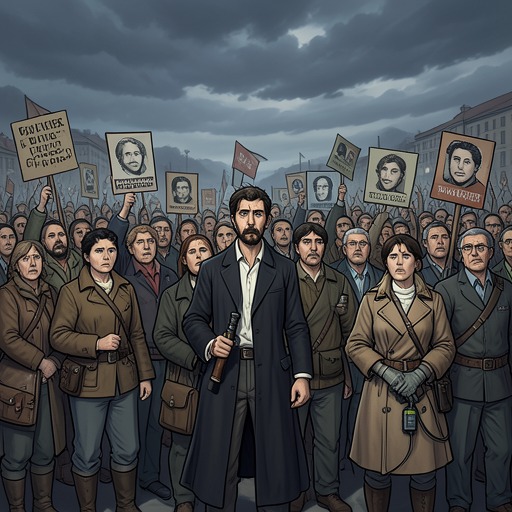
RAPP’s work addressed both the prescribing system and Purdue’s public presence. Its members lobbied for statewide prescription monitoring programs that would let doctors check patients’ prescription histories and reduce doctor shopping. They sponsored drug-prevention workshops in schools and displayed poster-sized pictures of their dead children outside Purdue’s headquarters. The group also encountered chronic-pain patients who praised OxyContin for helping them function or sleep. In this contested space, bereaved families’ warnings met claims of therapeutic benefit, and the debate concerned not only the drug’s uses but also how its risks had been presented and managed.
Nuss’s part in this activism was marked by objects she carried. Raised Catholic and deeply religious, she wore rosary beads for protection at events and kept a portion of Randy’s remains in a tiny bronze urn. She left the main urn at home but took this smaller one with her, making her son physically present in the places where she spoke and protested. The objects were not simply emblems of grief: they gave her public advocacy a personal witness that could not be reduced to numbers or corporate statements.
The Urn in Court
That witness entered a courtroom during Karen White’s whistleblower trial against Purdue. White had only one lawyer and no staff, a description that treated Bisch, Nuss, and the urn containing Randy’s ashes as part of her small circle of support. Nuss brought her rosary beads and lent White an extra set to hold during the proceedings. When Nuss realized several days into the trial that she had left the beads in her car, she excused herself and entrusted White with the urn while she was away from the plaintiff’s table. White was moved by the trust involved in being asked to hold it.
The urn was subsequently removed from the courthouse at the request of Purdue’s lawyers, who had heard it was there and asked the judge to exclude it from the building. Bisch and White expected Nuss to react angrily. Instead, she laughed and told them that Randy was absent in body but present in spirit, adding that although he had left the building, he would return. Her response turned an act of exclusion into a moment of defiance: removing the remains did not remove the son from the case or from his mother’s purpose.
Testimony and Public Meaning
At a later Purdue proceeding, Nuss asked the judge to reject the plea agreement and argued that a financial penalty would mean little to the company. She urged that the punishment fit the harm. The courtroom was crowded enough for observers to watch from a separate overflow room, and the judge later remembered Nuss’s testimony as the most heart-wrenching account from the parents. Her plea connected an abstract legal resolution to the life that had been lost before Randy could attend culinary school.
Nuss then raised the small brass urn she carried when she traveled. She addressed Purdue executives Howard Udell, Michael Friedman, and Paul Goldenheim, identifying Randy’s ashes as the remains of someone lost to their drug. A reporter thought she might throw the urn, but she waved it and returned to her seat. The gesture carried accusation without becoming an assault: she made the consequences visible, placed the company’s leaders in direct relation to a particular death, and then stepped away.
Nuss’s story also sits within the book’s broader account of unequal responses to drug use. Its discussion of prescribing and incarceration describes how doctors prescribed painkillers to people of color at lower rates than to white patients, while drug enforcement and imprisonment fell disproportionately on Black and Hispanic people. That context does not erase Nuss’s individual loss; it shows how the opioid crisis and the institutions responding to it produced different risks and consequences across communities. Her activism is presented as a challenge to Purdue and as part of a larger argument about whose suffering becomes visible, whose drug use is treated as a public-health emergency, and whose is answered primarily with punishment.