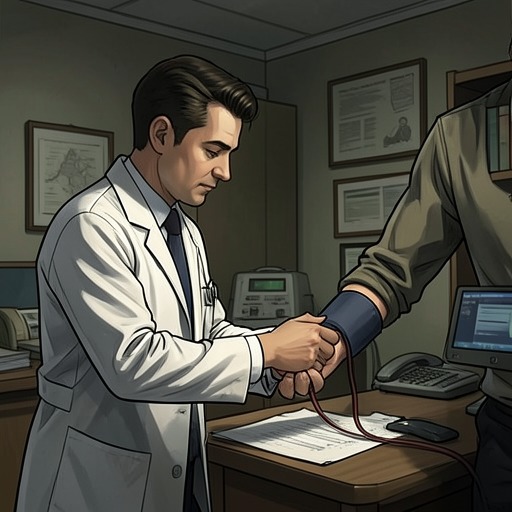
Steve Huff
DopesickSteve Huff is a family physician who moved from rejecting pharmaceutical gifts to confronting the consequences of extensive OxyContin prescribing in rural Virginia. His account links everyday practices that could make drug-company influence feel ordinary—free meals, social attention, and brief presentations—to patients’ worsening symptoms, the risks of combining opioids with sedatives, and the difficult withdrawal that followed when he stopped prescribing narcotics.
Identity and Early Practice
In the mid-1990s, Huff was a medical resident encountering pharmaceutical promotion at the beginning of his career. Drug-company representatives offered branded stickers, golf balls, and pens, but their attention extended well beyond small gifts: they took young doctors golfing and bought lunch on many days, pairing the meal with a short educational seminar about their products. Huff understood the setting as one in which companies were courting doctors who had a lifetime of prescribing ahead of them.
As he moved into family practice, Huff decided that accepting free meals was wrong. He repeatedly objected and made his refusal visible by bringing cold leftovers from home and taking them from the office refrigerator. When he tried to persuade colleagues to end the lunches, they resisted, saying staff would be disappointed to lose the free food. The episode shows the social friction involved in refusing a perk once it had become part of workplace routine: Huff’s objection was not only to a company’s direct pitch, but also to the custom that made the pitch easy to accept.
He also described why that custom could be persuasive. The representatives were personable and attentive, and drug names recurred during meals and conversation. Huff believed that even doctors who felt immune to influence could become more likely to prescribe a product after this kind of repeated exposure. His own response was to stop accepting pharmaceutical gifts altogether, including inexpensive items such as Post-it notes and pens. His refusal did not mean he had never prescribed a promoted drug: at his first family-medicine practice, in Stuart, Virginia, he prescribed OxyContin once or twice.
What He Saw in Patients
Huff’s early experience with OxyContin made its effects tangible in follow-up visits. Patients returned still complaining of pain, while reporting new problems that included sleepiness, confusion, constipation, and unsteadiness. A few remained on a stable dose once it had been properly adjusted, but, in his assessment, problems were more common. The treatment could leave the original complaint unresolved while adding difficulties for patients and for the physician caring for them.
He also noticed increased depression and memory loss among long-term opioid users at the practice. At the same time, news from the community raised another concern: drug seekers were breaking into some patients’ homes or cars to steal their medication. The pills were therefore present in two different but connected contexts—as prescriptions intended for pain and as commodities sought for their resale value. Huff’s account puts the consequences of prescribing beyond the examination room, where patients’ homes and vehicles could become targets.
Laurel Fork and the Inherited Prescriptions
In 2003, Huff moved his practice to Laurel Fork, in Carroll County, to fill a place left by two doctors who had departed. He found himself deluged with young-adult and middle-aged patients who had been prescribed large amounts of OxyContin by his predecessors. Many were also taking benzodiazepines, including Xanax, Klonopin, and Valium, which residents of Appalachia commonly called nerve pills. Huff found no explanation in the patients’ charts for why they had received so many prescriptions. In his view, adding benzodiazepines to the opioid regimens put them at enormous risk of overdose.
Many of these patients lived in nearby Galax, where two major employers, Hanesbrands clothing and Webb Furniture, had closed and other plants were downsizing. The book situates Huff’s practice amid that local economic contraction, describing sewing and furniture production moving toward lower-wage countries in the years after major changes in trade. This context does not establish why any particular patient received medication or became dependent. It does, however, place the prescription crisis in communities also facing diminished industrial employment and fewer secure sources of work.
Huff described OxyContin as having become a resource that could be exploited as well as a medication. A large bottle of eighty-milligram tablets could be sold for a dollar per milligram, he said, bringing in enough to live on for a month. That account clarifies why a prescription could acquire value outside its stated medical purpose. In the clinic, Huff was seeing the health risks of the medications; in the surrounding community, their resale could make the supply a source of income.
Discontinuing Narcotics
Huff eventually stopped the pattern of prescribing in his Laurel Fork practice. The response was immediate and difficult. Patients became angry, and some were in withdrawal without yet understanding that they were addicted. Nearly every day, he recalled, he had to face another group of about ten people and tell most of them that he was discontinuing their narcotics. He found the work strenuous and draining: the decision to halt prescriptions did not simply remove medication from the system, but brought the dependence and withdrawal already present into the room with him.
The pressure became personal. During one particularly difficult week, two patients threatened his life. Huff responded by getting in his car and driving to Mississippi for a long weekend with his sister. That temporary departure marks the cost of confronting the prescriptions in a setting where patients were already dependent and some reacted with anger. The evidence does not describe what happened to those patients afterward, or how Huff’s practice developed beyond this episode.
Significance
Huff’s account resists a simple contrast between a corrupting pharmaceutical system and a physician untouched by it. He recalled how promotion could shape ordinary professional life, rejected its gifts, and nevertheless prescribed OxyContin briefly before observing troubling effects among patients. Later, he inherited a practice where large opioid prescriptions and benzodiazepines had accumulated without clear justification in the charts. His decision to discontinue narcotics confronted that legacy, but exposed the dependence and withdrawal it had helped leave behind.
The arc also distinguishes stopping prescriptions from resolving the conditions produced by years of prescribing. Huff recognized the overdose danger of opioid and benzodiazepine combinations and tried to halt the flow of narcotics, yet patients’ withdrawal and the threats he faced made clear that the change could not be carried out without immediate consequences. His story contributes a clinician’s view of the crisis: commercial persuasion could become routine, prescribing could outlast its rationale in patient records, and an individual doctor’s attempt to draw a line could be both necessary and punishing.