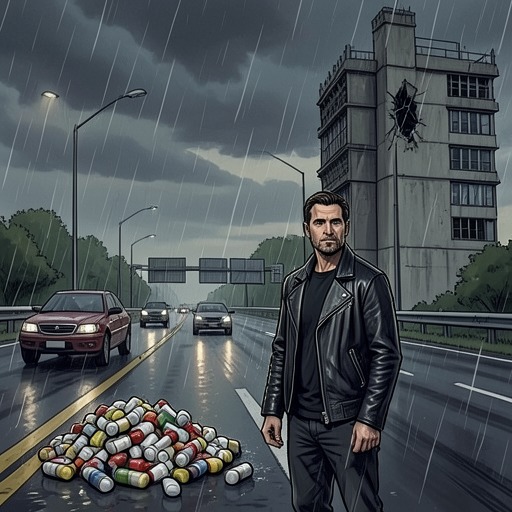
Ronnie Jones
DopesickRonnie Jones, known in Woodstock as D.C., was a twice-convicted drug dealer whose bulk heroin operation transformed a small-town market in northern Virginia in 2012 and 2013. His story is both a record of how that market expanded and a study in distance: he supplied a network that left hundreds of people dependent on heroin, yet described himself as a wholesaler far removed from the needle. The book places that account beside the families, investigators, and communities living with the consequences—and beside Jones’s own recognition that the criminal lifestyle had become an addiction of its own.
Identity and Background
Jones came to the northern Shenandoah Valley from the Washington suburbs in 2012, arriving in a Virginia Department of Corrections van. He had already been convicted twice as a drug dealer. In Woodstock, investigators first knew him by the nickname D.C.; Gray eventually told Bill Metcalf that D.C.’s real name was Ronnie Jones. He lived in a low-income apartment on the outskirts of town, but his operation would reach well beyond it.
The timing of Jones’s arrival mattered. Heroin had not yet taken hold in the bucolic northern Shenandoah Valley at the scale it would soon reach. According to the account police gave, Jones drew a handful of young people who had used pills recreationally—including football players, tree trimmers, and farmers’ children—into a growing heroin market. In a few months, what began with a small number of users had spread to hundreds. His prosecutors described the resulting devastation as a “tsunami of misery”: it began in Woodstock, then moved across the northwestern region of Virginia and into western bedroom communities of Washington.
Jones’s business was unusual for the small towns along the corridor. Authorities learned that his ring trafficked in seven counties and were building a case that he was the largest heroin trafficker along Virginia’s I-81 corridor, possibly the largest in the state. Metcalf contrasted Jones’s operation with earlier, less organized trips in which local users piled into a car to buy drugs in Baltimore. Jones brought substantial quantities directly into the region, establishing a supply that small towns had not previously experienced.
Building a Market
The operation depended on volume and on customers who could not simply wait out a disruption in supply. When Jones or his runners travelled to New York to restock, one of Jones’s user-dealers, Marie, told investigators that people in the area went into withdrawal while they were gone. She estimated that around two hundred people she knew would become sick, and that their distress eased when the supply returned. Her account makes the market’s dependence tangible: Jones’s trips were not merely deliveries but interruptions in the daily lives of people reliant on the heroin he sold.
Bulk sales also made the business unusually profitable. By importing heroin to a small town, Jones could make twice what dealers in Baltimore and other cities were earning. He spent conspicuously: new clothes accumulated in his apartment, and he discarded some after wearing them once. A security system announced, “Front door. Open.” He kept a personal trainer available, hired a designer to develop a logo for an all-natural skin-care line he hoped to sell, and bought new clothes for women in his circle. One woman kept stacks of new Lucky jeans at the apartment. Jones invoked the dealer’s maxim, “Never get high on your own supply.” The details of comfort and display sat beside a trade whose customers faced withdrawal when he was away.
His New York supplier, known as Mack, could also turn Jones’s access to bulk heroin into a mechanism for keeping him in debt and returning for more. When Jones sent a runner to Harlem for 200 grams at a cost of $13,000, Mack would typically send back 400 grams and charge an additional $14,000 for the extra heroin. The fronted supply carried an added cost of five dollars per gram, but Jones had no trouble selling it. The arrangement enlarged the flow of drugs while binding the local dealer more tightly to his supplier.
Metcalf interpreted Jones’s enterprise as more than an attempt to become a prominent dealer. In his view, it was also about money, control, and manipulation: Jones had created a market that had not existed before and then worked to increase its profitability. That assessment gives the business a double character. Jones was not simply serving an established demand; he helped expand the market on which his earnings depended.
Arrest and Incarceration
Jones’s arrest came in June 2013 after a chain of investigative steps: an informant’s tip led to a recorded purchase, which pointed officers toward one of Jones’s principal subdealers, former Marine Joshua Pettyjohn. Pettyjohn had been discharged from the Marines after alcohol-related charges and had later developed a heroin addiction. Metcalf tracked him as he bought 20 grams of heroin from Jones and drove away. When officers arrested Pettyjohn with heroin, he quickly confessed and provided details.
More than two dozen state, federal, and local officers eventually descended to arrest Jones. Brent Lutz watched him through binoculars from the Chinese restaurant next door and remembered that Jones looked unsurprised. Marie later recalled that Jones had anticipated a limited window for the operation, saying, “If I have a good run, it’ll last three months. If I have a great run, I can make it six.” The arrest was the end of the ring’s rapid expansion, but not of the consequences already moving through the region.
Jones received a twenty-three-year prison sentence for armed heroin distribution. Two years into that sentence, at the Hazelton Federal Correctional Institution in West Virginia, he received his first visitor. The reporter who travelled there had spent nearly a year hearing police and prosecutors describe him as a predator. Jones agreed to the visit, he said, because he wanted his daughters—then in kindergarten and first grade when he was arrested—to understand “there’s a different side of me.” The last time they had seen him before his arrest, he had brought birthday cupcakes to their school.
The meeting had initially been expected to last two hours, with no recording devices allowed. Instead, it continued from morning into late afternoon: a prison handler monitored the conversation through a glass wall while allowing it to run for more than six hours. The visit’s duration gave space to a fuller account, but it did not turn the interview into a simple redemption story. The reporter had also hoped to understand what led to Jesse Bolstridge’s premature death and whether the state corrections system’s repeated return of former prisoners to Virginia communities had contributed to a cycle of failure. Jones did not recognize Jesse’s name. When the reporter later broke that news gently to Jesse’s mother, Kristi Fernandez, the gap between the scale of Jones’s operation and his grasp of individual lives became painfully clear.
Responsibility and Narrative Significance
This was Jones’s third time in prison. The book situates that history within a wider pattern: people convicted of drug offenses could leave prison branded as felons, blocked from the mainstream economy, and caught in a cycle of jail and joblessness. Drug-involved offenders made up half the incarcerated population, and their recidivism rate was reported as 75 percent. Jones’s repeated imprisonment does not erase his agency in building the heroin ring; it places his trajectory within a system whose failures could help return people to prison without undoing the damage they had caused.
In the interview, Jones cast himself as the ring’s wholesaler, removed from the moment a needle entered a vein. He maintained that he had offered heroin more cheaply and in a safer setting than Baltimore. The book sets that defense against the evidence of a market he built, the quantities he moved, and the distress that followed when his runners were away. The comparison with Purdue Pharma’s claims about OxyContin underscores a shared pattern of blame-shifting: responsibility can disappear into the distance between those who profit from supply and those who experience its harms. Jones’s position in that pattern is not identical to a pharmaceutical company’s, but the book uses the parallel to examine how each can present itself as separated from the consequences of distribution.
Jones also described his involvement as a form of addiction. He said that he had promised himself he would not grow up to be like his father, and that although he was not addicted to a drug, he felt addicted to the lifestyle. He said he had not intended to continue in the trade, but that no one would hire him in the field for which he had trained or allow him to establish his own business. The explanation conveys constraint without absolving him: Jones could recognize the compulsive pull and economic dead end of his life while remaining the person who built and profited from the ring.
His story appears in a book concerned not only with dealers and arrests but with the gaps between criminal justice and health care. Families struggled to keep addicted relatives alive while people dependent on heroin tried to stave off withdrawal; in 2012, families across Virginia did not yet have online groups through which to share treatment advice and support. In that wider account, Jones is neither an isolated villain nor a substitute explanation for the epidemic. He is a consequential supplier whose choices accelerated heroin’s arrival in small towns, and a prisoner whose own explanations reveal how easily distance from the needle can become distance from responsibility.