Jesse Bolstridge
DopesickJesse Bolstridge was a nineteen-year-old football player and construction worker whose progression from painkillers to heroin and death from an overdose became one of the central personal stories in Dopesick. His mother, Kristi Fernandez, could not make the sequence add up: she wanted to know how a lively, athletic young man had become an overdose statistic, and hoped that understanding his experience might help other parents. The book follows that question from Jesse’s childhood and teenage injuries through his friendship with Dennis Painter, treatment and relapse, and the last days before a planned new attempt at recovery.
Identity and Early Life
Jesse was born in 1994 and died in 2013. In Strasburg, Virginia, he grew up in a community where high-school football carried local weight. He played for the Strasburg Rams, and his number, 55, later became a feature of his grave marker. He was remembered as a jokester and a popular boy next door, as well as a young man who worked in construction. Neighbors also remembered the cats that would follow him when he walked through the neighborhood.
The book presents his restlessness as an early feature of his childhood. As a toddler, Jesse resisted naps so persistently that he sometimes fell asleep on the floor in the middle of playing, still holding a toy. The account does not treat this trait as a diagnosis or as a simple explanation for what followed. Instead, it places his unusually high energy alongside a wider story about young people, prescription drugs, and the conditions in which addiction took hold.
Painkillers and the High-School Years
Kristi could not identify a single moment when Jesse’s life became dominated by pills. His exposure developed amid both medical treatment and peer exchange. At fifteen, he was diagnosed with Lyme meningitis; across high school he also sustained numerous football and snowboarding injuries that brought him to doctors’ offices and emergency rooms. He received opioid painkillers including oxycodone, Vicodin, and Percocet. By his junior year, after repeated concussions, a neurologist warned that another injury would mean he had to stop playing football.
Jesse also traded his ADHD medication, Adderall, to classmates. Some wanted it because they believed it helped them drink through the night without passing out; in return, they gave him painkillers. Those pills might have been bought on the black market or taken from the medicine cabinets of parents and grandparents. The book describes this informal circulation as part of the regional drug environment: medications prescribed for injuries could move among teenagers far from the circumstances for which they had been prescribed.
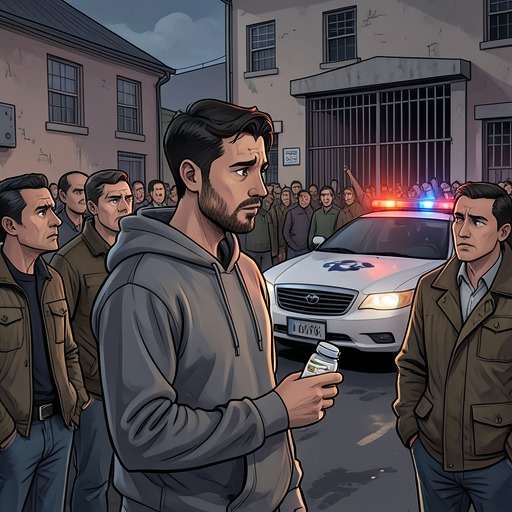
Kristi later understood that painkillers had made Jesse feel calmer and more normal, but she did not know this at the time. Nor did she know that he and his friends were passing pills around at gatherings described as pharm parties. Her first direct warning came from the mother of a friend, who accused Jesse of taking Percocet from her bathroom cabinet after he had spent the night at the friend’s home. Kristi defended her son and suspected that the other boy had taken the pills. The episode captures the uncertainty in the family’s early view of his drug use: an allegation was made, but its significance was not yet clear to her.
Dennis Painter and the Shift to Heroin
Jesse and Dennis Painter had been friends since toddlerhood; Dennis recalled photographs of the two of them playing together at three years old. They began partying together at sixteen, around the time Jesse was exchanging Adderall for painkillers. Their friendship continued as their drug use changed. Jesse and Dennis often drove to Baltimore together, and sometimes stopped at a city health department van to obtain clean needles. The journeys show how their lives had become tied not only to local drug use but also to seeking drugs and supplies beyond their hometown.
In the early stages of the heroin trade in the area, Jesse still preferred injecting crushed Roxys, Dennis recalled. Heroin became his drug of choice as their cravings grew because it was cheaper, stronger, and easier to obtain. Jesse’s first injection of heroin came from drugs Dennis had bought from a subdealer. Their relationship thus joined long-standing friendship to a changing pattern of use and supply; it also meant that the two friends could reinforce each other’s return to drugs.
In 2013, their parents paid for them to enter residential treatment at separate facilities outside the state. Both returned to drug use soon after coming home and reuniting. A Facebook post from April that year records Jesse marking a day of sobriety, evidence of an effort to stop even as the larger course of his addiction remained unstable. The account gives no basis for treating that post as proof of sustained recovery; it sits instead beside the repeated cycle of treatment, return, and renewed use that shaped his final period.
The Planned Treatment and Jesse’s Death
Two days before Jesse was due to fly to a treatment center in Jacksonville, Florida, he and Dennis were both caught in the immediate demands of drug use. Dennis was experiencing withdrawal and said he needed heroin. Jesse had spent the summer injecting black-market Roxys and expressed reluctance to use heroin, but the pills had worn off and he had been sick through the day. The account notes that he tried to eat foods he particularly liked and could not keep them down. His planned trip to treatment was close, but so was the pressure of withdrawal.
That night, Jesse and Dennis stole insulin needles from Jesse’s grandmother and bought heroin. The next morning Jesse complained of a headache, declined an offer of Tylenol, and returned to the spare bedroom. About two hours later, Dennis found him unconscious in the bathroom. Jesse died of an overdose before he could make the planned trip. The closeness of the treatment appointment gives the ending its stark chronology: a new attempt was scheduled, but it did not arrive in time to interrupt the immediate crisis.
Kristi Fernandez’s Search and Memorial
After Jesse’s death, Kristi continued to search for the missing links in his story. She wanted more than a general account of addiction: she hoped to understand how her son had moved from football and construction work to overdose, and to be better equipped to warn other parents. The book’s reporting returns to this unresolved inquiry. In 2016, the reporter met Kristi at Jesse’s grave on a hillside in Strasburg, Virginia, where the marker’s large 55 recalled his football jersey and the cemetery overlooked the stadium where he had once played.
The grave became a continuing family act of remembrance. Kristi changed its decorations for the holidays, cleaned away mud, and added small keepsakes; Jesse’s twin sisters helped clear away grass clippings. A cat’s paw was engraved at the base of the stone, recalling the animals that followed him, and the family’s marker carried a private expression of enduring love. Kristi also looked for signs of Jesse in ordinary occurrences, including a license plate bearing 55 and a receipt with the number 64.55. These details show grief continuing as a practice of tending, noticing, and searching rather than ending with the burial.
Narrative Role and Significance
The book introduces Jesse’s story through Kristi’s effort to understand her only son’s death. His grave, his football number, and the remembered stadium place an individual loss within a particular hometown; his history of injuries, prescription medication, pill exchange, and eventual heroin use gives that loss a wider social context. Born as opioid addiction was taking root, Jesse represents the epidemic’s movement into the northern Shenandoah Valley and the toll on a generation whose drug use could remain hidden within families and communities.
His story also makes visible how difficult it can be to reconstruct a gradual change after a death. Kristi had not known how much the pills affected him, did not know about the gatherings where pills circulated, and initially disputed an accusation that he had taken medication. Later, treatment and a recorded day of sobriety did not prevent relapse. The book does not resolve every question she asks; instead, it keeps her investigation central. Jesse’s life becomes both a family history she is trying to recover and a case through which readers can see the progression, interruptions, and narrowing opportunities that made the epidemic difficult to recognize before it became irreversible.