Teresa Gardner Tyson
DopesickTeresa Gardner Tyson is a nurse practitioner who leads mobile health care efforts for uninsured residents of Virginia’s coalfields. Through the Health Wagon and the annual Remote Area Medical outreach, she treats patients who often have few other options, while confronting the consequences of unaffordable care and limited public support. Her story makes visible both the reach of local commitment and the limits imposed on it by the health system around her.
Identity and Community Role
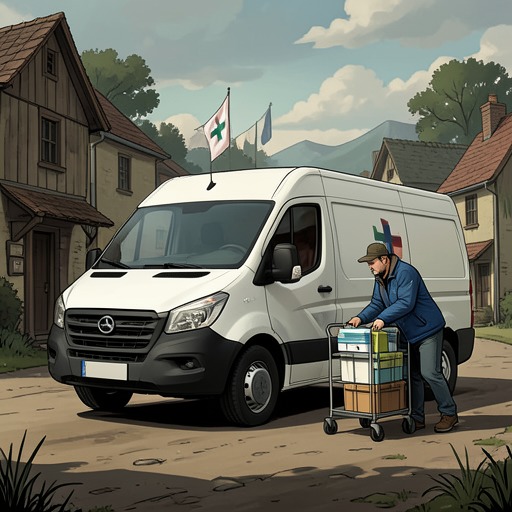
Tyson is a nurse practitioner and a devoutly religious wife and mother from Coeburn. She works with the Health Wagon, a grant-funded organization whose staff of twenty tends to the health needs of uninsured people across the region. The organization’s name recalls its origins: in 1980, Catholic nun and medical missionary Sister Bernie Kenny began providing care from the back of a red Volkswagen Beetle. Tyson’s work carries that model of mobile service forward, reaching patients where they live rather than expecting them to overcome distance, cost, and limited local resources on their own.
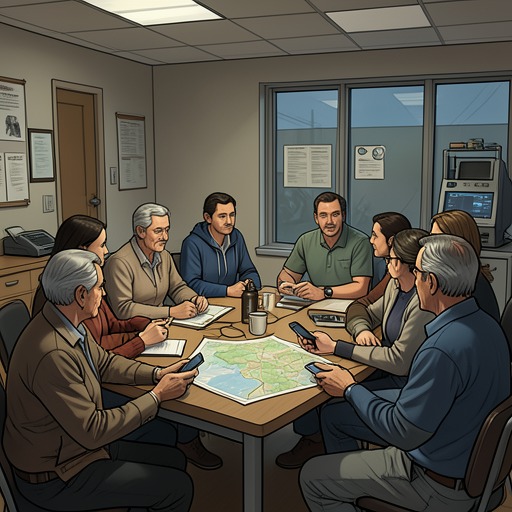
The book places Tyson among the people who respond to needs left unmet by public institutions. Across Central Appalachia, she encounters worn-out emergency workers, preachers, probation officers, and other caregivers trying to sustain their communities. Her own role is concrete: she treats patients, runs a free clinic, and takes a mobile unit over rural roads. The narrative connects that work to a Christian ethic of service, noting that a passage from Matthew 25:40 is embroidered on the back of her white coat.
Mobile Care and Remote Area Medical
One of the Health Wagon’s largest public efforts is its work with Remote Area Medical (RAM), the nation’s largest free medical outreach event. The three-day gathering takes place each summer at the Wise County Fairgrounds and serves uninsured patients seeking medical, dental, and eye care. Tyson helps plan and host it. In the weeks before the July 2017 event, she coordinated with media outlets, including some from the Netherlands, and made urgent calls when her assistant could not secure enough bottled water. A nonprofit that usually supplied pallets had already committed them to natural-disaster relief; the book records Tyson’s exasperated response that the unmet needs around her were themselves a disaster.
The event is a striking concentration of need, but the book also follows what happens after the visiting volunteers leave. Tyson operates the Health Wagon’s 2001 Winnebago along the region’s winding roads, managing calls from nurses, patients, and journalists while continuing her work between stops. The annual event draws outside attention, yet it cannot replace the daily services required by people who remain uninsured once the temporary clinics close. The contrast between RAM’s brief, large-scale gathering and the mobile unit’s continuing rounds defines the practical scope of Tyson’s work.
Patients and the Cost of Gaps in Care
A visit to a substitute teacher shows how those gaps shape ordinary life. Tyson treated the woman’s wrist during a mobile-clinic stop. At fifty-four, the teacher had not had insurance for decades, since a pregnancy for which she qualified for Medicaid. Her husband, a former Walmart worker disabled by a series of strokes, received Medicare. Because Virginia had not expanded Medicaid under the Affordable Care Act, the teacher pieced together free care at RAM and occasional visits to Tyson’s unit. She avoided her family doctor, who offered a discounted cash visit for $63, until she was nearly dying. Her daily pay as a substitute had also fallen from $70 to $56 amid school-district austerity and declining enrollment.
Tyson also confronted the consequences of untreated hepatitis C among patients who had stopped using drugs but still could not obtain specialized care. One forty-two-year-old man died after being unable to afford a specialist; by the time treatment could be arranged, the damage was too advanced for him to recover. Reggie Stanley, forty-five, had been sober for several years after a history of intravenous drug use, but remained uninsured. Tyson tried to find him treatment and could not persuade a gastroenterologist to accept him as charity care. He later died in a Charlottesville hospital while awaiting a liver transplant, after twelve years with untreated hepatitis C. By the time he reached the transplant list, his disease had progressed too far. Tyson subsequently had success distributing free Harvoni supplied by its manufacturer, but that development does not undo the delay that Stanley experienced.
Policy and the Limits of Local Effort
Tyson’s patients’ difficulties unfolded amid Virginia’s repeated rejection of Medicaid expansion. The book describes the state’s decision as a loss of federal funds and insurance coverage for hundreds of thousands of low-income residents, while states that expanded Medicaid could use the program to pay for treatment, counseling, and addiction medication. The contrast matters to Tyson’s work because the Health Wagon treats people whose needs are not met by ordinary coverage or local services. A mobile clinic can bridge some gaps, but it cannot substitute for sustained access to specialists and treatment.
In 2017, as national arguments over the Affordable Care Act continued and opioid advocates awaited a federal emergency declaration, Tyson followed political developments on her phone between patients and grew angry at what she read. The book presents that frustration alongside her daily care rather than as a separate political role: public decisions determine how much of the burden falls on the small organizations and practitioners serving uninsured communities. The distinction is especially clear in the cases of hepatitis C, where years without affordable specialist care could turn a treatable condition into a fatal one.
Safety, Persistence, and Narrative Significance
Tyson’s work also required changes to how and where the mobile unit operated. In Lebanon, she sometimes set up outside a Food City grocery store; in St. Paul, near the town square. In smaller communities, however, she learned to avoid residential neighborhoods. A close call in the former coal camp of Clinchco prompted her to move the unit from a neighborhood to the police-station parking lot. Neighbors had rushed the RV asking for help, but the person they first approached was not the patient they meant to identify. By the time staff reached the person in another room, it was too late to help; others in the trailer shouted at the Health Wagon staff to leave. Tyson stood by the decision to attempt care, while acknowledging that the changing circumstances made it unsafe to enter blindly.
The book shows Tyson both sustaining this work and bearing its emotional cost. She cried for days over Stanley’s death and continued looking at his obituary on her phone; its photograph showed him in his high-school graduation gown, and its guest-book entries recalled his music and the affection of those who knew him. The juxtaposition is central to her narrative role: the people behind the region’s statistics are patients she has tried to help, and the limits of care are not abstract when a person dies after treatment could not be secured. Tyson’s mobile practice offers a continuing response, but the story leaves its significance in the tension between what one committed practitioner can provide and what the surrounding system has failed to make available.