Mariatta's son
KalevalaMariatta's son is an infant whose exceptional growth, disputed names, and startling speech unsettle the authority of the old hero Wainamoinen. At only two weeks old, he challenges Wainamoinen's judgment against him; Wirokannas then blesses him and grants him royal heirship, marking the child as a possible successor and the beginning of a changed order.
Identity and Naming
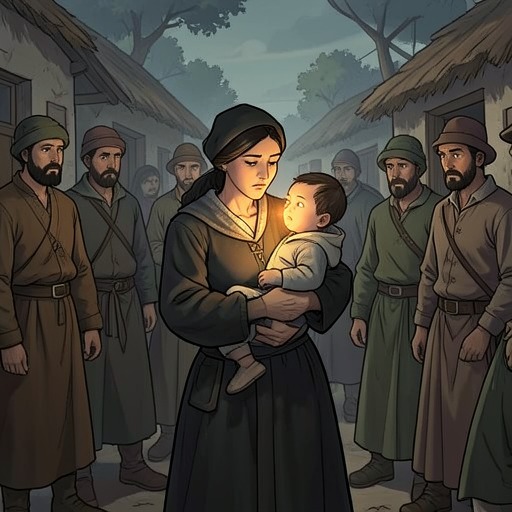
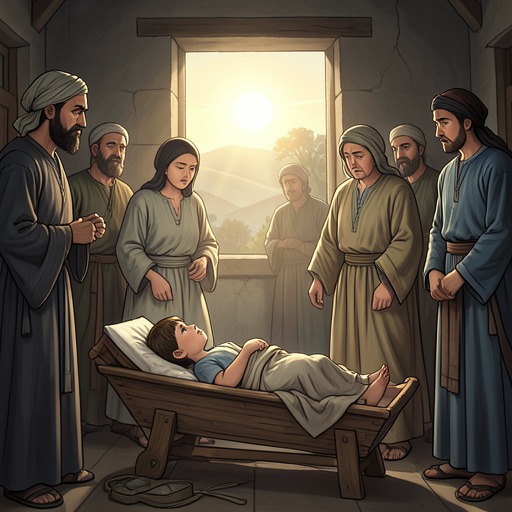
After Mariatta takes the young child to her father's dwelling, he grows in beauty, strength, light, and wisdom. The narrative makes his development strikingly expansive: he does not merely grow larger, but gathers qualities associated with understanding and distinction. All of Suomi sees and wonders at him, so his exceptional character becomes a public matter rather than a private conviction held by his mother.
The child has no settled name. No one knows what to call him, and the two names that emerge express sharply different responses to his arrival. Mariatta names him Flower, a name of beauty and promise; other people call him Son-of-Sorrow, registering the grief or trouble attached to his birth. Neither name is presented as a final resolution of his identity. Together they hold open the contrast between the child as a cherished new life and the child as a source of sorrow, while the community's uncertainty reflects the difficulty of fitting him into familiar expectations.
That uncertainty persists as Mariatta seeks the priesthood to have him baptized. The passage places the naming problem beside a public religious appeal, but the evidence does not supply a completed baptismal naming. The child instead becomes publicly defined through the judgment made about him and the authority that later recognizes his claim. His identity is thus shaped not by one uncontested name, but by competing names and consequential acts of judgment and blessing.
Judgment and Rebuttal
Wainamoinen orders the child taken to the marshes and killed by having his head dashed against a birch tree. The judgment turns the infant's uncertain standing into an immediate question of life and death. Wainamoinen speaks from the position of an ancient hero empowered to pronounce sentence; the accused, by contrast, is only two weeks old and is described as the child of Mariatta.
The infant answers. His speech does more than plead for survival: it reverses the direction of judgment and makes Wainamoinen answerable to his own past. He calls him “O, thou ancient Wainamoinen, / Son of Folly and Injustice, / Senseless hero of the Northland,” then declares that he has judged falsely. The force of the rebuke lies in its combination of formal accusation and astonishing speaker. A newborn, conventionally dependent on others to speak for him, names injustice with a confidence that the established hero has failed to show.
The child grounds his challenge in unequal treatment. He recalls that Wainamoinen committed greater follies, sins, and misdemeanors in his own years, yet was not treated as evil or banished by his people. The comparison does not deny that Wainamoinen's past contained wrongdoing; instead, it asks why the infant faces a punishment from which the old hero himself was spared. The child therefore exposes not only a harsh sentence but a double standard in the judgment of wrongdoing. His survival follows from a direct moral challenge, rather than from an intervention described as physical rescue.
Recognition and Royal Heirship
After the exchange, Wirokannas, ruler of the wilderness, touches the child with holy water and gives him a blessing. The gesture answers the preceding sentence with a different exercise of authority: where Wainamoinen's judgment would have ended the child's life, Wirokannas's ritual act affirms his right to live and grow. The narrative does not present this as an ordinary naming ceremony; it gives the blessing a political consequence as well.
Wirokannas grants the child the rights of royal heirship and declares him free to live, grow into a hero, and become a mighty ruler, king and master of Karyala. These are stated as rights and a future, not as a report that the child has already ruled. The distinction matters: the scene establishes an acknowledged succession and a possible destiny, while leaving the fulfillment of that destiny beyond the child's infancy. His standing changes from an infant facing execution to one formally authorized to develop into a ruler.
Narrative Role and Significance
The scene sets two kinds of authority against one another. Wainamoinen possesses the stature of age and heroic reputation, but the child demonstrates the moral insight to identify an unjust sentence. Wirokannas's blessing then converts the child's successful rebuttal into public recognition. The movement is from a disputed and sorrow-marked identity, through a threat to life, to a sanctioned future as heir.
The child's precocious speech is the decisive reversal: the most vulnerable figure in the scene becomes the judge of the old judge. His argument depends on remembered precedent within Wainamoinen's own life, so the challenge is not merely an assertion of innocence; it is a demand for consistency. The child's brief intervention thereby exposes the limits of Wainamoinen's authority and makes room for a different source of legitimacy.
That change resonates with the nearby account of Wainamoinen recognizing his waning powers as the years pass. The passage does not say that Mariatta's son immediately replaces him, but it places the child's newly granted heirship beside the old hero's acknowledged decline. Flower and Son-of-Sorrow remain contrasting names, yet Wirokannas's blessing gives the child a future beyond the sorrow others attach to him: he is permitted to live, grow, and become a ruler.