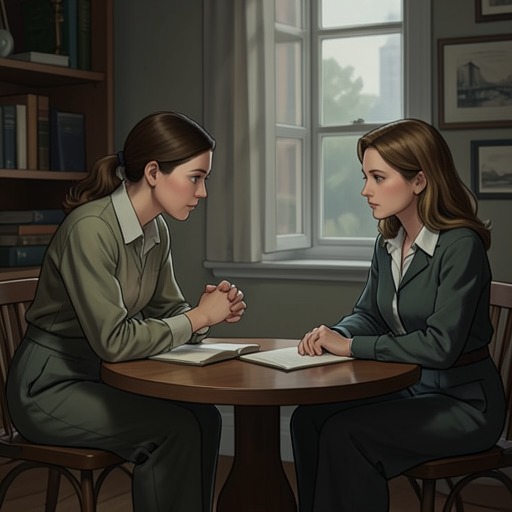
Ariane Le Minier
PossessionAriane Le Minier is a French scholar of women’s writing whose research leads Maud Bailey to the journal of Sabine de Kercoz, a rare record covering nearly all of Christabel LaMotte’s 1859 visit to Brittany. By sharing the journal with Maud, Ariane transforms an uncertain search for LaMotte’s whereabouts into an investigation grounded in a contemporary witness’s account.
Identity and Scholarly Interests
Ariane is a young researcher at the University of Nantes, where she studies women writers. In a letter to Leonora Stern, she describes her admiration for Stern’s work on women poets, especially Christabel LaMotte, whose writing she approaches through its Breton inheritance of myth and legend. She singles out Stern’s analysis of the sexualized landscape in The Fairy Melusina as particularly important to her own critical interests.
Ariane is also researching Sabine de Kercoz, a little-published writer. Sabine published several poems in the 1860s, including sonnets praising George Sand, whom she had never met but whose ideals and way of life she admired. Ariane is working toward an edition of Sabine’s four unpublished novels—Oriane, Aurélia, Les Tourments de Geneviève, and La Deuxième Dahud. The last draws on the legend of the drowned city of Is, also treated in LaMotte’s poem of that name.
Meeting with Maud and Roland
After Maud contacts her, Ariane agrees to meet Maud and Roland Michell briefly in Nantes before leaving for a holiday in the south. The meeting takes place over lunch, and Maud and Ariane quickly find common ground in their exacting approach to scholarship. They discuss liminality and Melusina’s monstrous form as a transitional construction that can free a woman from fixed gender identification. Roland, by contrast, contributes little to their scholarly exchange.
Maud’s request is delicate: she wants access to Sabine’s papers but cannot readily explain why she needs them or how the request relates to Leonora’s absence. The archive is locked, and Ariane’s imminent departure initially makes access seem unlikely. The obstacle gives way when Ariane reveals that she has already located a journal kept by Sabine, covering almost all of LaMotte’s visit in autumn 1859. She suggests that Sabine wrote in French, rather than Breton, partly in imitation of George Sand’s practice of keeping a journal.
The Journal and Its Significance
Ariane has made a photocopy of the journal for Maud, both to share with Leonora and in recognition of Maud’s scholarship on Melusina. She explains the gesture as an expression of feminist cooperation: research and information should be shared rather than held back. The copy also compensates for Ariane’s absence and the archive’s closure, allowing Maud to pursue the evidence without waiting for a later visit.
The journal’s importance lies in its proximity to the events Maud is trying to reconstruct. Instead of offering only a later scholarly inference about LaMotte’s Breton journey, Sabine’s record covers nearly the whole visit. Ariane does not disclose its contents in advance, emphasizing that Maud will be surprised by what it contains and inviting her to discuss the implications after reading it. Her discovery therefore supplies both new evidence and a further interpretive problem: the past reaches Maud through Sabine’s written account, preserved and circulated by Ariane.
Narrative Role
Ariane is a supporting character whose decisive action is scholarly rather than dramatic. She links contemporary feminist research to a nineteenth-century archive, and her willingness to share a photocopy enables Maud’s investigation to move forward despite restricted access to the papers. The episode also gives practical force to the ideas the two scholars discuss: cooperation is not merely a topic of criticism but a method of recovering women’s writing and making its evidence available.