Randolph Henry Ash
PossessionRandolph Henry Ash is a Victorian poet whose literary reputation and private history come into view through different kinds of evidence: published poems, intimate correspondence, portraits, and the recollections of later scholars. His letters to Christabel LaMotte disclose a relationship that his public record had not made visible, while his enduring marriage to Ellen Ash gives that revelation its personal and ethical consequences. The novel makes Ash both a historical subject and a figure whose life can only be pieced together through texts that were never all intended for public readers.
Identity and Literary Reputation
Ash’s standing as a major poet is established through his work and its reception. His dramatic poems appeared in 1856 in Gods, Men and Heroes, but reviewers did not respond as he had hoped: they called the verses obscure, the tastes perverse, and the characters extravagant and improbable. The collection included “The Solitary Thoughts of Alexander Selkirk,” a meditation by a castaway, as well as “The Tinker’s Grace,” presented as Bunyan’s reflections on divine grace, and a poem about Pedro of Portugal’s extraordinary declaration of love for a murdered, embalmed body. These subjects show a poet drawn to unusual states of mind and experience, although the available evidence does not make their strangeness a simple explanation for the reviewers’ hostility.
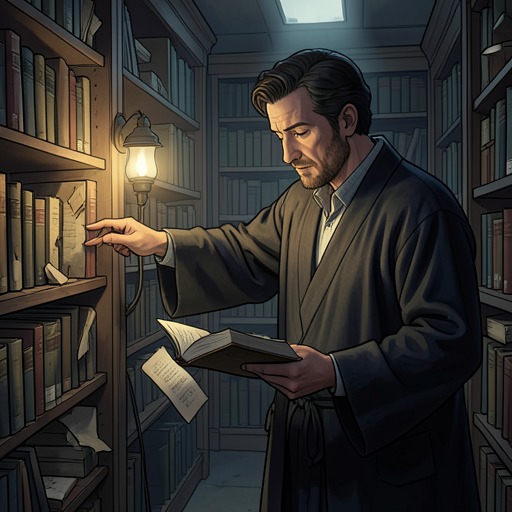
Ash’s work continued to invite editorial attention after his death. James Blackadder was working on Mummy Possest, a spiritualist poem dated 1863, as part of an edition of Ash’s writings. The editorial enterprise treats the poems as objects to be annotated and organized, but the archive surrounding them also exposes the limits of such work: biographical claims and textual interpretations remain open to challenge. A later descendant, writing about an ancestor’s letter, disputes Blackadder’s identification of that woman with Mrs Eckleburg, a credulous fictional figure in Mummy Possest. The disagreement shows that Ash’s writing becomes a site of competing interpretations, not merely a settled body of work.
The Letters and LaMotte
A surviving letter from Ash to Christabel LaMotte begins in the afterglow of their conversation at Crabb Robinson’s breakfast gathering. Ash recalls the unusual sympathy, wit, and judgment he found in her, and says he wants their conversation to continue. His request to visit her the following week turns an intellectual encounter into the beginning of a personal correspondence. The language is immediate and self-revealing, but it is also a letter addressed to a particular recipient: later readers encounter it outside the original exchange and must interpret what it can and cannot establish.
As Roland Michell reads the letters, he first feels shock and then the excitement of a scholar. He tries to place the undated writing, reasoning that it must postdate Gods, Men and Heroes in 1856. The letters’ chronology thus has to be reconstructed from clues rather than supplied directly. Roland recognizes, too, that the correspondence was not written for him. The distinction between Ash’s poems, which were intended for readers, and his letters, which were addressed to LaMotte, places a limit on scholarly possession: discovery makes the private writing available, but does not erase its original intimacy.
Ash’s letters trace a growing attachment and the effort to understand its meaning. He insists that an embrace was not a passing impulse, but arose from what was deepest in him, and says that from their first meeting he had known LaMotte was his fate. At the same time, he acknowledges the fact that he has a house and a wife. When LaMotte asks him to speak about Ellen, he says he is unable to answer, while recognizing that she had every right to ask. The exchange holds attraction and responsibility together: his declarations do not cancel the marriage that gives the relationship its moral difficulty.
The correspondence also records the work Ash is doing and the imaginative exchange between the two writers. He tells LaMotte that her household is well, asks after her work on Merlin and Vivien and the increasingly absorbing Melusina, and reports that he has nearly completed his poem on Swammerdam. He describes having blocked out the poem, knowing what belongs in it and what has been abandoned, and says he will make LaMotte the first fair copy once he has corrected its imperfections. The letter presents literary labor as revision and selection, as well as a form of communication between poets.
One letter about the return of their papers makes the fragility of the archive explicit. Its writer reports that two letters have been burned, fears that others should meet the same fate, but cannot bring herself to destroy anything written by Ash. The letters are prepared for delivery into his hands, with the decision about their fate left to him. The writer weighs the impulse to protect privacy against the literary value of preserving intimate words, invoking Abelard and Eloisa and the Portuguese Nun as examples of what would have been lost had their writings disappeared. Ash’s correspondence therefore appears not as a complete, stable collection, but as a record shaped by selection, destruction, and the possibility of survival.
Marriage, Confession, and Loss
Ash’s marriage to Ellen is not simply a piece of background to the LaMotte correspondence. He calls Ellen his dear wife and says that he loves her; in a separate confession, he tells her that he has been in love with another woman for perhaps a year. He describes the experience as a kind of possession or blinding, beginning with letters and becoming an encounter in Yorkshire. The disclosure changes how the marriage can be understood without reducing it to an obstacle: the account presents affection for Ellen alongside Ash’s other attachment, and leaves the consequences of that coexistence visible.
Ellen’s writing after Ash’s death registers the difference between a person and the objects left behind. Unable to sleep at two in the morning, she writes while he lies in his coffin and reflects that his possessions, now hers or no one’s, seem to lose his presence more slowly than he himself has. In the objects around her she feels a continued presence, even as she struggles to write to him. Her account is at once a record of mourning and an attempt to address the absent person through the things he used.
At the burial, Ellen places a box on Ash’s coffin containing their letters and other mementoes. She regards them as too precious to burn and too private to expose to public view. The box is buried with him beneath the flowers and earth. This act gives the letters a double status: they are treasured evidence of a life together, yet Ellen chooses to keep them outside public circulation. Their later appearance as an object of scholarly interest thus carries forward the conflict between preservation and privacy built into their burial.
Portraits, Scholarship, and the Afterlife of the Poet
Roland’s three images of Ash reveal how a public likeness can become a puzzle. A photograph of Ash’s death mask stands on Roland’s desk; two other images are photographic copies of portraits in the National Portrait Gallery. The mask presents a broad-browed, bearded head, yet another photograph shows Ash in his last sleep, still bearded. The question of when and by whom he was shaved remains unanswered. Mortimer Cropper had asked the same question in his biography, The Great Ventriloquist, without resolving it. Ash’s image is therefore mediated by artifacts that do not neatly agree, and even a seemingly minor detail of his appearance becomes part of the biographical mystery.
The later scholarly world does not merely recover Ash; it competes over who may interpret and control the materials associated with him. A literary solicitor describes a fierce dispute over a correspondence between dead poets: American buyers have offered large sums, while English scholars seek to have the papers declared nationally important and prevent their export. The owner allows scholars to see only specimen letters one at a time, and press attention brings journalists and gossip writers into the conflict. The dispute gives concrete form to the tensions around Ash’s private writing: cultural importance, commercial value, scholarly access, and personal ownership do not point toward the same outcome.
Ash’s afterlife as a poet is consequently assembled from works designed for publication and private records intended for particular people. The poems sustain editorial debate; the letters disclose affections and uncertainties; portraits preserve an appearance without resolving its history; and the buried box embodies Ellen’s decision to protect what she loved. None of these sources alone supplies a complete account. Their differences make Ash’s biography an act of reading in which public reputation, intimate testimony, and the rights of the dead remain in uneasy relation.