Crabb Robinson
PossessionCrabb Robinson is a literary diarist and host whose records preserve the first documented meeting between Randolph Henry Ash and Christabel LaMotte. His archive gives Roland Michell a factual starting point for tracing their connection, while its gaps and competing accounts show how much historical understanding depends on the form and limits of surviving testimony.
Identity and Archive
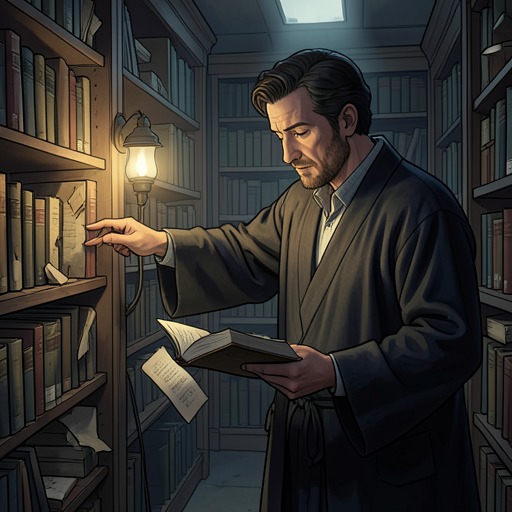
Robinson’s papers were kept at Dr Williams’s Library in Gordon Square, in a building originally designed as University Hall. Robinson had supported the institution as a place where lay students could experience collegiate university life. For Roland, the papers offered a practical route from an unidentified correspondence to a possible occasion: Robinson’s diary might record a breakfast at which Ash, a mathematics professor, a political thinker, and a reclusive woman connected with poetry were present.
Robinson understood his own literary limitations. He had not, he wrote, possessed the ability to secure the place among English authors he would have wanted, but he believed he could gain knowledge of distinguished people and do some good by recording his interviews with them. His journals accordingly span two generations of writers and public figures, including Wordsworth, Coleridge, De Quincey, Lamb, Goethe, Carlyle, Tennyson, and Bagehot. The value of his archive lies less in literary self-assertion than in its record of encounters.
The Breakfast Meeting
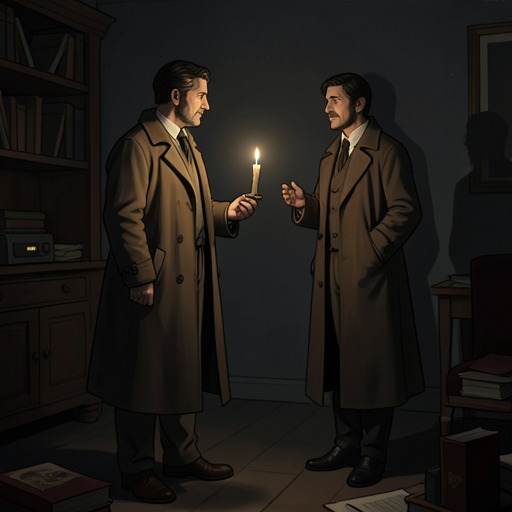
In June, Roland found Robinson’s account of a breakfast party attended by Bagehot, Ash, Mrs Jameson, Professor Spear, Christabel LaMotte, and her friend Blanche Glover. Robinson recorded that Ash had not previously met LaMotte and that she had come specially to please him and to speak with her father, whose mythologies Robinson had helped bring before English readers. The discussion ranged over Dante and Shakespeare; Robinson found LaMotte more forceful than expected and strikingly animated in conversation.
Spiritualist manifestations also came under discussion. Blanche Glover said she believed such phenomena could occur. Ash demanded experimental proof and said he did not expect it to be forthcoming. Bagehot challenged him with the suggestion that Ash’s account of Mesmer’s ideas showed a less absolute confinement to positive science than Ash professed. Ash answered that historical imagination required a kind of poetic belief in the mental world of one’s characters, so powerful that he risked having no beliefs of his own. When the company appealed to LaMotte about spirit-rapping, she declined to take a position.
Robinson’s record does not make the encounter a transparent account of what the meeting meant to its participants. He noted the animation of the discussion but left no further reference to LaMotte, although Ash appeared often as host or guest. Roland also recognized the risk of copying the diary inaccurately: his own cramped transcription could not claim the careful checking that Mortimer Cropper required of his students. The episode therefore enters the novel through evidence that is revealing precisely because it remains incomplete.
A Differing Account
Another account of the breakfast appears in the narrative attributed to LaMotte. In that version, the gathering was not at Robinson’s but at his home, Ash attended without Ellen because she was indisposed, and LaMotte judged his poetry unfavorably. She questioned whether he was serious and found his position on animal magnetism difficult to discern. Rather than disclose her own opinions about the discussion of the Tractarians, she kept them to herself and welcomed the return to the privacy of her home.
The contrast with Robinson’s journal does not simply settle which participant understood the meeting better. His account emphasizes lively conversation and LaMotte’s unexpected force; hers stresses reserve, skepticism, and a desire to withdraw from company. Read together, the records make the breakfast a scene of differing perspectives rather than a single authoritative portrait. Robinson preserves the occasion that lets Roland identify LaMotte, but his diary cannot by itself supply her inward response or establish what followed between her and Ash.
Spiritualism and the Limits of Testimony
Robinson’s interest in spiritualist claims recurs in a letter to Priscilla Penn Cropper. He thanked her for writing about her experience with a planchette and acknowledged his interest in anything associated with Samuel Taylor Coleridge, but objected to the idea of Coleridge being made to perform parlour manifestations or produce trivial messages after death. He described his likely explanation of such phenomena as fraud combined with collective agitation, while also connecting spiritualist enthusiasms to uncertainty produced by materialism and challenges to inherited religious accounts. His position is skeptical, but the letter recognizes that doubts about religion and hunger for certainty coexist.
At a séance held by Mrs Hella Lees, Ash likewise tested the claims rather than accepting them. His account describes manifestations in a darkened room and his intervention when a wreath appeared: he caught at it and found that he had seized the medium’s hand. In Mrs Lees’s own recollection, Ash entered at her request after she had been told he sought consolation following a recent loss. She described his skepticism as coexisting with unusual spiritual sensitivity, and recalled him saying that spirits spoke to him through language. Her testimony then records a trance, a voice that denied the presence of a child, and a sequence of unsettling effects before Ash called for lights and grasped the medium’s wrist.
These accounts do not resolve whether the séance’s apparent phenomena were supernatural, fraudulent, or products of expectation. Instead, Robinson’s broader documentary setting helps establish the competing habits of interpretation surrounding Ash: experimental skepticism, spiritual consolation, and the poet’s capacity to enter imaginatively into beliefs he did not necessarily hold. As a character, Robinson is defined by this archival function. His records initiate Roland’s inquiry, preserve the moment Ash and LaMotte met, and leave enough uncertainty for the past to resist a final, uncomplicated reconstruction.