Mortimer Cropper
PossessionMortimer Cropper is a professor and collector whose career is devoted to Randolph Henry Ash. He is at once a resourceful scholar, a powerful institutional buyer, and a rival claimant to Ash’s legacy: his research seeks to recover the poet’s life, but his methods repeatedly turn discovery into possession. His pursuit culminates in a clandestine excavation of Ash’s grave, where he finds a container of letters and personal objects that transforms his long-standing scholarly hunt into a literal act of taking.
Identity and Scholarly Position
Cropper works at the Stant Collection at Robert Dale Owen University in New Mexico, the largest single gathering of Ash’s scattered books and papers. There he undertakes a monumental edition of Ash’s complete correspondence. The collection is backed by substantial institutional and philanthropic resources, and Cropper’s account of its purchasing power is blunt: one letter from Ash, sold at Sotheby’s for £500, went to him, and he boasts that the institution can use its cheque book rather than depend on the university’s library budget. In this world, scholarship and acquisition are inseparable; the ability to interpret documents depends in part on the ability to obtain them.
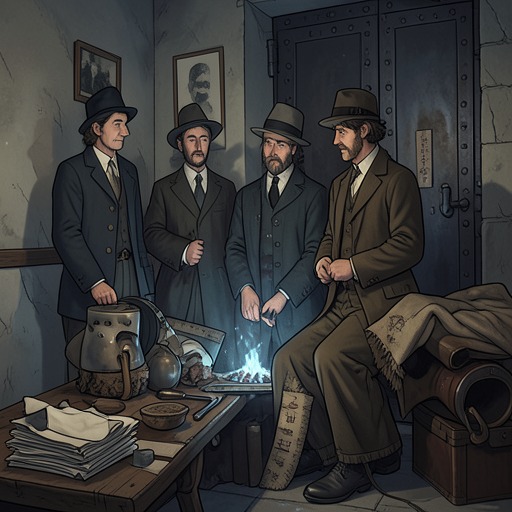
Cropper’s research is expansive and often meticulous. He has traced Ash’s Yorkshire holiday closely enough to reconstruct the route along the Roman Road toward Pickering, and his account of the poet’s fieldwork at Filey itemizes the equipment Ash carried, including a landing net, specimen bottles, tools, and a specially designed metal case with a glass inner vessel. The detail conveys Cropper’s capacity to make a historical scene almost tangible. Yet the same biographical thoroughness can also narrow its subject: Maud Bailey finds his version of Ash unpleasant, and judges Cropper’s biography as much a portrait of its author as of the poet it claims to explain.
Research, Interpretation, and Rivalry
Cropper’s approach to evidence is acquisitive as well as analytical. In his account of Ash’s letters from the Yorkshire trip, he treats them as the correspondence of a solitary husband writing home from holiday. Roland Michell and Maud question what the letters omit: Ash never says that he wishes Ellen were there, or that he wishes she could see the places he describes. Their alternative reading is that the travelogues do not sit easily with the known circumstances of Ash’s relationship with Christabel LaMotte. Cropper’s reconstruction is therefore both a store of useful facts and an interpretation that other researchers must test against absences in the record.
Maud is particularly wary of Cropper’s way of shaping his subject. Reading his biography, she senses what she calls a reverse hagiography: rather than idealizing Ash, Cropper takes satisfaction in cutting him down to size. Her reflection on the word subject exposes the power built into his method. Ash is the subject of the biography, but also the object of Cropper’s research and the person whose public identity is being produced through Cropper’s sentences. The book’s question is not simply whether Cropper has gathered evidence, but who controls the account that evidence is made to support.
Cropper also presents himself as an experienced reader of scholarly upheaval. He tells Sir George Bailey that scholars both hope for and fear discoveries capable of confirming, overturning, or changing a lifetime’s work. He invokes letters from William Wordsworth to his wife, which had forced scholars to revise their assumptions about Wordsworth’s marriage. The example reflects Cropper’s awareness that private documents can unsettle settled literary history. It also sharpens the irony of his own career: he recognizes that archives can overturn scholarship, while his own methods press toward acquiring and interpreting intimate papers on his terms.
Objects, Access, and the Claim of Ownership
Cropper’s relation to Ash is mediated by objects as well as texts. Roland notices that Cropper carries Ash’s large gold watch and arranges his time by it, an especially pointed expression of scholarly identification with the poet. Roland, by contrast, is drawn to Ash’s copy of Vico not only because its marginalia might illuminate Ash’s poem The Garden of Proserpina, but because it is a book the poet himself handled. When Roland discovers notes concealed within the volume’s bindings, the material traces make the past newly present: faded sheets, written on the backs of bills and letters, have remained in their original positions for a very long time. Such discoveries show why Cropper’s collecting is more than a matter of owning books; physical custody can open access to evidence that might otherwise remain hidden.
That access is never uncomplicated. Ash’s books and manuscripts are dispersed across Europe and America, held by institutions and private families. At Seal Court, Maud explains that the LaMotte family papers include manuscripts, lyrics, successive revisions of Melusina, and Blanche Glover’s journal, but that the collection is small and its earlier history uncertain. Elsewhere, Ellen Ash’s decisions to burn some papers and preserve or bury others have shaped what later scholars can find. Cropper’s pursuit takes place within this fractured archive, where surviving evidence is inseparable from decisions about custody, inheritance, concealment, and destruction.
His interest in the jet brooch found by him and held in the Stant Collection further illustrates how an object’s location becomes part of the contest over evidence. Maud has seen a photograph of the brooch on sea-green moiré silk and knows that Cropper found it. The brooch is not merely a biographical clue: its preservation and display also establish the collection as the place where such traces can be consulted, while reinforcing Cropper’s role as the scholar who has secured them.
Deals, Pursuit, and the Grave
Cropper is persistent in dealing with private custodians. He courts Sir George Bailey for access to the family’s papers, imagining that patience will eventually wear down his resistance. The prospect of examining the letters is part of the attraction: Cropper wants to turn them over one by one, searching their details for hints and secrets. His vivid imaginative reconstruction of the household and its occupants accompanies that pursuit, making the expected archive feel already partly possessed in his mind.
His ambition also draws him into a proposed arrangement with Hildebrand Ash, a descendant of Randolph Ash’s family. Cropper and Hildebrand form a project that is part scholarly scheme and part daydream. Later, Beatrice Nest reports overhearing Cropper suggest that the two could keep a secret for several years, wait until Hildebrand inherited, and then present the discovery as though it had been found legitimately before Cropper purchased it from him. The proposal reveals how readily Cropper’s pursuit of historical material can shade into a plan to manage its custody and appearance for private advantage.
Beatrice also warns that Cropper intends to disturb the Ashes’ grave at Hodershall, acting with Hildebrand to discover what lies in the box buried there. The plan turns a long-running interest in Ash’s papers into an attack on the boundary between scholarly access and the privacy of the dead. Ellen had described her promise to burn what should not be seen, explaining that Ash objected to the exposure of private life and that she had burned some materials and intended to burn more. Cropper’s search proceeds against this history of deliberate concealment; the grave is not an accidental storage place but part of a protective decision.
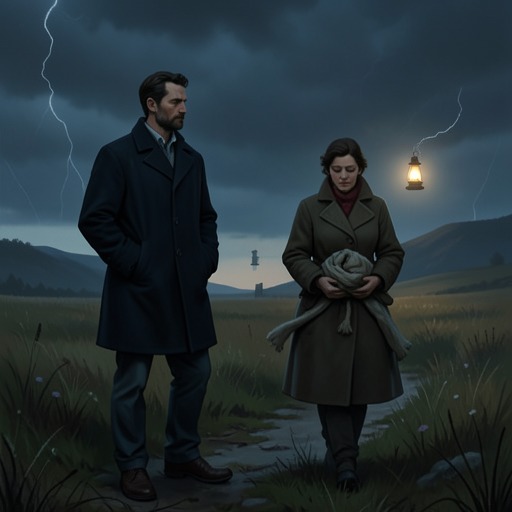
Cropper and Hildebrand go ahead with the excavation at night and have to work quickly before daylight. Cropper believes the box lies near the heart of the larger plot, but the evidence makes clear that this precise location has been nurtured by his imagination: he has pictured the reburial so often that he has begun to treat the scene in his mind as knowledge. Trusting his intuition, he directs them to dig methodically from the head of the grave toward the feet. When he strikes metal, he scrabbles in the earth and brings up an oblong, corroded object. Inside the container, he finds Ash’s glass specimen vessel, still intact. It holds a hair bracelet with a silver clasp formed by two joining hands, a blue envelope containing finely plaited pale hair, a bundle of letters tied with ribbon, and a sealed envelope addressed to Randolph Henry Ash under cover.
Narrative Significance
Cropper embodies the tension between scholarship as recovery and scholarship as possession. His accurate reconstructions and institutional resources help make dispersed evidence accessible, but his conduct repeatedly raises the question of whether access grants a right to control, buy, or expose what has been found. His attachment to Ash is visible in the watch he wears and the years spent editing the poet’s correspondence; it is also visible in the assumption that intimate documents should ultimately be available to his project.
The novel complicates any simple opposition between responsible and irresponsible scholarship. Cropper recognizes that private letters can force a rewriting of literary history, and his archival work is built on that possibility. Yet his own drive toward discovery puts the interests of the biographical subject, the family, and the researcher into conflict. His grave-robbing is the most extreme instance of that contradiction: the scholar who seeks evidence crosses from studying a preserved past to physically disturbing the place where its guardians chose to leave it. The recovered letters and keepsakes consequently signify both a major evidentiary breakthrough and the ethical cost of obtaining it.