Melusina
PossessionMelusina, the fairy at the center of Christabel LaMotte’s epic The Fairy Melusina, is at once a folkloric character and a test of how stories make meaning. Her pact with a mortal husband, their children, and her eventual flight after he sees what she has kept private give the tale a dramatic shape; LaMotte’s poem makes that inherited story a place where questions of female autonomy, sexuality, religion, and change remain in motion.
Folkloric Identity and Story
In Fergus Wolff’s account, Melusina is a fairy who marries a mortal in order to gain a soul. She sets a condition: her husband must not spy on her on Saturdays. For years he keeps the pact, and they have six sons, whose unusual physical features include odd ears, tusks, and a third eye. Melusina also builds castles in Poitou, making her a figure of creative power as well as supernatural difference.
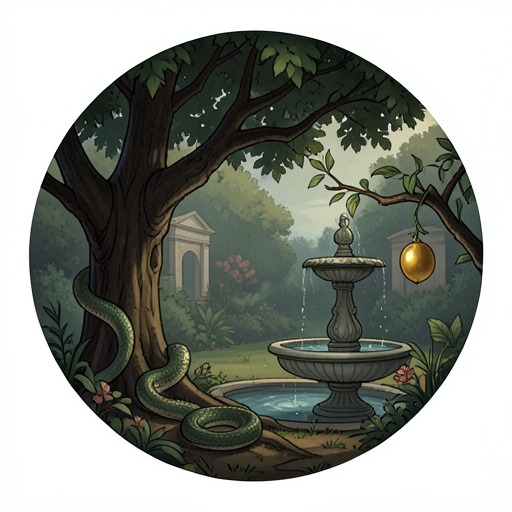
The story breaks when the husband looks through a keyhole—or, in another version, cuts a hole in a steel door with his sword. He sees Melusina bathing in a form that is partly fish or serpent. She does not immediately respond, but conflict follows through their son Geoffroy’s actions: when his brother Fromont takes refuge in a monastery, Geoffroy burns it down. The husband blames Melusina for what has happened and calls her a horrible snake. She reproaches him, changes into a dragon, and flies around the battlements, foretelling deaths among the Counts of Lusignan when she returns. Her story thus binds domestic life and an injunction against intrusion to the public, destructive consequences of its breach.
LaMotte’s Poem and Its Reception
LaMotte’s The Fairy Melusina reworks the legend in a long, convoluted poem written in the 1860s and published at the beginning of the 1870s. The novel describes it as a work of tragedy, romance, symbolism, strange creatures, and unsettled sensuality. Its form repeatedly changes focus, moving from precise description of the serpent’s tail toward cosmic conflict. Early critics admired the poem, while later feminist readers found in Melusina’s bath an image of female sexuality that does not depend on men. Other interpretations read the figure as expressing women’s frustrated desire or, following Virginia Woolf, as an image of the creative mind’s androgyny. The poem’s shifting scale and symbolism allow these readings to coexist without making any one interpretation final.
Blanche Glover, LaMotte’s artistic companion and a maker of wood engravings, is believed to have encouraged her to undertake the epic. Its contemporary reputation was mixed: some Pre-Raphaelite critics admired its ambition, but the account of LaMotte’s career distinguishes it from the restrained lyrics on which her more lasting reputation rests. After Melusina, LaMotte appears to have written no more poetry. The poem therefore marks both an ambitious act of female authorship and a boundary in her recorded creative life.
A Figure Remembered and Read
Melusina’s place in LaMotte’s imagination began in childhood, through stories told by her father, Isidore, while he worked on his Mythologie Française. He told LaMotte the tale repeatedly and treated her at times as a fellow scholar, discussing the problem of whether France possessed a mythology comparable to those of Germany and Scandinavia. He regarded Melusina as a prominent figure in French legend and connected her, in some aspects, with the white ladies who appear to warn of death. The poem’s supernatural heroine thus emerges from family storytelling and learned inquiry alike.
The figure also reappears in later readers’ records. Beatrice Nest’s notes record that she read The Fairy Melusina in 1872. After Roland Michell finds the cross-reference, he seeks Beatrice’s account of the poem; her surviving entry praises its originality, force, and refusal of the conventions expected of women writers. She likens its imagery to a vast tapestry in a shadowed hall, where birds, beasts, elves, demons, fire, water, jewels, hair, and serpent scales move across the woven scene. Her response is not merely a verdict on a book: it registers the shock of encountering a woman’s work that refuses timid sentiment and makes its reader confront the poem’s unsettling vision.
Metamorphosis, Secrecy, and Competing Explanations
Melusina’s transformations connect the poem to the novel’s recurring interest in metamorphosis. In LaMotte’s correspondence, she describes the ambition to write an epic or saga about the fairy and says she has many poems on metamorphosis, which she regards as a problem for every age. Randolph Henry Ash, in turn, connects Melusina to the spirits described in Paracelsus: beings imagined as lacking rational souls, inhabiting strange bodies, and dwelling in forests, ruins, tombs, and by the sea. His comparison does not settle what Melusina is; it reveals how folklore, learned texts, and poetic invention supply rival vocabularies for the same figure.
That uncertainty echoes the novel’s broader dispute over spiritual manifestations. At Crabb Robinson’s breakfast party, LaMotte declines to state an opinion on the reported spirits, while Ash distinguishes imaginative sympathy with the past from claims that require experimental proof. Elsewhere, he argues that spiritual phenomena should be investigated through patient study rather than séances. Melusina’s status as fairy, serpent, dragon, literary image, or possible spirit belongs to this unsettled border between belief and explanation. Her most lasting force lies in that instability: each account reveals the assumptions of its interpreter as much as it defines the woman-shaped wonder at its center.