Leonora Stern
PossessionLeonora Stern is the leading specialist on Christabel LaMotte and a forceful advocate for her literary importance. Based in Tallahassee, she combines scholarship, friendship, and political commitment: she has pursued LaMotte’s unpublished writing, challenged conventional accounts of women’s authorship, and joined the effort to recover the Ash–LaMotte correspondence. Her interpretive confidence makes her an ally in the search and a counterweight to male scholarly authority, but the novel also tests the limits of readings that make sexuality explain everything.
Identity and Scholarly Work
Leonora is introduced as one of the two people said to know all that is known about LaMotte; the other is Maud Bailey, who directs a Women’s Resource Centre at Lincoln University. The two met at a Paris conference on sexuality and textuality. Leonora’s expertise is not merely reputational: she edits a selection of LaMotte’s narrative and lyric poems, including work that draws on Breton mythology, and she is trying to assemble an edition of LaMotte’s letters despite their scarcity. The extant correspondence consists largely of family matters—admonitions, recipes, and complaints—along with a few letters from visits to Brittany. LaMotte and Blanche Glover shared a house and therefore had little need to write to one another; the limited surviving record makes the scholar’s task dependent on gaps as well as documents.
The material is also difficult to access. Leonora suspects Sir George Bailey at Seal Court may possess additional letters, but he refuses researchers entry and has threatened Leonora with a shotgun. She had considered sending Leonora rather than approaching the family herself, given a history of litigation and hostility between the Seal Court and Norfolk families; Leonora’s approach, however, had an unfortunate effect. The episode places her scholarly ambition within a contest over private papers, family control, and the right to interpret an author whose archive remains incomplete.
Leonora’s critical method appears vividly in her account of LaMotte’s poetry. In the edition she prepares, LaMotte’s use of Breton legend becomes a way to imagine a female world set against patriarchal and industrial civilization. The underwater city in “The Drowned City” is presented as the obverse of the male-dominated world of Paris, while Dahud embodies an instinctive, earthy pagan alternative. Leonora’s reading treats inherited myth not as passive folklore but as material a woman poet can reshape into a critique of cultural power.
Maud Bailey and the Problem of Interpretation
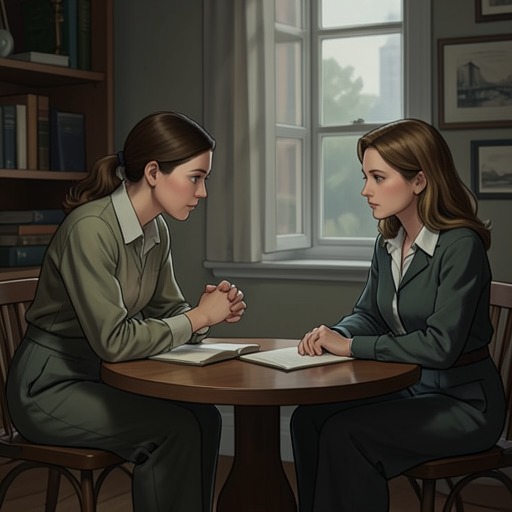
Leonora’s relationship with Maud is intellectually close and personally complicated. She acknowledges that she had a brief affair with Maud, first in Paris and later in England. When Maud considers whether to disclose the newly discovered correspondence, Leonora’s position matters beyond professional courtesy: Maud worries that Leonora would resent being left uninformed, especially if she continued publishing confident arguments about LaMotte’s sexuality. Maud sees secrecy as a possible betrayal both of their friendship and of the feminist solidarity their work presumes. The archive thus becomes a test of intimacy as well as a scholarly resource.
The two women differ in emphasis over how to read silence. Leonora had questioned Beatrice Nest about Ellen Ash’s sexual relations, looking for meaning in metaphors and omissions. Beatrice objects that this is not how she was taught to do scholarship, and rejects the presumption that a gap must conceal sexual information. Maud grants that Leonora can be single-minded and zealous, while conceding that a systematic omission may matter. The exchange gives Leonora’s feminist attention to what the archive leaves out both force and risk: absence can expose the conditions under which women’s lives were recorded, but it cannot by itself prove one particular hidden story.
A similar tension surfaces when Roland Michell objects that metaphorical connections can swallow the world they are supposed to illuminate. His examples include gloves, Blanche Glover, literary allusions, and sea-anemones, all collapsing into a single sexual explanation; he compares this tendency with Leonora’s reading of the earth as female body and vegetation as sexual imagery. Maud recognizes the danger in such interpretive reduction. The criticism does not erase Leonora’s contribution; it makes her method part of the novel’s inquiry into the difference between discovering a pattern and forcing every detail into it.
Presence, Advocacy, and Public Authority
Leonora’s entrance into Maud’s workplace is both welcome and unsettling. Maud is apprehensive about her friend’s arrival, yet delighted when she appears unexpectedly at the Resource Centre after Blanche Glover’s death. Leonora has travelled to England with a grant to continue her work and asks for accommodation and access to the archives. Her expansive manner fills the small space; Maud’s response combines affection with a familiar sense of being crowded. The friendship is therefore shown not as effortless agreement but as an attachment in which enthusiasm and pressure coexist.
Leonora’s work also reaches Maud through personal correspondence. In a letter, she sends love and urges Maud to visit her in America, promising that she could find her a post in Women’s Studies. She asks Maud to visit LaMotte’s grave, tend it, and leave flowers on her behalf. The request makes scholarship an act of care: Leonora’s connection to the poet is expressed not only through editions and arguments but through concern that LaMotte’s resting place has been neglected. Maud finds the letter moving, while recognizing the moral difficulty of withholding the newly discovered papers from a friend who has invested so much in LaMotte.
On the television program Events in Depth, Leonora is introduced as the expert on LaMotte and asked to explain the poet’s importance. She offers a compact, emphatic portrait of a neglected major poet whose writing undertakes an unflinching analysis of female sexuality and the significance of the seemingly trivial. Her performance contrasts with James Blackadder’s more cautious manner: where he deliberates, she speaks expansively and makes the case for LaMotte’s place in literary history. The public interview turns her specialist knowledge into advocacy, giving a woman scholar a visible authority that the historical poet herself had been denied.
Leonora’s forceful defense is also openly adversarial. Preparing for the broadcast, she tells Blackadder that she wants to strike a blow for LaMotte and against Mortimer Cropper, whom she resents for excluding LaMotte from a course and threatening a friend with a defamation suit. She has a practical lead about where Maud and Roland have gone and says that she showed them the way. Her scholarship is consequently entangled with loyalty and the struggle over who may control or benefit from the recovered documents; she is not a detached observer of the contest.
Role in the Investigation and Ending
Leonora eventually joins the group assembled around the Ash–LaMotte papers. Beatrice is wary that she might try to take a manuscript, so Leonora promises that she will not snatch one covertly or openly and says she wants only to read the documents. Blackadder considers her likely to be materially helpful. Her standing as a LaMotte scholar gives the group a source of contextual knowledge, while her declared interest keeps the question of access and ownership in view. The gathering includes Maud, Roland, Blackadder, Val, Euan MacIntyre, and Beatrice, and Leonora’s presence adds another voice to an already fraught negotiation over the letters.
She contributes information about Mortimer Cropper’s research: through a friend working in the Stant Collection, she has learned that he has been reading faxes of letters from LaMotte to his great-great-grandmother, Priscilla Penn Cropper. The information helps expose the breadth of Cropper’s private access to the archive and feeds the group’s questions about the child whose fate remains uncertain. Leonora’s connections therefore supply evidence that is consequential even though she does not possess the central papers herself.
At the novel’s climactic confrontation, Leonora is among those who find Cropper after the storm has trapped him among fallen trees and vegetation. Roland’s flashlight reveals her with Maud, Blackadder, and a transformed Beatrice; the group returns on foot to the Rowan Tree Inn, where they take shelter with Cropper and the others. The immediate crisis suspends the scholarly rivalry in a scene of shared survival. Leonora’s final role is thus characteristic: she remains beside the documents and the people contesting them, an invested reader whose loyalty to LaMotte and Maud drives her into the center of the search without making her its sole interpreter.
Narrative Significance
Leonora embodies both the recovery of women writers and the hazards of interpretive certainty. Her edition, feminist criticism, and public advocacy challenge LaMotte’s neglect, while her attention to sexual meanings in metaphors and omissions prompts resistance from Beatrice, Maud, and Roland. The novel does not reduce this disagreement to a choice between insight and error: the incomplete archive makes silence genuinely important, yet its gaps cannot be treated as automatic confirmation of a favored account.
Her friendship with Maud brings these intellectual stakes into personal life. The question of whether to share evidence is also a question of trust; Leonora’s work is bound to her affection for Maud and her commitment to LaMotte. At the same time, her eagerness to read the papers and her hostility toward Cropper show that feminist recovery remains a contest over access, ownership, and authority. Leonora’s significance lies in this combination: she helps make a neglected woman poet legible, but the novel keeps her interpretations open to scrutiny rather than granting any scholar final possession of the truth.