Maia Thomasine Bailey
PossessionMaia Thomasine Bailey is the concealed daughter of Christabel LaMotte and Randolph Henry Ash, born in Brittany and raised in England by Ash’s sister Sophie as her own child. Her life carries the consequences of a secret arranged to protect her future: the family presents her as legitimate, her biological parents remain unknown to her, and the truth emerges only generations later through Maud Bailey’s discovery of their shared ancestry. In the novel’s closing scene, Ash encounters Maia as a child without revealing their relationship, giving their connection a tender but irreparable incompleteness.
Identity and Family Background
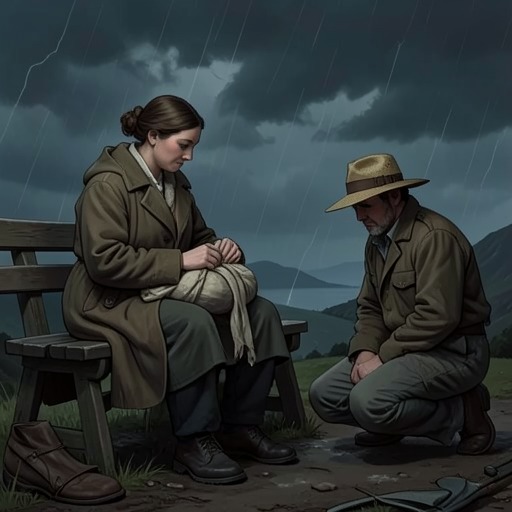
Maia is born after Christabel and Ash part, when both understand that their relationship may have resulted in a child. Ash later tells Christabel that he arranged for the birth to take place in Brittany, at a convent, and enlisted his sister Sophie to help conceal the circumstances. Sophie brought the infant to England and raised her as her own, in accordance with the plan. Ash describes Sophie as having loved and cherished Maia, who grew up with the security of a family while the identity of her biological parents remained hidden from her.
The concealment was not simply a private family arrangement: it answered the period’s legal and social constraints. When the parentage is discussed generations later, Euan MacIntyre explains that children born outside marriage could not inherit at the time, and that Victorian families sometimes placed such children within legitimate families to give them a respectable chance in life. The arrangement thus protected Maia’s social position while separating her from the history that shaped her birth.
Childhood and the Unrevealed Encounter
Ash’s letter to Christabel reports that Maia grew up in English fields, married a cousin in Norfolk, and became a squire’s wife. The family presented as her parents were Sophie and her husband; Maia did not know either Ash or Christabel as her biological parent. Ash sends Christabel a photograph of Maia as an adult, describing her as well and married, and as the mother of a beautiful boy. He notes that the daughter resembles both parents, though she does not know either one as such.
The final scene returns to Maia as a child, swinging on a gate and making a daisy chain, when a tall, bearded wanderer carrying an ashplant stops to speak with her. He asks her name and learns that she is called May, though she dislikes another name she has; when he asks to hear it, she gives her full name, Maia Thomasine Bailey. Ash responds by associating Maia with Hermes and Thomasine with a waterfall he knows, while the child answers from her own experience, recalling a pony called Hermes. He tells her that she has her mother’s look and says that he thinks he knows her mother. He does not tell her that he is her father. The encounter grants him a glimpse of the daughter he has never openly claimed, but leaves Maia’s knowledge unchanged.
Inheritance and Recognition
The family transmission of Christabel’s papers helps preserve the history that Maia herself was denied. After Christabel’s death in 1890, her sister Sophie sent papers and poems to her daughter May, Maia’s descendant, explaining that Christabel had wanted her work passed down through the female line. That account connects the family’s custody of manuscripts to Maia’s own lineage: the papers travel through women even as the truth of the child’s parentage remains concealed.
The eventual revelation makes Maia’s ancestry newly legible to Maud. When the photograph associated with the family history is shown, Maud recognizes the woman in it and says that she has seen her before: the woman was her great-great-great-grandmother. Euan observes that, because Maia could not inherit as an illegitimate child, Maud might otherwise have owned the entire body of documents outright. Maud’s discovery is therefore at once genealogical and archival: she realizes that the history she has been investigating is also her own, and that the papers’ passage through the family has preserved evidence of a connection obscured by the original arrangement.
Significance
Maia’s story makes concealment both protective and costly. Sophie’s care gives her a loving upbringing and a recognized place within a family, while the false account of her origins prevents her from knowing her biological parents. The secrecy also shapes what can be inherited: it shields Maia from a period’s restrictions but leaves later descendants to encounter their history indirectly, through letters, photographs, and family testimony.
Her brief meeting with Ash concentrates that tension into a single scene. He can speak with Maia, hear her full name, and recognize Christabel in her face, yet he does not cross the final threshold of disclosure. Maia remains a child speaking freely to a stranger, while the reader understands the kinship that neither she nor the family around her can name. Her life thus links the novel’s private romance to its later recovery of family history, without turning recovered knowledge into a reunion the characters never had.