Hella Lees
PossessionHella Lees is a prominent medium whose séances make the disputed boundary between spiritual communication and human performance a central problem in the novel. A specialist in materialization and the touch of the dead, she offers bereaved participants the hope of reunion; Randolph Henry Ash, approaching her work as a rational investigator, concludes that the manifestations are contrived and intervenes in one séance. Neither account settles what occurred: the novel preserves Lees’s claims, Ash’s skepticism, and the emotional consequences of their confrontation without granting either witness complete authority.
Identity and Practice
Lees is described as an early specialist in materialization, particularly manifestations associated with dead children and the sensation of dead hands. She holds séances in darkness, where participants sit together and clasp hands. The physical arrangement is part of the practice: Lees presents herself not as an independent conjurer but as a medium through whom spirits may choose to speak. The novel also notes that she was never exposed as a fraud and that contemporary spiritualists continued to regard her as a pioneer in the field.
Her own account distinguishes mediumship from clairvoyance. Lees denies that she possesses the power to summon spirits or that she can reliably attract vanished beings. She says that she has witnessed manifestations at her séances and that she has faith, but not the sort of control or skill that Cropper attributes to her. She separately describes a power of scrying: images appear to her in a crystal ball or in ink in a dish, beginning as points of light before becoming apparently solid scenes. These are Lees’s reported experiences, not independently established facts; the novel’s documentary form leaves their status open.
Lees’s testimony gives particular weight to what séance participants believe they have experienced. She refers to a bereaved mother who said she held her dead infant and felt its small body, and to the child’s father touching its curls. In an earlier discussion of spiritual manifestations, Blanche Glover likewise defends the possibility that such events occur, while Ash insists that he requires experimental conviction. The disagreement establishes the stakes of Lees’s work: a séance may be treated as evidence about the dead, but it also answers an urgent desire for consolation.
The Séance at Olivia Judge’s House
The central encounter takes place at Olivia Judge’s home in Twickenham, where a circle of women known as the Vestal Lights gathers for sustained spiritual inquiry. According to Mrs Lees’s account, Ash had recently suffered a loss and wanted to attend. He required that his identity and purpose be withheld from the other participants in advance, ostensibly to preserve the naturalness of the circle. Lees says she agreed, although she had doubts about admitting him to a séance already working well.
Lees describes Ash’s arrival as a disruptive presence. She interprets his skepticism as a coldness that affects the circle and says that, despite this resistance, she senses an unusual spiritual sensitivity in him. Ash speaks of language as a medium through which spirits may also reach him. The participants then sit around the table in near-darkness, holding hands. Lees says she becomes physically unwell and enters a trance, after which she has no conscious memory of what happens. Her account of the remaining events depends on notes kept by Judge.
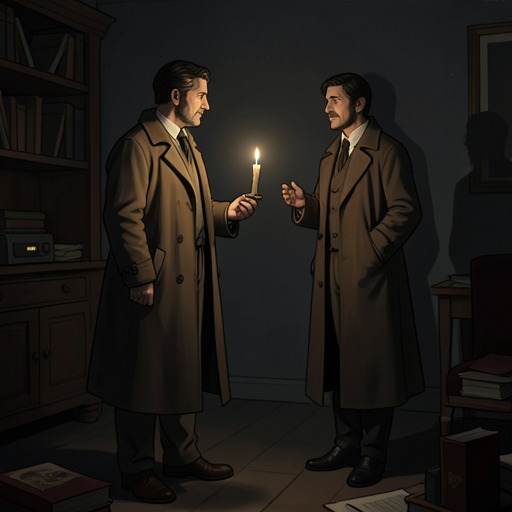
The notes describe a sequence of disturbances: a voice refuses to identify itself, participants hear an answer referring to “Nobodaddy,” and the gathering experiences knocking, apparent touches, and a book thrown across the room. After further messages and sounds, a voice announces gifts of reconciliation; a white hand appears to carry a wreath, and Lees is about to enter an inner room with two women when Ash cries out and reaches for the manifestation. Lees collapses, and another participant loses consciousness. Ash is found holding Lees’s wrist and says that the hand carrying the wreath was hers. The accounts offer conflicting interpretations of the same scene: in Lees’s telling, Ash’s intervention breaks up a séance; in his, the apparent supernatural effects are devices connected to the medium.
Ash’s own description, preserved in a letter quoted by Cropper, recounts how he caught at a floating wreath and found himself holding Lees’s hand. He says that the room contained familiar séance effects, including apparent hands, flowers, moving furniture, touches, and lights, and that his intervention exposed the mechanism behind them. Yet the passage also records his discomfort with the scene and his concern about the use of bereaved people’s hopes. His criticism is therefore not merely that the séance is a trick: it is also that a claim to contact the dead can exploit grief, whether through deliberate fraud or through collective expectation.
Ash, LaMotte, and the Meaning of the Encounter
Lees’s séance becomes important to the larger plot because Christabel LaMotte was associated with the Vestal Lights and was present at the gathering Ash interrupted. The connection emerges gradually through archival and scholarly interpretation. Cropper reads a letter from LaMotte that describes her experiences of spiritual manifestations, then considers whether she attended the same séance as Ash. He identifies the event as the episode later known among scholars as Ash’s Gaza exploit, named after Ash’s own reference to it and popularized as a chapter heading in Cropper’s biography.
The encounter’s significance is not limited to the question of whether Lees’s manifestations were genuine. James Blackadder later argues that Ash’s poem Mummy Possest is directed at LaMotte’s association with Lees and that LaMotte was present when he interrupted the séance. Blackadder conjectures that Ash believed LaMotte was attempting to communicate with her dead child and that this belief intensified his anger. This interpretation connects the public dispute over spiritualism to a private history of love, loss, and concealed parentage, while remaining an inference rather than a fully verified account of Ash’s motive.
LaMotte’s own letter presents a different view of Lees’s work. She reports witnessing spirit hands and other phenomena and describes Lees as a figure through whom manifestations occur, but also insists that she herself has no mediumistic ability. Cropper regards the letter as evidence of mental derangement, a judgment that reflects his interpretive position rather than settling the truth of its contents. The contrast among Lees’s account, Ash’s letter, LaMotte’s testimony, and the later scholars’ deductions makes the séance a contested archive as much as a supernatural episode.
Narrative Role and Significance
Lees is never given final authority over the events associated with her séances. Her account is embedded in a chain of documents and later readings: Ash’s account of the interruption, Lees’s recollection of the circle, Judge’s notes, LaMotte’s letter, and scholars’ attempts to connect the evidence. The reader encounters the event through these partial and differently interested witnesses. Its apparent manifestations are vivid within the testimony, but their causes remain disputed; the novel neither confirms a supernatural explanation nor reduces every participant’s experience to a simple trick.
That uncertainty matters because the séance brings together questions the novel repeatedly holds in tension: whether grief can make people vulnerable to deception, whether sincere experience counts as evidence, and whether imaginative or poetic acts resemble the production of spiritual appearances. Ash compares the false or fictive reanimation of the dead with the poet’s own making of life through language. Lees, by contrast, understands herself as an instrument rather than an author of what appears. Their disagreement therefore concerns not only spirits but also agency: who produces an image, who claims to interpret it, and whose account will survive in the historical record.
The séance also changes how the reader understands LaMotte’s connection to Ash. What might first appear to be an abstract dispute between scientific skepticism and spiritual belief becomes entangled with the private consequences of the past. Lees’s circle offers a setting in which the dead are claimed to return, while the surviving documents repeatedly fail to establish exactly what happened or what Ash believed he was confronting. Her role is thus both practical and structural: she organizes the scene that Ash disrupts, but the novel uses the unresolved evidence around her to expose the limits of certainty in biography and historical reconstruction.