Blanche Glover
PossessionBlanche Glover is an artist and Christabel LaMotte’s companion in the Richmond household where their creative lives and private affections become entangled. The novel first presents her through a journal and through the work she makes alongside LaMotte; later, her suicide and the evidence she left behind unsettle the scholarly story of LaMotte’s life. Blanche’s paintings, a friendship brooch, a handful of letters, and a carefully composed final statement give her a voice that is both vivid and incomplete: she insists on the value of her work even as poverty and the limits imposed on women close around her.
Identity and Artistic Work
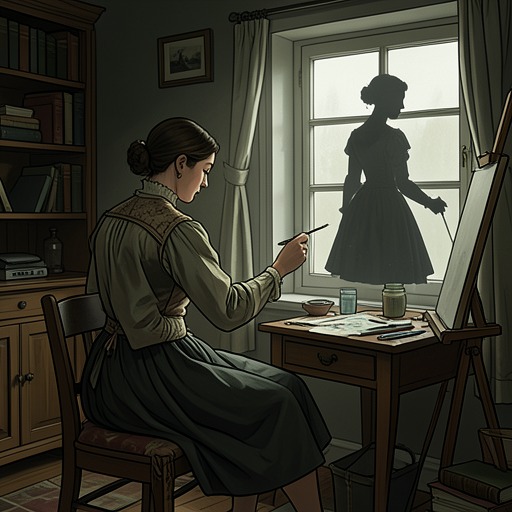
Blanche shares LaMotte’s artistic ambitions. She paints large oil canvases, none of which survive, and carves intricate, mysterious wood engravings for LaMotte’s books, including Tales for Innocents, Tales Told in November, and Orisons. The engravings make her a collaborator in works more readily associated with LaMotte’s authorship, while the disappearance of her paintings leaves much of her own practice known only through written testimony.
Blanche is believed to have encouraged LaMotte to undertake The Fairy Melusina, an ambitious retelling of the half-woman, half-snake figure. The poem’s later critical reputation differs sharply from Blanche’s own more materially grounded artistic aspirations: she is not merely a witness to LaMotte’s writing, but a source of encouragement and an artist in her own right. Her paintings repeatedly turn toward Arthurian subjects. In her journal she considers depicting Merlin’s imprisonment by Nimue or the Maid of Astolat, and describes sketching oak trees in Richmond Park, dissatisfied that her lines fail to convey the trees’ solidity and force.
A surviving journal entry makes that artistic frustration concrete. Blanche wants force in her painting, yet feels her work is too thin, like stained glass waiting for light from beyond it. She also compares her own worth unfavorably with LaMotte’s certainty. The entry records a shared domestic routine of meals, walks, readings, and music, but the household’s apparent ease does not erase the unequal confidence and security between the two women. The journal is among the few surviving records that let readers encounter Blanche’s ambitions in her own words.
Companionship and the Richmond Household
Blanche and LaMotte establish a home together in Richmond after LaMotte receives a small inheritance in 1853. They have met at a Ruskin lecture; Blanche, like LaMotte, is artistically ambitious. Their life together includes work, reading, and companionship, and Blanche’s journal calls the Richmond home a pleasant retreat. But the same record also reveals tension beneath that domestic refuge. Blanche resents being excluded from letters LaMotte receives and rejects the role of a maid or governess, even while acknowledging that LaMotte rescued her from the latter fate.
Her journal describes a long letter that LaMotte smiles over and folds away, followed later by Blanche’s insistence that she is neither blind nor a trained servant who should pretend not to notice what is withheld from her. She protests that she is not a watcher or a governess and does not wish LaMotte to mistake gratitude for a claim upon her. The entries make the household’s intimacy inseparable from a question of standing: Blanche belongs in the home, yet fears that she can be treated as dependent labor rather than as an equal companion.
The journal’s language of a threatened dwelling gives that unease a sharper shape. Blanche imagines a prowler testing the shutters and door, and plans to place mountain-ash berries and a horseshoe over the lintel to keep out the Fairy Folk. Her dog, Dog Tray, bristles at what he hears. The image of a small, locked refuge conveys the vulnerability of the home without establishing that a literal intruder exists; it also sits uneasily beside Blanche’s awareness that the private letters and concerns within the house are not hers to see.
When LaMotte writes to Randolph Henry Ash, she describes Blanche as an invalid, suffering severe headaches and nausea that leave her prostrate and unable to continue a large painting of Merlin and Vivien. LaMotte makes tisanes and wet handkerchiefs for her, while the servant Jane is diligent but clumsy and Dog Tray is no help as a nurse. The painting, poised at the moment when Vivien’s charm puts Merlin to sleep through time, is unfinished because Blanche is too ill to work. This episode presents artistic labor as bodily labor too: illness interrupts not an incidental pastime but the work Blanche regards as her life.
Poverty, Authorship, and the Suicide
Blanche dies by suicide in June 1860, jumping from a bridge at Putney into the Thames. The later account states that she had wetted her clothes and filled her pockets with large round stones to make sure she sank. Her body was recovered two days later, below Putney Bridge. The circumstances recall her admiration for Mary Wollstonecraft’s attempted suicide from the same bridge; Blanche had apparently noted the difficulty of sinking when clothes floated. Her method is thus presented as deliberate, not as an accidental drowning.
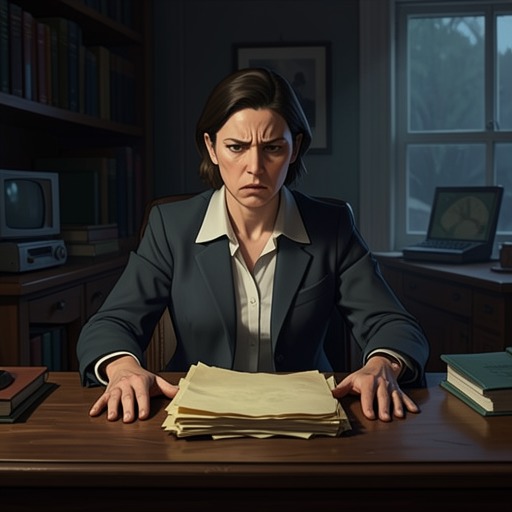
The surviving suicide note gives her reasons in her own terms. First is poverty: she can afford no more paint, has sold little work in recent months, and hopes the sale of four flower paintings will pay for her funeral. She explicitly wishes that the expense not be charged to LaMotte. Second is pride, bound to a refusal to return to governess work. Even kind households, Blanche writes, make such a life a form of slavery, and she would rather not live than submit to it. Nor will she ask LaMotte for charity, since LaMotte has obligations of her own. Her decision emerges from economic deprivation and the denial of a viable independent livelihood, not from a simple quarrel or a single explanation supplied by others.
The note inventories how little Blanche considers legally or materially hers. She says that the house belongs to LaMotte and that the furnishings bought from their shared savings belong more to the wealthier partner. She leaves her worn copies of Shakespeare, Keats, and Tennyson to a former pupil with whom she read them. Her seed-pearl cross is to remain with her; other trinkets may go to Jane, except the jet brooch showing two clasped hands, a gift from LaMotte that she asks LaMotte to take back.
Her provisions for her art are more insistent. Blanche records twenty-seven finished paintings in the house, as well as sketches and drawings. Two large works, Christabel before Sir Leoline and Merlin and Vivien, belong to LaMotte. Blanche asks that LaMotte keep them, hang them where she works if she can bear to do so, and not sell or give them away during her lifetime if looking at them is too painful. She wants the remaining work kept together, if possible, until a future public can judge it. Her hope that those not yet born might understand her gives the note an artistic purpose that outlasts its practical arrangements: the paintings are fragile, but she refuses to regard them as worthless merely because the present market does.
Blanche explains that she intends to follow Wollstonecraft’s example but has sewn large volcanic stones into her mantle to make death quick and certain. She also writes that she does not believe death is the end. Her faith in survival is linked to the spiritual meetings of Hella Lees, where she believes there has been visible evidence of the departed’s painless existence in another world. She imagines that there her capacities for love and creative work, unwanted and unused in this life, will find a better purpose. Her religious and spiritual convictions do not soften her judgment of her earthly circumstances; instead, they supply a language in which she hopes to be known and forgiven after death.
The Archive and the Unsettled Story
For Maud Bailey and Roland Michell, Blanche’s life is encountered through fragmentary evidence rather than continuous biography. In the Lincoln archive, Maud brings Roland boxes of LaMotte materials, including a thick green volume titled A Journal of Our Home-Life in Our House in Richmond. The journal discloses the ordinary texture of the shared household and, in scattered entries, Blanche’s mounting resentment and fear. It does not provide a complete account of what happened between the women or of LaMotte’s movements near the end of Blanche’s life.
The inquest, the newspaper report, the suicide note, and a few letters to a former pupil make up a meagre file on Blanche’s death. They establish that she died on the night of June 26, that stones were sewn into her clothing, and that LaMotte’s whereabouts were unknown. LaMotte had said she was away from home, but scholars had previously assumed that this meant only a short absence. The gap in her record, extending across the period before Blanche’s death, makes the connection between the two women harder to settle. Maud recognizes that the familiar supposition of a quarrel now looks different, but the documents still do not clarify where LaMotte went or what she knew.
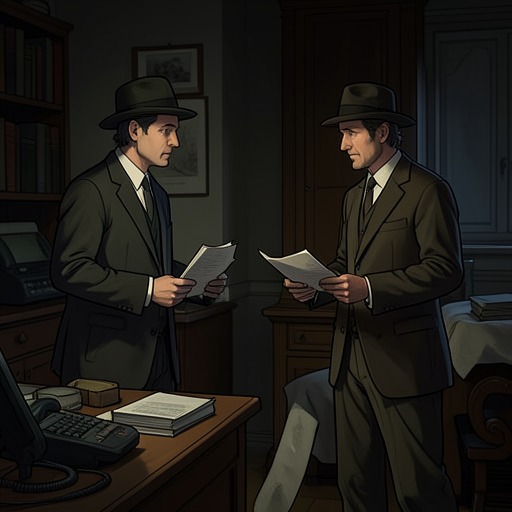
A letter found among papers associated with Ellen Ash adds another uncertainty. Its anonymous writer tells Mrs Ash that she has evidence which concerns them both and is a matter of life and death; a second sheet accuses the recipient of keeping that evidence and insists that the writer’s words were true and urgent. The handwriting and paper appear related, but the letter has no heading or signature. Maud wonders whether the evidence involved a clandestine correspondence, LaMotte’s journey to the Yorkshire coast with Ash, or another stolen manuscript. The text does not establish which possibility is correct. Its importance lies partly in the way it makes Blanche’s role in the chain of concealed papers difficult to distinguish from the suspicions later readers bring to the archive.
The surviving record consequently resists a single, settled account of Blanche and LaMotte. Scholars had assumed that LaMotte was present around the time of Blanche’s death and had explained her absence through a quarrel; later evidence makes the chronology and the relationship less secure, not more. In the novel’s present, Maud and Roland can recover Blanche’s words and material arrangements, but cannot turn every silence into a fact. Blanche’s journal and note make her more than the tragic companion in another person’s biography, while their gaps preserve the limits of what can responsibly be claimed.
Narrative Significance
Blanche’s story joins creative ambition to the material conditions that can extinguish it. She wants to paint with force, to have her art understood by people not yet born, and to avoid dependence on governess work or charity. Yet she has little money, cannot sell enough work to buy paint, and regards even the shared house as belonging more to LaMotte. Her carefully stated wish that the paintings remain together becomes a final effort to protect an artistic identity the world has failed to sustain during her life.
The contrast between the intimate record and the public explanation also matters. The coroner attributes her death to a temporary female imbalance of mind and generalizes about women’s irrational temperament; Blanche’s own note instead lays out poverty, pride, labor, ownership, and a considered plan. The documents expose how a woman’s account of her circumstances can be displaced by a ready-made diagnosis. Her insistence that she acts in sound mind is therefore not merely personal testimony: it contests the authority of those who would interpret her death without attending to the conditions she names.
Blanche remains a figure of both intimacy and absence. The clasped-hands brooch, the unfinished Merlin and Vivien, and the paintings entrusted to LaMotte preserve the shape of a shared life, while the missing canvases and unexplained interval in LaMotte’s biography keep that life from becoming fully legible. Through Blanche, the novel asks who owns women’s work, who is permitted to speak for a dead woman, and how much a damaged archive can reveal without turning uncertainty into invention.