Vestal Lights
PossessionThe Vestal Lights are a circle of women who gather at Olivia Judge’s house in Twickenham for spiritual inquiry, séances, and social reform. They give the novel a distinctly female setting for collective intellectual and spiritual life; when Randolph Ash enters one of their sittings, however, the fragile authority of that community is tested by his skeptical, physically disruptive intervention.
Identity and Setting
The Vestal Lights meet under the roof of Olivia Judge, whose home, Yew Tree Lodge, stands in Twickenham near the river. The name appears to be an affectionate term used among the women rather than the title of a formally organized institution. Their gatherings are described as sustained inquiry into spiritual truth, with the circle repeatedly meeting and sharing experiences they understand as communications from the departed.
The group’s membership includes Miss Judge, Miss Neve, Christabel LaMotte, and Mrs Furry. They sit with other guests at séances, clasping hands in near darkness according to their custom. This arrangement depends on shared attention and trust: the women’s practice is collective, and the conditions under which it operates are carefully maintained rather than left to an individual medium alone.
Activities and Reform Commitments
The Vestal Lights’ interests extend beyond spirit communication. Through Olivia Judge’s correspondence with Priscilla Cropper, the circle is associated with meetings on spiritual healing, Fourierist doctrine, women’s emancipation, and the proscription of strong drink. The house thus serves as a gathering place for spiritual inquiry and reform causes, connecting the women’s search for enlightenment with debates about social organization and women’s position.
Their séances are presented by Mrs Lees as occasions of repeated communication and consolation. Before Ash arrives, the circle has been engaged in talks with spirit guides and has experienced what its members regard as marvels. The group’s practice requires particular conditions: they sit in near darkness, hold hands, and are wary of admitting a newcomer into a circle already working well. Their collective ritual is therefore both a spiritual method and a boundary around a vulnerable shared space.
The Séance and Ash’s Disruption
Mrs Lees recounts that Ash was admitted after she was told he had recently suffered a loss and needed spiritual comfort. His identity and purpose were to be concealed from the circle in advance, ostensibly to preserve the naturalness of the sitting. On his arrival, Lees describes feeling a cold presence and a choking sensation; she also recalls Ash greeting her with a joke about calling spirits from the deep. Her account presents an immediate clash between his skepticism and the medium’s conviction that spirits speak through her at their own discretion.
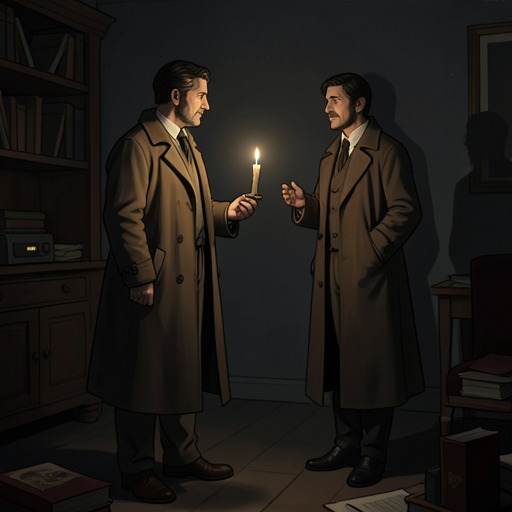
The sitting turns chaotic. A strange voice refuses to identify itself, objects are thrown, and the participants hear what they take to be signs of a hostile presence. Then a sweet voice announces gifts of reconciliation, while a white hand appears above the table carrying a wreath surrounded by silvery lights. As the medium and two moved women prepare to enter an inner room, Ash cries out and reaches toward the apparition, demanding lights. Mrs Lees collapses, and another woman loses consciousness. Ash then seizes the entranced woman by the shoulders and demands to know what has happened to a child, despite the other women’s warnings that disturbing a person in trance is dangerous.
Consequences and Narrative Significance
In Mrs Lees’s version, Ash’s intervention endangers the medium and another participant, breaks the séance’s fragile concentration, and leaves the circle in disorder. Olivia Judge’s notes, reproduced by Lees, describe the women’s physical distress and Ash’s refusal to leave until he receives an answer. The account therefore makes the conflict more than a contest of beliefs: the women’s bodies and their carefully maintained ritual become the immediate terrain of Ash’s demand for proof.
The episode also reaches the reader through competing layers of evidence. Cropper, trying to establish whether LaMotte may have attended the same gathering, pieces together the possibility from Mrs Lees’s published memoir, Judge’s house, and Priscilla Cropper’s letters. He considers the Vestal Lights a possible connection in LaMotte’s biography, while lacking access to the Lincoln papers and not yet knowing about LaMotte’s lost year or the circumstances surrounding Blanche Glover’s death. The circle consequently occupies two roles in the narrative: it is a community with its own spiritual and reform activity, and a contested archival clue through which later investigators try to reconstruct LaMotte’s past. Its history arrives through memoir, private correspondence, and notes, none of which makes the séance’s supernatural claims independently certain.