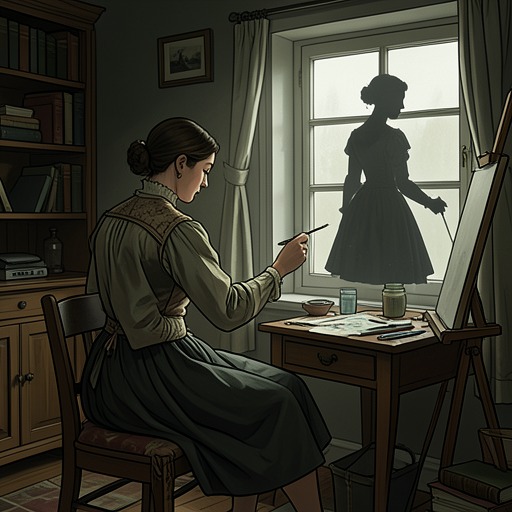
Beatrice Nest
PossessionBeatrice Nest is a scholar whose long stewardship of Ellen Ash’s papers brings her into conflict with changing academic expectations and, ultimately, into the defense of private historical evidence. Asked to edit Ellen’s journal as a safe, manageable project related to Randolph Ash, she gradually becomes attached to the woman whose apparently ordinary life fills its pages. Her work places her amid debates over how Ellen should be read, what her journal can establish, and whether the archive should yield its secrets to biographers and collectors.
Identity and Academic Background
Beatrice is a scholar of Randolph Ash and Ellen Ash’s papers, but the novel presents her as more than the custodian of documents. Her substantial physical presence is described through other people’s impressions: some reduce her to a comic or obstructive figure, and James Blackadder, in a bad mood, imagines her as a pale spider at the centre of a web. Such images register how readily observers substitute an external caricature for knowledge of her inner life. The narrative later gives that inner life weight through her professional disappointments, her gradual identification with Ellen, and her decisions about the papers.
Her scholarly path was shaped by the limits imposed on her at the outset. She wanted to write a doctoral dissertation on Ash’s poem Ask to Embla, but Professor Bengtsson doubted that the project would make a secure contribution to knowledge. In his view, an edition was the safest kind of PhD, and he discouraged work on Ash. A connection to Lord Ash suggested another subject: Ellen was known to have kept a journal, and editing it could be new, modestly useful, manageable, and associated with Ash. Beatrice consequently began her career with work presented as suitably limited for her sex and supposed capacities, rather than with the ambitious poetic study she had proposed.
Work on Ellen Ash’s Papers
Beatrice works amid the material disorder and practical routines of scholarship. James Blackadder sits among the slips, index cards, and files of his edition, while Beatrice occupies an inner room beyond the typewriter cubicle, nearly enclosed by boxes containing Ellen Ash’s diary and correspondence. The image makes her relation to the archive literal: she is surrounded by it, and its documents form both the substance of her work and the boundaries of her scholarly world.
The editorial project extends across twenty-five years. Beatrice initially judged Ellen’s journal rambling and dull, but prolonged attention altered that response. She came to share, imaginatively and intellectually, Ellen’s long days of prostration in darkened rooms, her concern for damask roses, and her interest in the doubts of oppressed curates. As the journal’s daily concerns became important to her, Beatrice grew defensive when Blackadder suggested that Ellen was an unsuitable partner for a man as curious about life as Randolph. In reading the journal, she came to recognize privacy itself as something Ellen had been protecting, even through expansive, ordinary prose.
That change in Beatrice’s understanding complicates the criticism directed at her work. Blackadder says that she first set out to present Ellen as self-denying and supportive, painstakingly following recipes for gooseberry jam and repeated trips to Broadstairs. By the time the critical mood shifted, some readers wanted evidence that Ellen had been rebellious, wounded, and creatively thwarted. Beatrice’s earlier book, Helpmeets, and her 1950 anthology of sayings by the female companions of celebrated men left her poorly placed in that new climate. The criticism does not erase her long work; it exposes the strain between a scholarly project shaped by conventional expectations and later demands that the archive support a different account of women’s lives.
Relationships and Interpretive Conflict
Beatrice’s professional relationship with Maud Bailey begins awkwardly. They find one another physically unsympathetic, and Maud approaches their discussion with a questionnaire organized under headings on Victorian wives. Yet the conversation reaches a question that matters to both: why Ellen wrote. Beatrice’s answer is informed by the journal’s treatment of biographical intrusion. Ellen made sharp comments about rummaging through a writer’s desk before he was properly buried, and Beatrice believes Ellen understood that Randolph’s fame would eventually attract biographers and scavengers. Ellen burned many letters, Beatrice argues, probably herself rather than through Patience and Faith; some, she adds, were buried with her.
Beatrice does not claim certainty where the evidence is incomplete. She signals that she has a theory but regards it as far-fetched, and her account distinguishes what the surviving documents establish from what she infers about Ellen’s choices. When Maud asks to examine the journal’s account of 1859, particularly in relation to Randolph’s Yorkshire letters and Huxley’s lecture, Beatrice hands it over. Her willingness to share the journal contrasts with her vigilance about the limits of what can be responsibly claimed from it.
The surviving archive is incomplete. Maud explains that the family papers include manuscripts of the Tales, undated lyrics on small slips, many revisions of Melusina—rewritten at least eight times—a commonplace book, letters from friends, and Blanche Glover’s journal for only three years. She says that little care was taken of the materials and that no further documents have come to light. Beatrice’s work therefore takes place among both abundant records and absences: what survived enables new interpretations, while loss and destruction make certainty difficult.
Custody, Privacy, and the Threat to the Archive
Beatrice’s convictions about privacy connect her editorial work to Randolph’s wishes. Ellen’s journal records that when Randolph was dying he told her to burn what others should not see. He objected to the contemporary biographical appetite for private papers and intimate concealments; Ellen recalls promising to act, and describes burning some things while intending to burn more. Her account frames destruction not simply as loss but as an attempt to keep the couple’s remembered life from becoming material for idle curiosity. Beatrice’s awareness of this record helps explain why she treats archival access as an ethical question, not merely a scholarly opportunity.
That responsibility becomes urgent when Beatrice learns that Mortimer Cropper is examining the part of Ellen’s journal describing Randolph’s death and mentioning a box known to have been intact when Ellen was buried. Beatrice overhears Cropper discussing a plan with Hildebrand Ash: the box could remain secret for several years, then be found after Hildebrand inherited it and sold to Cropper. She is shocked by the arrangement and recognizes that Cropper means to disturb the Ashes’ grave at Hodershall to discover the box’s contents.
Beatrice does not remain a passive witness. Although she is terrified of making telephone calls, she contacts Maud, identifying herself as calling on behalf of Ellen Ash, though she immediately qualifies that claim. The hesitation conveys the personal and moral character of her intervention: she sees herself as speaking for a woman whose private wishes can no longer be expressed directly. Her warning brings the threat to the attention of those able to respond and makes her custodianship an active part of the struggle over Randolph and Ellen’s history.
The Mortlake Meeting and Narrative Significance
The Mortlake conference takes place at Beatrice’s invitation in her home, chosen conspiratorially because Mortlake is considered outside Cropper’s attention. She prepares onion and cream tart, green salad, and chocolate mousse, recalling the food she once made for graduate students. The domestic hospitality sits beside the meeting’s serious purpose: its participants gather to consider Cropper’s threat, while Beatrice notices the tensions and unspoken matters among her guests without interrupting the business at hand.
At the meeting, she recounts the circumstances of her discovery: the relevant passage in Ellen’s journal, her walk to the ladies’ room, and her return in time to overhear Cropper’s proposal to Hildebrand. She is careful to say that her remembered version is not verbatim, even while asserting confidence in her verbal memory. That qualification marks her as a witness who takes accuracy seriously rather than claiming documentary precision she cannot provide.
Beatrice’s role also makes visible the instability of archival authority. She has spent decades editing and protecting Ellen’s papers, yet her institutional standing has become vulnerable to scholars who want to use the journal to prove a more dramatic account of Ellen. Meanwhile, Cropper’s interest in the grave’s box threatens to turn private materials into objects of acquisition. Beatrice’s development lies in the movement from a constrained, apparently modest editorial assignment to a self-conscious defense of Ellen’s privacy and the evidentiary limits of the archive. Her work cannot restore everything that was burned, lost, or never preserved; it can, however, keep the surviving record from being mistaken for a transparent or complete account.