Euan MacIntyre
PossessionEuan MacIntyre is a solicitor whose legal work helps turn the dispute over the Ash–LaMotte papers from a contest of scholarly influence into a question of inheritance, physical ownership, and copyright. His intervention gives Maud Bailey a route to establish her claim to Christabel LaMotte’s manuscripts and letters, while his ties to the legal and racing worlds let him pursue that claim through channels unavailable to the researchers alone.
Identity and Introduction
Euan first appears in the orbit of Val and the racing syndicate that owns The Reverberator. After the horse wins, he introduces Val to Toby Byng, one of the partners, and the celebration’s sociability becomes a point of entry into the manuscript dispute. Toby explains that he has been drawn into a fierce argument over correspondence between deceased poets: American buyers have offered large sums, English scholars are seeking to prevent export, and the papers’ owner will show only specimen letters. The quarrel has reached journalists and the Minister for the Arts. Euan is therefore connected to the controversy before he meets Maud directly, through both his professional circle and its contacts with the people handling the documents.
The racing connection is more than a social detail. Euan later explains that he knows Sir George Bailey’s lawyer because they share a horse. That casual relationship gives him access to a family solicitor and, through that solicitor, to old deedboxes that contain evidence relevant to Maud’s claim. The novel sets the informality of this network—partners, shared interests, and personal introductions—alongside the formal legal distinctions on which the case depends.
Legal Investigation and the Will
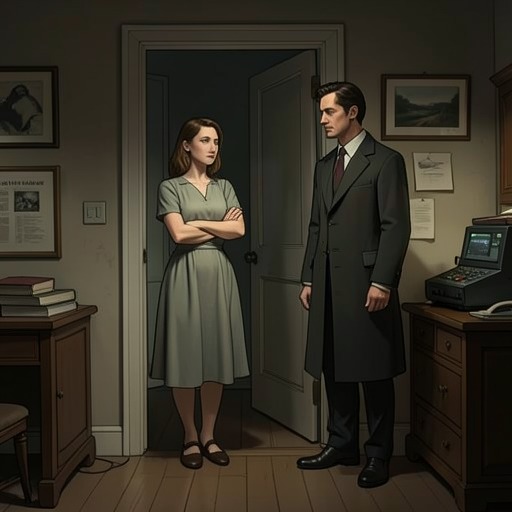
When Euan contacts Maud, he makes clear that he wants to speak to her rather than merely to Roland Michell, though Roland is welcome too. He has something important to communicate. He has asked his friend Toby to search the old deedboxes held by the firm, an inquiry that worries Toby because he is Sir George’s family solicitor and cannot take the matter further himself. Euan brings Maud a photocopy of a document and says that he has checked its signature at the Women’s Studies Resource Centre while she was away.
The photocopied will, dictated by Christabel LaMotte to her sister Sophia Bailey on 1 May 1890, makes a specific bequest: LaMotte leaves her money, furniture, and china to Sophia, provides £60 for Jane Summers if she is still alive, and leaves all her books, papers, and copyrights to Maia Thomasine Bailey, hoping that Maia will one day take an interest in poetry. Euan has found the paper folded among Sophia’s accounts. Those accounts show that Sophia located Jane Summers and paid her legacy, evidence that she carried out at least part of her sister’s wishes while keeping the will itself.
The document changes the basis of the dispute. Maud had understood that Sophia sent LaMotte’s papers to May, her daughter, after LaMotte’s death, with a covering letter describing LaMotte’s wish that the papers pass through the female line. That family transmission had left Maud unsure whether there had been a will and what legal force attached to the papers. Euan’s discovery supplies the missing testamentary evidence and names Maia Thomasine Bailey as the intended recipient of both manuscripts and copyrights.
Ownership, Copyright, and Strategy
Euan insists on separating the physical letters from the rights in their contents. The material letters belong to their recipient, while copyright remains with the writer; in this case, however, LaMotte had asked for her letters to be returned and Randolph Henry Ash had complied. Because the letters were returned, Euan argues that the ownership of the physical documents follows LaMotte’s side of the exchange rather than the ordinary recipient-based rule. He also explains that LaMotte’s will left her manuscripts and copyrights to Maia Thomasine Bailey.
At the later Mortlake conference, Euan presents himself as Maud’s legal adviser. In his view, she is certainly heir to the ownership of LaMotte’s letters and almost certainly to the manuscripts of Ash’s letters, although the copyright in Ash’s writing belongs to Ash’s heirs. He further explains the chain of transmission: Maud’s father would be the direct heir to the bequest, but he had already gifted Maud the manuscripts that came down to their ancestress, and she had deposited them at the Women’s Resource Centre in Lincoln. The distinction between custody, ownership of the paper, and copyright prevents the dispute from collapsing into the simpler question of who has the documents in hand. It also leaves an unresolved complication: Euan says he does not know what Lord Ash would wish, while the evidence suggests that Cropper has secured Hildebrand Ash’s promise of both letters and copyright.
Euan recognizes that legal entitlement alone will not settle the matter without cost. He warns that if Sir George disputes Maud’s claim, the proceeds could be consumed by legal fees. He therefore proposes a tactical way to bring the evidence into view without Toby appearing to have deliberately uncovered it: Euan would contrive a story in which Toby became his apparent victim, persuade him to show some of the papers during a pretextual search, and then produce the surprise. Val calls the plan piratical; Euan’s strategy is to use the relationships surrounding the documents to expose evidence while managing the risks of a formal contest.
Alliances and the Manuscript Campaign
At Beatrice Nest’s Mortlake meeting, Euan arrives with Val and explains his presence to the assembled scholars as Maud’s legal adviser. The gathering has been called because of the threat posed by Mortimer Cropper, and Euan’s legal account gives the group a basis for treating the papers as a contested inheritance rather than simply objects that an institution with deeper pockets might acquire. His explanation also distinguishes the claims on LaMotte’s papers from those on Ash’s: Maud’s case is strongest for LaMotte’s letters and manuscripts, while the copyright in Ash’s letters belongs to his heirs.
Euan’s alliances are practical and interconnected. Toby supplies access to the firm’s records and knows Sir George’s lawyer; Val passes along what she knows about Cropper’s activities; and Euan acts for Maud. The relationships place him between the scholars’ research and the legal machinery required to defend its consequences. Later, when Cropper’s party is confronted, Euan identifies himself as Maud’s lawyer and says that he believes he can prove her legal ownership of the manuscripts of both sides of the correspondence, then in Sir George Bailey’s possession. The assertion is pointed but carefully framed as a claim he can prove, not as a statement that he already controls the papers.
Role in the Resolution
Euan’s contribution is not the discovery of the letters themselves but the conversion of documentary traces into a legal argument. He finds the will in Sophia’s accounts, verifies its signature, explains how returned letters affect material ownership, and traces the later gift to Maud. Each step addresses a different weakness in the claim: whether LaMotte made a testamentary disposition, whether the returned letters belong with her papers, and whether Maud has inherited the relevant manuscripts through her family.
His character is defined chiefly through competent intervention and a talent for turning personal access into a usable strategy. The shared horse that links him to Sir George’s lawyer, the friend who can search deedboxes, and his offer to represent Maud all make the law in the novel a social practice as well as a set of rules. Euan does not erase the conflict over access, preservation, or the competing scholarly and institutional claims. Instead, he clarifies what each party may own and gives Maud a defensible position from which to contest the attempt to control the correspondence.