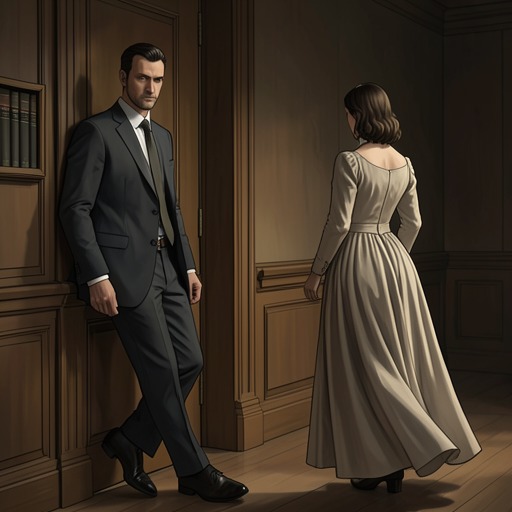
Fergus Wolff
PossessionFergus Wolff is a successful literary theorist, a magnetic and disquieting presence in the academic world of Randolph Henry Ash, and the former lover whose relationship with Maud Bailey leaves a persistent mark on her. Older and more professionally established than Roland Michell, he embodies the allure of intellectual brilliance and social ease; in his dealings with Maud, however, that allure becomes entangled with rivalry, intrusive curiosity, and a physical insistence she remembers as battering. His interest in Christabel LaMotte’s work also connects the modern scholars’ private discoveries to the institutions and contests that seek to interpret them.
Identity and Academic Position
Fergus is a child of the Sixties who temporarily dropped out, embraced freedom and Parisian revolutions, and sat at the feet of Barthes and Foucault before returning to dazzle Prince Albert College. He is older than Roland and at home in literary theory, a field in which intellectual fashion and professional opportunity meet. The contrast with Roland is sharp: Roland is an accomplished graduate with a doctorate, yet survives through part-time tutoring, errands for James Blackadder, and restaurant dishwashing; Fergus wins a coveted departmental job despite a record that seems less consistent. Val is more indignant than Roland about the appointment, but Roland’s embarrassment is not simple resentment: he likes Fergus and wants to remain able to like him.
The novel presents Fergus as both intellectually agile and socially compelling. In the British Museum cafeteria he appears to Roland as a tall, bright-haired figure in a white sweater and loose black trousers, smiling with voracious pleasure. He is generally pleasant, yet people who meet him sense that he may be dangerous in some unspecified way. The combination of friendliness and threat is part of his effect: he attracts attention before his motives are clear, and his charm does not cancel the unease it produces.
His theoretical work ranges across literary texts and interpretive fashions. He is writing a deconstructive account of Balzac’s Chef-d’Oeuvre Inconnu, a book whose painting becomes a chaotic mass of brush-strokes; he describes the challenge as deconstructing something that seems already to have deconstructed itself. At a conference in Paris on Gender and the Autonomous Text, he presents on Balzac’s hermaphrodite hero and heroines. Maud finds the argument apparently feminist, while its delivery seems mocking and subversive, edged with self-parody. His capacity to perform several positions at once—scholar, provocateur, seducer—makes his intellectual persona difficult to separate from his personal one.
Scholarship and the LaMotte Archive
When Roland asks whether Fergus knows a Miss LaMotte who wrote children’s stories and religious poetry in the 1850s, Fergus laughs and replies that he should. He identifies Christabel LaMotte as the daughter of the mythographer Isidore, names Last Things, Tales Told in November, and the epic The Fairy Melusina, and immediately launches into the Melusine legend. His account describes the fairy’s marriage to a mortal, the pact against spying on her on Saturdays, their six strangely afflicted sons, and the husband’s eventual discovery of her in a bath with a fishlike or serpentine lower body. The speed and confidence of the explanation establish him as knowledgeable, but also introduce the interpretive appetite with which he turns LaMotte’s work and mythic material into intellectual performance.
That appetite becomes more pointed when Maud receives a letter from Fergus after more than a year without communication. He proposes giving a paper at the York conference on metaphor, titled The Queen of the Castle: What is kept in the Keep?, and asks for her approval and access to her archive. He advertises possible readings of Melusine’s castle-building, invoking Jacques Le Goff’s account of Melusine as an earth spirit or local goddess, then proposes a Lacanian interpretation of the keep as a fortress of the divided subject. He even suggests bringing in Maud’s work on the liminal. The proposed scholarship is thus also a bid for access to the materials Maud studies and, implicitly, to Maud herself.
Fergus has heard that Maud and Roland have been discovering something together and are spending the New Year investigating connections. His message reports that a young woman, displeased by the turn of events, has been acting as his spy; he expresses curiosity about Roland and warns Maud not to eat him, dismissing him as beneath her academically. The joke carries a competitive edge. Fergus’s invitation to collaborate is not detached from his interest in Maud’s research partnership, and his request for access arrives at a moment when the archive has become both a scholarly resource and a closely guarded secret.
Maud reacts bodily to the letter: Fergus’s handwriting turns her stomach, and the image of the tormented bed returns to her. She dislikes his proposed siege-paper and his obscure allusions, then tracks down one of them as a method of defending herself against anxiety. Her response shows how his academic language continues to reach into an intimate history she would rather keep at a distance. In their relationship, theory is not merely a shared subject; it is one of the means by which he can provoke, pursue, and re-enter her attention.
Relationship with Maud Bailey
Maud’s memories of Fergus begin with the conference where they met. She spoke about thresholds; he delivered his paper on Balzac’s hermaphrodite hero and heroines. He then approached her with sweeping declarations of her intelligence and beauty, and of his desire for her. Maud cannot rationally explain why the encounter became irresistible, but acknowledges that he was right about its force. The attraction is neither presented as a simple triumph of compatibility nor dismissed as a trick: its intensity becomes inseparable from the conflict that follows.
In retrospect, Maud associates Fergus with an unmade, stained, rumpled bed, a private image of the disorder and repugnance that coexist with desire. She recalls that he used to argue by increments of noise, interrupting as she tried to speak with something cleverer and louder. He would quote Freud at six in the morning while walking naked around their flat, and the performance made it impossible for her to work. Maud says she felt battered and describes the relationship as one in which they tormented each other. The specific domestic memory gives substance to the imbalance she describes: intellectual display and sexual openness, which might have looked daring from outside, became an exhausting intrusion into her working life.
After the relationship has been severed, Fergus continues to tug at its remaining threads. Maud recognizes his habit of making small pulls at the carefully cut connections between former lovers, though she is not experienced enough to have named that pattern before. She suspects that his proposal for the siege-paper has been improvised partly to annoy her. Even his learned references become part of this renewed provocation: she is irritated by them, but also compelled to look them up. Her recourse to research restores a measure of control, while demonstrating how readily his gestures reactivate the old entanglement.
Pursuit, Jealousy, and Conflict
The pressure becomes explicit when Fergus appears unexpectedly in the corridor outside Blackadder’s office. He asks whether Maud is going to pursue the Melusine or see Roland; she denies both possibilities and says she is in a hurry. When she steps around him, he blocks her path, then clasps her wrist like a handcuff. The gesture recalls the bed she associates with their past, while his body and the briefcase she carries are drawn toward him by the pull on her arm. The scene turns his habitual verbal confidence into literal obstruction: he does not merely ask for her attention but physically impedes her departure.
Fergus says he is suffering from curiosity and jealousy in roughly equal measure. He cannot believe Maud has become involved with Roland, whom he calls useless, and demands to know what she is doing at the Ash Factory. He asks for a meal and conversation, invokes how much he misses her, and presses her to tell him what she and Roland are doing, promising discretion. Maud answers that there is nothing to tell and tells him to let go. When she later informs Roland that Fergus threatened her in the Library with finding out what they were doing, Roland concludes that the pair must watch him. Fergus’s jealousy thus has consequences beyond the former couple: it makes the secrecy around Roland and Maud’s research feel vulnerable to deliberate interference.
Fergus’s conduct also exposes a tension between his intellectual self-presentation and his personal methods. He can frame himself as a feminist-minded theorist and propose sophisticated readings of female myth and authorship, yet Maud’s recollection is of a man who overwhelms her speech, disrupts her work, and treats her refusal to engage as something to be worked around. His scholarship does not simply disguise his behavior, nor does it make him a mere caricature: the same appetite for interpretive control that animates his academic performances can be felt in his pursuit of Maud and her archive.
Relations with Roland and the Scholarly Contest
Fergus’s relation to Roland is a mixture of collegial liking and competition. He likes Roland, and Roland likes him; after Fergus receives the job Roland wanted, Roland worries that Fergus may interpret his withdrawal from their shared meals as resentment. The appointment nevertheless marks a difference in their security and standing. Roland’s credentials and persistence have not brought him stable work, while Fergus’s brilliance and ability to entrance his teachers have helped him secure the position. Their friendship exists inside the same scarce academic economy that has made Roland feel like a failure.
Fergus’s interest in the Ash–LaMotte discoveries raises the stakes of that contrast. He probes Maud for news of what she and Roland have found and later confronts her directly about their activities. In the British Museum, he also approaches Mortimer Cropper after Cropper’s paper on the identity of the narrator in Ash’s Chidiock Tichbourne, praising the deduction that the narrator was the executioner. This encounter links Fergus’s theoretical and social networks to the wider competition over Ash’s writings, though the evidence does not establish that he joins Cropper’s attempt to acquire the letters.
The conflict over the papers takes place in an academic world where money and institutional access matter. James Blackadder fears that Cropper will use generosity and funding to gain influence over manuscripts lodged with institutions but not owned by them. When Blackadder hears that someone is seeking a valuation for perhaps fifty long letters from Ash to an unnamed woman, with an offer in the region of six figures and possible involvement by Cropper, he suspects the matter is connected with Roland’s visits to Maud. At a later meeting, Maud’s legal adviser Euan MacIntyre distinguishes ownership of physical letters from copyright and explains that Maud’s claim to the LaMotte manuscripts rests on Christabel’s will. These disputes clarify why Fergus’s request to consult Maud’s archive carries more than personal significance: access to documents, their ownership, and their scholarly use are contested matters, not neutral courtesies.
Fergus is therefore a consequential secondary figure without becoming the center of the novel’s archival mystery. He is a bridge between literary theory and social maneuvering, between Maud’s private past and the modern scholars’ investigation, and between professional success and the unequal distribution of academic security. His charm can draw Roland into friendship, his expertise can orient a discussion of LaMotte, and his pursuit can make Maud’s boundaries newly urgent. The resulting portrait resists a single label: he is neither simply a brilliant colleague nor simply a threatening ex-lover, but a character whose intellectual fluency and personal entitlement repeatedly occupy the same space.