Maud Bailey
PossessionMaud Bailey is a scholar of Christabel LaMotte and a descendant of the poet whose papers she studies. Her dual position—as an academic investigator and a member of the family that preserved LaMotte’s archive—makes her central to the recovery of a hidden literary history. She begins by organizing the evidence with disciplined distance; as the investigation develops, the archive implicates her own family and origins, turning scholarly inquiry into personal revelation.
Identity and Background
At her first meeting with Roland Michell, Maud is striking without being easily recognized. She is tall, considerably taller than Roland, and dressed in a carefully coordinated combination of pine-green tunic and skirt, white silk shirt and stockings, and shining green shoes. A turban of painted, peacock-feathered silk covers her hair. Roland registers the composed clarity of her features and the unusual coherence of her academic dress, presenting her through his observing gaze even before he knows who she is.
Maud is related to LaMotte through her great-great-grandmother, who married a cousin, settled in Norfolk, and raised ten children. That ancestry makes Maud LaMotte’s great-great-great-niece. When she came to her academic post, she persuaded her father to place the family papers in the Archive. The collection is incomplete: it includes manuscripts of the Tales, undated lyrics on loose slips, a commonplace book, a few letters from friends, and Blanche Glover’s diary, which covers only three years. LaMotte’s revisions of Melusina are especially substantial; she rewrote the work at least eight times, continually changing it. Maud acknowledges that the family took poor care of the papers and that more material may once have existed, though none has surfaced.
Her research is not confined to the archive. Maud is preparing a full-length study of Melusina and has searched her card index for references to Ash. Before the newly discovered correspondence changes the picture, she has found only one: a note to William Rossetti concerning a poem he published for LaMotte. The narrowness of that trace gives the letters their force: they do not merely add a document to Maud’s research but require her to reconsider its subject.
Scholarly Method and the Archive
Maud approaches scholarship as work that requires procedures, comparison, and careful handling of evidence. When she and Roland begin examining the letters, she proposes that each read the correspondence of the poet who chiefly interests them and that they record their observations on index cards, following a system she already uses at the Women’s Resource Centre. Roland initially resists this division. He had imagined them bent together over the manuscripts, sharing the unfolding story and its emotions; Maud’s system, by contrast, prioritizes efficient analysis and leaves the narrative sequence to be reconstructed through cross-reference later.
Their disagreement is more than a difference in temperament. Roland fears that indexing will fragment the narrative, while Maud argues that they have little time and that contemporary scholarship can accommodate narrative uncertainty. Her method treats the archive as a set of traces that can be organized without pretending to possess a complete, continuous story. The missing papers and undated lyrics in her own family collection make that caution materially important: the evidence is abundant enough to transform scholarship, but never whole enough to remove uncertainty.
The discovery also creates an ethical problem for Maud. A letter forces the question of when, and how much, to tell Leonora Stern. Leonora dislikes Ash and has continued to publish confident work on LaMotte’s sexuality. If Maud conceals the discovery, Leonora may feel betrayed when she learns that Maud knew; yet disclosure may itself violate the secrecy surrounding the letters. Maud recognizes that the decision bears on scholarly trust and on the obligations of intellectual sisterhood, not simply on who can use the evidence first.
When she later confronts a restored likeness, Maud calls it a simulacrum and notes the uncanny effect of restoration. The term suits her broader relationship to the archive: surviving papers and images allow the past to be approached, but they cannot make the absent whole present again. Her scholarship depends on interpretation while remaining alert to the gap between a trace and the person it represents.
Partnership with Roland and the Investigation
Maud’s first response to Roland is entangled with the hostility she perceives toward Ash. Roland feels that her antagonism toward the poet includes him, and briefly regrets having come. The collaboration nevertheless becomes necessary when she understands that the correspondence alters the basis of her work on LaMotte. She tells the custodians that access would let her and Roland establish the letters’ significance for scholarship and assess whether an edition is possible; she cannot continue her study of LaMotte without taking them into account, just as Roland’s work on Ash must change.
The pair’s work brings different expertise into contact: Roland knows Ash’s writing, while Maud knows LaMotte’s. Maud insists that the inquiry be undertaken together, and proposes that both travel to Yorkshire. On the journey, they follow the route associated with Mortimer Cropper and Randolph Ash, with the imagined presence of LaMotte shadowing their search. They drive in a small green car to Flamborough and walk out to Filey Brigg. Their attention to signs and interpretations nearly spoils the day; they are no longer certain what they are seeking and feel that it may be improper simply to enjoy themselves. Yet their walking pace fits naturally, a small physical accord that neither notices at the time.
In Brittany, even a place-name becomes part of their work. Maud explains that the name of the bay may derive from a Breton expression for a stream-mouth, transformed into a name meaning a bay of troubled souls; she connects the marshes at the river mouth with the traditional location of the City of Is. The layers of sound and meaning make the landscape a repository of competing histories rather than a neutral backdrop. Maud observes that their pursuers must have worked out where they were, and the pair continue to discuss the dead over buckwheat pancakes in Pont-Aven, drinking cider from earthenware pitchers as they ask difficult questions. Their research keeps returning to absent lives even as their own partnership takes shape in the present.
Family History and Personal Disclosure
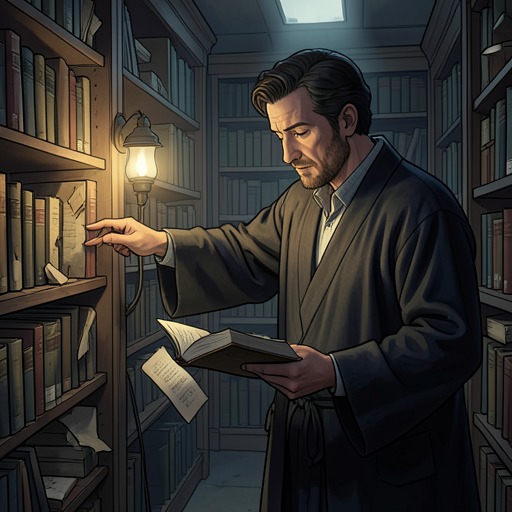
Maud’s archival work brings her into contact with the remains of Blanche Glover’s life. At the Women’s Studies Resource Centre, she studies a sparse file: a newspaper report, the inquest transcript, a copy of the note found under a granite stone on the table at Bethany in Mount Ararat Road, and a few letters to a former pupil whose father was sympathetic to women’s causes. Maud searches these fragments for clues to how LaMotte spent the interval between the Yorkshire journey and the inquest. The search makes the archive’s silences tangible: very little of Blanche survives, and the surviving material cannot straightforwardly fill the missing time.
Years of inherited custody become newly legible when Maud discovers LaMotte’s will. Dictated to her sister Sophia Bailey on May 1, 1890, because LaMotte was too weak to write clearly, it leaves her money, furniture, and china to Sophia, provides for Jane Summers if she is still alive, and assigns all her books, papers, and copyrights to Maia Thomasine Bailey in the hope that Maia may become interested in poetry. This bequest links the literary archive to Maud’s family line and to the long history of its preservation. The papers Maud persuaded her father to lodge are not merely an academic resource; they belong to an inheritance LaMotte deliberately directed toward a future descendant.
Maud later admits to Leonora that she acted wrongly by taking Leonora’s letter from Ariane Le Minier and leaving without telling her. At the time, Maud says, the secret felt as though it belonged not only to her but also to Ash and Roland. Le Minier’s copy of Sabine de Kercoz’s journal made clear that a child had been born, though that child could not be traced. Maud’s confession resolves neither the earlier ethical dilemma nor the scholarly costs of secrecy, but it marks a change: she can name the injury and accept responsibility for her part in it.
Revelation and Narrative Significance
The investigation finally turns Maud’s relation to LaMotte from scholarly kinship into a startlingly wider inheritance. Blackadder observes that she has turned out to descend from both LaMotte and Ash, and that she has spent the investigation exploring the myth—or, as he corrects himself, the truth—of her own origins. The revelation joins the two writers whose correspondence Maud and Roland had been trying to understand, making the object of her research part of her own ancestry.
Maud’s response is exhaustion rather than immediate interpretation. She says she cannot go on thinking and must sleep; she asks Roland to help her find a bedroom. She wants all the papers placed in Professor Blackadder’s safekeeping, but asks to keep Ash’s photograph for that night. The contrast is precise: the documents are returned to institutional custody, while the photograph remains temporarily with Maud, a personal object she can hold close before the implications of the discovery become thinkable. Her arc thus binds archival rigor to the limits of what scholarship can absorb. Maud helps recover the evidence, confronts the ethics of its use, and discovers that the past she has studied is also the history from which she comes.